
NSHP House Handover in Caenwood, Portland
Statement
by
Dr. the Most Honourable Andrew Holness, ON, PC, MP,
Prime Minister of Jamaica
at the
NSHP House Handover in Caenwood, Hope Bay, Portland
on
July 3, 2026
—————————————————————————————————————
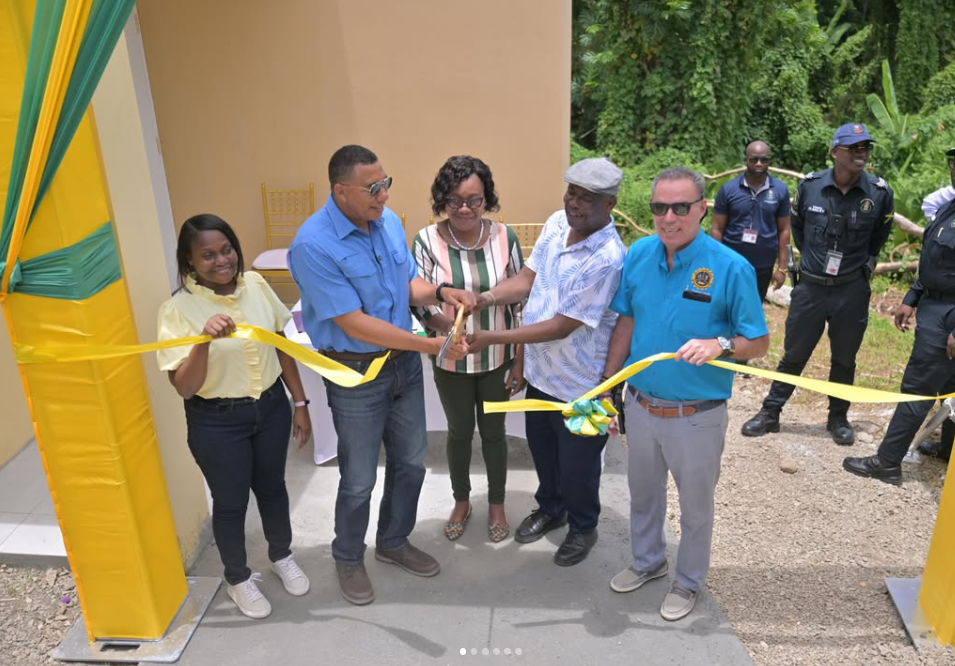
For those 500 houses and several basic schools, obviously this is a Member of Parliament who has the interest of the people at heart, a working and effective Member of Parliament. Now to the matter at hand, it is my distinct pleasure to hand over this social housing unit to a worthy recipient. His name, for those of you who don’t know, is Recardo Gibson, otherwise known as “bad luck”.
I officially change his name from “bad luck” to “good luck”. So now he’s officially Recardo “good luck” Gibson, because obviously the Lord has smiled at him through the New Social Housing Programme to give him a structure for himself and his wife and his other family members can live with some dignity.
It is always, for me, a sign of the effectiveness of the programme that when the benefit is individualized as it is now, one person is getting the benefit or a family, the entire community comes out in celebration of that person. Every one of you there secretly in your mind saying, I wish it were me, right? I know every one of you saying that I wish it were me, but you know what? None of you are saying it should never have been him. No bad mind and that tells you that the programme is effective, that the person selected is definitely a person in need and that by this person getting it, he has been made better off.
No one has been denied anything or made worse off. So, as a result of that, the entire community and everybody’s welfare has improved. Having this lovely structure in the community has lifted the community.
When others of you decide to build, you’re going to say, “I want my house to look like this and to be as strong as this.” And so, this house also changes the possibilities for you and your expectations. So, that again lifts the community.
The commitment of the government is to make 6,000 of these houses. It is a challenging thing because it is not as if we are building 6,000 houses in one location where we can benefit from the economies of scale, the logistics of transportation and movement of labor and all of that. It’s dispersed all over the island, going up into the hills and valleys and all kinds of areas that are very difficult to engineer buildings. That is where people have land and so that is where we have to bring houses.
I should take this opportunity for the press that is here. The programme is pivoting, and it has to pivot because of Hurricane Melissa. I am here today in Portland, which though affected, was certainly not at the level of St. Elizabeth, Westmoreland, Hanover, St. James, Trelawny and parts of St. Ann and Manchester. Those areas were particularly badly damaged and so the programme has to pivot its resources to support the rebuilding of houses in those areas and we have tasked the New Social Housing Programme to support the deployment of what we call the modular semi-permanent housing solution. Some people say container homes; that’s not the accurate description. We had bought them from China. We have imported them into Jamaica, but they need a base. You can’t just put them down on the raw earth so, they have to create a concrete platform.
The New Social Housing Programme team has developed the skill in working in dispersed areas that they will take on that task along with the NHT and ODPEM to ensure that those 2,500 semi-permanent modular housing solutions can be actually implemented. Now when those 2,000 units are put in place, we will monitor them. We will study them to see how well they stand up to Jamaican conditions, to see potentially how long they will last because you know our culture. Our culture is that a good house must be concrete and steel and a slab roof, right? You all know this huff and puff and blow your house down.
Nobody must be able to huff and puff and blow your house down in Jamaica. We build strong. We overbuild but technology is changing, building materials are changing and right now you have houses that can be assembled in days that can withstand hurricane winds. They are prefabricated, well-engineered solutions and we need to find ways to bring that into Jamaica to allow persons who are building to get access to that kind of building system. Instead of going to ply and zinc, we could replace that with more modern, aesthetically pleasing and more ergonomic building systems that give you more functionality and safety and more value.
So, the new direction of the New Social Housing Programme is not just to build the houses but to stimulate a change in building culture in Jamaica at the grassroots level and so they are working on a programme for that.