
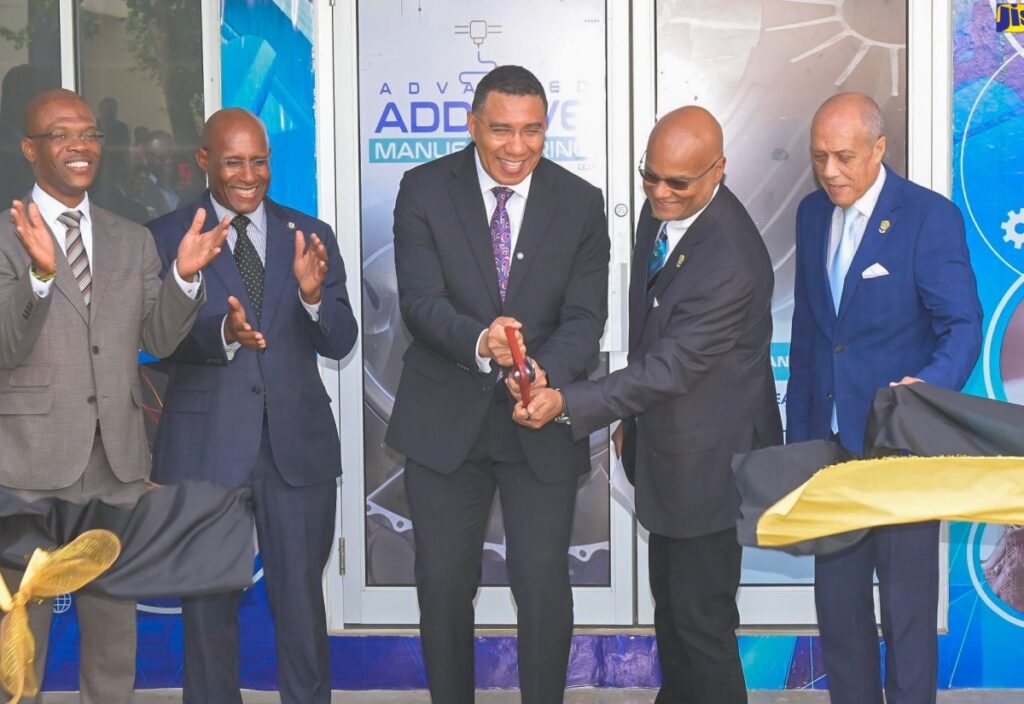
Official Launch of UTech Lloyd Carney Foundation IMEK Laboratory
Keynote Address
by
Dr the Most Honourable Andrew Holness, ON, PC, MP,
Prime Minister of Jamaica
at the
Official Launch of UTech Lloyd Carney Foundation IMEK Laboratory
on
February 10, 2026
___________________________________________________________
Professor, no need to do further introductions, and I will borrow the general term used by Lloyd. I would normally say all nice and decent people, but I like how Lloyd has dignified the term. He said, all dignified people here, it is not my intention to stand on protocols today.
We are opening this lab against the backdrop of Hurricane Melissa. For those of us in Kingston, and the eastern end of the island generally, Hurricane Melissa may seem like a distant memory three months ago, but for others, especially those in the impacted areas, it is still the reality they face.
We are recovering, no doubt, and I do visit the impacted areas quite regularly and I can see progress being made, houses are being restored, roofs are being restored, businesses are reopening, the roads are cleared, lots of traffic. There is accessibility, but you still see the tarps on the roofs and there are still persons without roofs at this time and there are people who are still struggling directly as a result.
We have mobilized very quickly relative to how we would’ve mobilized in the past. We should also recognize that Hurricane Melissa is a super phenomenal event. It is the third strongest storm recorded, whether in the Atlantic or in the Pacific. It is a Category 5 hurricane, that the only way to describe it is an atomic bomb of wind and water.
Jamaica is no stranger to these kinds of weather events. I want to, however, place the weather event in a broader context that Jamaica is no stranger to shocks. We face shocks in weather events, whether they be heavy rains, which cause floodings, tropical storms, hurricanes, and then on the other end, intensive drought which destroys agriculture, a great inconvenience to households because of lack of water.
But we are also susceptible to energy shocks. Variability in oil prices can have devastating impact on us. As we would’ve seen from the pandemic, we’re subjected to supply chain shocks. Shipping delays in goods can have crippling impacts on our economy and all of this leads to what the consumer, the average citizen may experience immediately being inflation, or more taxes on you in order to pay for recovery, or more debt to pay for the fallout. The point of my introduction is that shocks generally have an impact on our balance sheet as a country, and not just the balance sheet of the country, but your balance sheet for your household.
It can either have a shock on the revenues that you earn or the income that you earn. Many people are without income now; the country’s revenue is down. It can have a shock on the expenditures that you have to undertake for the household; you’re going to have to rebuild your houses, buy new furniture. For the government, we’re going to have to rebuild your houses, buy new furniture, fix new roads, bridges and the like, and in order to do this with revenues down, it means you have to borrow. We should take out of our minds anything about grants or any form of philanthropic donation. We have received, and we are grateful for the philanthropic efforts but as citizens looking at the balance sheet, that will be nowhere near what will be necessary to restore your roads, your bridges, your telecommunications, your electricity, your water supply, your hospitals, and then to reconstruct in a way that should the next shock happens, you don’t go through the cycle again.
Having set that context, the challenge for Jamaica for the last 50 years has been how to manage its revenues, its expenditure, and its borrow in order to be able to withstand shocks; that’s what we’ve been trying to do for the last 50 years. Have we done it well? I will leave that for you to judge, but I will say this, in the last 10 years, we have focused heavily on managing our expenditure, our revenues, and our debt to the point where our expenditure keeps in line with our revenues so that we do not incur unnecessary debt. This is what we mean when we say we have done a deep fiscal reform. Whenever you hear the term used about fiscal consolidation, fiscal discipline, that’s what Jamaica has achieved in the last decade, managing the financial affairs of the government to avoid crises, to prevent crises, and to help us to recover when crises occur. I should also put in that, savings. In the last decade, Jamaica has built savings which act as buffer for crises.
What does all of this have to do with IMEK and our Chancellor, Lloyd Carney?
Fiscal discipline and fiscal management have a limit. Fiscal discipline is a necessary condition, but it is not a sufficient condition for our economic development. We have solved the first part of the problem, which is fiscal discipline, fiscal management. Good fiscal management is the foundation, but you need growth in order for fiscal discipline itself to last and for the people of Jamaica to achieve prosperity because without growth, then the pressures to break fiscal discipline will grow. In other words, the same public that benefits from the fiscal discipline will say, listen, I can’t take the potholes any longer, borrow the money to fix the road. The same public will say, look, the hospitals are in crisis, don’t tell me about fiscal discipline anymore, go and borrow the money to fix the hospitals.
So, the challenge for the next decade is not just how to keep your expenditures within your revenues and don’t borrow a lot, the challenge for the next decade is how do we increase revenues, how do we increase production, how do we increase the size of the economy? That is a discussion that we have avoided. We don’t want to talk about it because somehow, we believe that fiscal discipline alone is going to result in increased wages or increased employment. It is a false and dangerous notion.
The government has to focus on growth policy in parallel with maintaining good fiscal policy. What is growth policy? Growth policy is granular. It addresses production and productivity. It brings together the entrepreneur, capital, regulators into a market. It supports innovation and research. It brings education and industry together reinforced in a common direction. It also addresses anti-growth issues and in Jamaica culture can sometimes be anti-growth. We must develop a pro-social culture and a pro-growth culture. That thinking has to seep into our consciousness and in my opinion, that is going to be the biggest challenge. How do we get more of our parents encouraging more of our children to like math? It’s a social issue because parents will say ‘I never liked Math’, ‘I never did well in Maths at all’ psychologically turning children off from math. We have to address that in our society.
Many years ago, when I was minister of education, I was despaired at the direction that our technical university was heading. I’m a social scientist, I love the social sciences, but because of that I understand the importance of the natural sciences and technology and how they form the basis, the building blocks for growth and how they should be supported, and so I was concerned that the university which was established as a technical university was going off into other fields. I’m very happy today to see that the university is owning its DNA as a technical university.
We long knew at least five years ago that the challenge is growth and it’s not a simple proposition for growth. It’s a very complex issue and one of the things that we set out to do was to establish champions of growth; people who had international exposure, because that’s one of the other challenges we face as a country. Locally, the level of exposure to what is happening in the world, you see it reflected in the level of commentary. You see it locally that we’re not always tuned in understanding where the world is going and what the future holds. We’re not educating our population enough and I’m not talking about schools; I’m talking about the general public discourse. Things that we hold in high value are of no value to us in the long term.
What I set out to do was to identify Jamaicans who could become growth champions, opinion leaders, and offer an alternative to the old narratives that exist in our society and our culture. And so, I appointed several investment ambassadors, and their job simply is to bring to Jamaica the investment and the technology and the connections that we need to grow because remember what I said, growth is not a policy on paper, growth is granular in action. It’s about finding the little opportunities, the little windows and going through them knocking on the doors and opening physically bringing in the investment.
I appointed Lloyd Carney. I had met him some years before, and Lloyd has done exceedingly well in technology internationally; well-known and well respected. He hasn’t said too much about his resume, and you can go on Google and you will see everything about him but this would not be, as he had said, the only technology lab that he has sponsored it, but I repeat what he said, this would’ve been the most satisfying to do it in his own country of birth and it is significant. He has used a million US dollars from his foundation to put this lab here so Lloyd, permit me to challenge you to expand it and probably do another one. I know you can. But I also take this opportunity to challenge and invite other Jamaicans to do this. This is an investment in our capability and capacity to grow.
We have been, as a government, making the investments in our capacity to grow. One of the things we have done, for example, is to make significant investment in agriculture. Last week we opened a new facility in St Elizabeth that will create the ability to store excess production, process excess production, and properly market excess production, support farmers, and create an entire ecosystem where the agricultural market is relieved of the structural in obstacles that would’ve made it inefficient. We are making these kinds of investments that will expand agriculture, make the agricultural market more efficient, and increase agricultural output moving us towards greater food security.
Today, I’m happy to be present at the launch of the IMEK Lab. I don’t want to get too much into the technical issues. You would’ve seen the presentation, but point of note, manufacturing is changing. You will always have conventional manufacturing, subtractive manufacturing, as Mr Cargill pointed out, but the technology is evolving that allows smaller countries to participate in the manufacturing game of not necessarily scale and mass, but in high value, high technology.
The example of Luxembourg is a good example of a very small country, but they produce very high value manufacturing output. We can do it right here. We have the bright people here too. We have the people who understand the science and the mathematics and the design, and we must cultivate them and support them and dedicate resources to them. I’m very pleased, as I’ve said, to see that UTech is moving back into this direction, not afraid of science, moving towards it and using it in practical ways in collaboration with the industry.
Now, there are many industries in Jamaica that use very sophisticated machinery and parts, and most of them have to import the skills to service those machines. Now, can you imagine when we have supply chain disruptions, what that could do to our very small manufacturing industry? Having the capability to design and use additive manufacturing here gives us another layer of security. A plant could go down that needs a specialized plant, you can’t get it here, you can’t get it there, you’re backed up… Well, what are the specs? You get the specs. You ask some of the bright UTech students, put this on your CADD, (Computer-Aided Design software), design it, feed it to the machine, and the machine literally prints it. It’s a capability that we need to have and again, I want to thank you Lloyd and thank the Lloyd Carney Foundation for making that investment in Jamaica.
This should be seen as a part of the government’s growth strategy, and you’re going to see the growth strategy being unfolded in more direct terms as we move to pivot from fiscal discipline. We’re still keeping our foot firmly planted on that step, but we’re looking to go up now on the step of growth and it is things like these, investments like these that places us now firmly in the growth era which is for the next 10 years, that is what Jamaica must be focused on, growth.
Growth and fiscal discipline, as I said, both must work together. Fiscal discipline will prevent the crisis, but growth will take advantage of the opportunities that a crisis can give. And if you put the two together, then we will get prosperity and that is the objective that every Jamaican, regardless of what political affiliation or church you go to, agree that Jamaica is a country destined for prosperity, but we must reach out and grasp it deliberately with both hands.
Ladies and gentlemen, I thank you.