
Ceremonial Launch of Re-Leaf Initiative
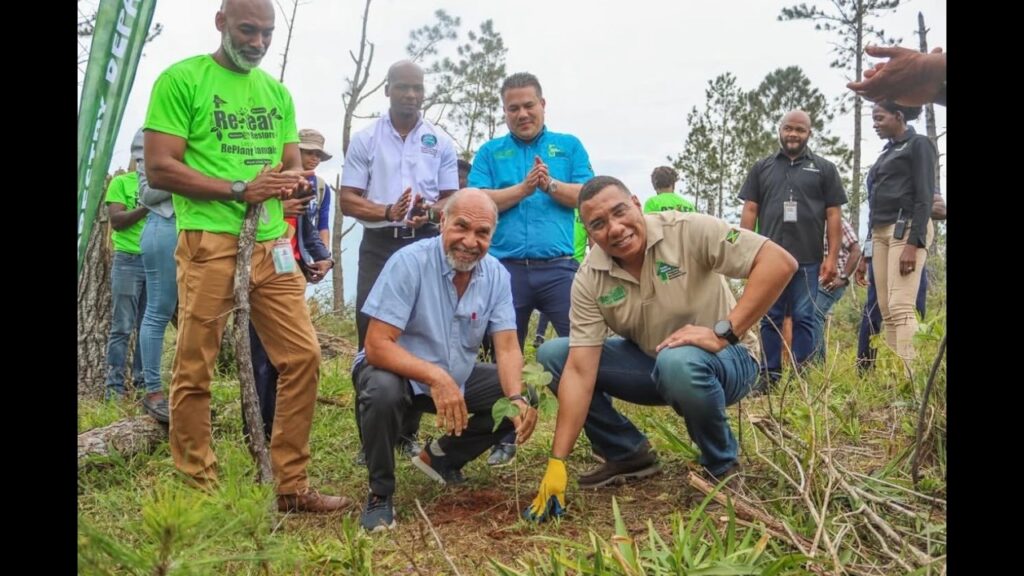
Keynote Address
by
The Most Honourable Andrew Holness ON, PC, MP
Prime Minister of Jamaica
at
Ceremonial Launch of Re-Leaf Initiative
Lowe River Forest Reserve, South Trelawny
on
March 25, 2026
_______________________________________
Excellency,
Ministers,
Distinguished ladies and gentlemen,
Boys and girls, it is indeed a good afternoon.
A few hours after Hurricane Melissa struck, I hopped on a helicopter, and I flew across the island, hugged the south coast and turned northwesterly to look at the damage caused by Hurricane Melissa. To best understand the impact of Hurricane Melissa, I draw the image in your mind of the atomic bomb dropped on Hiroshima or Nagasaki in Japan to end World War II. Some of you may be familiar with those images; the younger ones may not. I encourage you to go and research it. It’s much easier today to research these things than it would have been during my time and you would see the incredible devastation, not just to buildings and structures, but to our forests.
In fact, you could say that there was a trail of destruction from where the storm hit first at New Hope, going across the Cockpit Country and coming out in St James, across to Trelawny and St Ann. And what struck me was that what was once a green landscape was stripped bare of every leaf off every tree, even if the trunks were left standing, they were a bear, and that is the description of the ferocity of the hurricane. It totally wiped out the forest in the areas that it impacted.
When I landed and a few days after on tour, I saw the destruction of the forest up front; huge trees snapped like twigs, and I thought to myself at the time, who am I to question the fury of nature. It is a part of the reality of our existence, and I thought to myself, how would the Tainos manage when they inhabited the island, and most likely inhabited the forest? And then I got to thinking that it may be possible that the Tainos would’ve seen a hurricane with this ferocity, but it is also likely that they may never have seen such a hurricane because science is now telling us that this hurricane approached the limit of what the physics of the earth could possibly produce.
In other words, it is the product of the forces of nature at its extreme, and there is even consideration that there may have to be certain reclassifications done because there may be changes in some of the factors that create such a powerful storm. One of those factors being the warming of the sea, that the warmer the sea is, the more powerful the storms they are able to create, and this is one of the foundational concepts of our climate change.
But it also got me to think, would the Tainos be able to recover their forest? Would they have to recover their forest? If a hurricane were to destroy their forest, would they need to replant? It is just an act of nature, the hurricane is actually necessary to allow the forest to be rebirthed and grow, to clear away old trees and give space for new ones to grow and get the sunlight.
It dawned on me that civilisation needs nature. The challenge that we are faced with is that there is the belief that civilisation can occur without nature, that civilisation is a denaturalizing process, which is a grave error. The distinction between Jamaica now and Jamaica, maybe a thousand years ago, is that we have a civilization here that is very modern in its thinking and outlook as it relates to nature, and we are heavy exploiters of nature to the point sometimes where we forget that nature can be exhausted in some instances and that we have to use nature with conservation in mind and sustainability.
But more importantly, we have to see ourselves as stewards of the natural assets in our environment and therefore, one of the benefits of civilisation is the advance of science, which is the understanding of the natural world, and therefore, we are in a better position because of knowledge, because of science to be able to take care of nature, but the stewardship of nature doesn’t only require knowledge and science, it also requires a certain moral posture and that moral posture is the duty of each person to protect and preserve the environment as a legacy for future generations.
But there is also a great dose of self-interest in our stewardship of nature, because the truth is that without nature, civilisation cannot prosper, and the truth is that for governments, the forest is an infrastructure like roads, dams, and bridges. One of my greatest concerns, and I went to Parliament and I addressed this matter, is that what is likely to happen is that after the hurricane destroys the forest, we may have a challenge with water following the hurricane in the months after. Catchments are disturbed, land slippage, it might affect the microclimate that the forests would create that would bring the water, it wouldn’t trap as much carbon dioxide from the atmosphere as was before, and so there could be impacts on not just water but on the temperature.
And with this knowledge, with this self-interest, but also recognizing our moral duty, I said to our hardworking minister, who is truly the minister of religion in climate, he believes in it not just from a political perspective, but it is his strong personal belief that we have to address the issue of the destruction of the forests because while the Tainos may not have need needed to do anything, our society, our civilization must do something if we are to survive and recover and he told me that already the CEO was discussing this matter and that there were plans under consideration and so here I am today to endorse the efforts of the government, both from the moral perspective and the selfish perspective to help nature along for the recovery of the forests that were destroyed by the hurricane.
We’re going to be doing this in a strategic way, firstly through partnership so this is not a political event, this is not a programme of the Government of Jamaica solely. This is an effort of the state of Jamaica and the state of Jamaica involves the opposition, the private sector, the unions, business; everyone, and so I’m happy to see that there is a wide representation here in this effort and I acknowledge Mr Newell, the spokesperson on environment and other matters who are here representing the leader of the opposition. The Governor General explained himself, but I will repeat the point that this is a state event and therefore the Governor General made himself available to officiate at this event as a signal to the entire population that this is a national effort and we want everybody to be involved, including, and in particular our churches.
I use this platform to appeal to all Jamaicans to volunteer and participate. Minister Samuda was whispering to me that already they have over 2000 volunteers who will assist them in planting 300,000 trees across Jamaica and there is a very limited timeline that has been set to have this done because we want to do it very quickly and we are also being very strategic about how and what we replant. We’re not just looking at our land forest, but we might be looking at our mangroves as well, and we’re not only going to be replanting vegetation in terms of ornamental trees and flowers, but we’re also going to be replanting fruit trees or planting fruit trees where none were before and we’re going to look to diversify the trees because what they have discovered in the assessment, that is the Forestry Department in the assessment that they have done is that where there is a uni culture, the damage seems to have been far worse than where there is a diversity of tree stock and so they are going to seek to introduce diversity in some of the areas that were formerly uni culture.
Those are very important features of this effort, and I want to say to the Forestry Department that I intend to spend a little bit more time in your forests because I’m not going to be doing so much running these days. I’m going to try and do more hiking and therefore I’m going to be seeking your permission and guidance and support in this endeavour to discover the beauty of our natural assets in our forest. I know His Excellency was an avid icon and Excellency, I will take over from you, sir.
Aside from the economic value of our forests, our natural assets in our forest, the environmental health is our mental health as well. It is also our physical health. How we treat our environment reflects on our personal health. My message today, therefore, is that for our resilience as a country, as a people, we must be able to be good stewards of all our assets, whether they be manmade or natural. And this idea of resilience is simply that when there is a shock to whatever system it is, whether it is to the economy or to the ecological system, that the stewards of the system is able to inform our people about what has happened, prepare them for what will happen, and develop the strategy to recover from loss and damage and then to implement it, and that is how your government has been operating in ensuring that we have resilience.
So yes, our forests have been damaged. They are recovering naturally. They may not recover at the pace that we would like or in a way that supports the economy and the society as we would like, but we have the knowledge and the know-how to support the recovery of the forest and so we’re going to do that. We’re going to mobilize the resources, mobilize the people to help our forests to recover and to recover in a stronger way, but a part of resilience is that it is not centralized. You can’t say that a system is resilient only if the centre of the system can recover.
Resilience is not just a feature of the government, every institution in the society and every individual in the society must be resilient. We have a term where we say, ‘we little, but we tallawa’. Sometimes that can be interpreted as we can endure hardship and recover, but more often it is being interpreted that we are small, but we’re going to fight everybody; that’s the duality in the Jamaican psyche. Let us, in this instance, interpret little, but with tawa, meaning we face adversity, but we’re going to recover and recover stronger. We’re going to not just survive adversity; we’re going to recover from adversity and thrive after adversity. We’re going to resurge. Let us reinterpret, ‘little, but we tallawa’ as individual resilience, and that is what we’re trying to build in every Jamaican. We are not just going to resist, we’re going to build and that has to become now the national psyche, that has to become the way in which as a people, we’re going to survive and thrive.
Ladies and gentlemen, it was my great pleasure being with you and to launch this very important national initiative. We had an initiative before where we planted 3 million trees. I’m told that we hit the target and surpassed the target so I’m going to go and inspect the forest just to see those new trees. I know I did my fair share. We planted at OPM and at Jamaica House and at King’s House, and we did the East West Highway. I’m going to pick some ackees because I know I planted some ackee trees and all kinds of mangoes so I’m going to stop there one day and see if I can get a few. And now we have these 300,000 trees that we intend to plant. We need your help. Please come out and volunteer. Go to the forestry website and there is a portal there where you can sign up to become a volunteer to support this out of the budget. The Forestry Department will be building new nursery facilities in Western Jamaica and that I’m hopeful will give you all the trees that you want including I hope a lot of fruit trees so I will come for my stock to do some planting all over, and I encourage all Jamaicans to plant trees all around. Let us help to restore our environment.
God bless you and thank you.