
Dedication & Naming Ceremony The Portia Simpson Miller Building
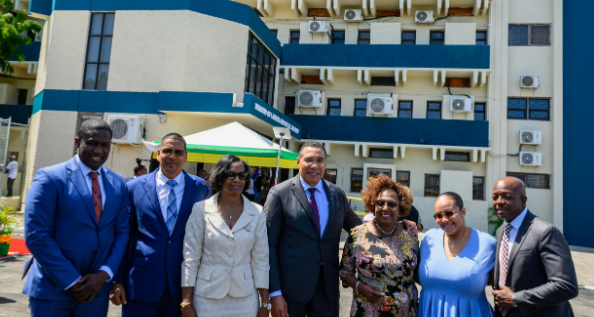
Keynote Address
by
The Most Honourable Andrew Holness ON, PC, MP
Prime Minister of Jamaica
at the
Ministry of Labour and Social Security
Dedication & Naming Ceremony The Portia Simpson Miller Building
on
May 26, 2026
————————————————————————————————————————————–
Thank you, Auntie Fae.
Leader of the Opposition,
Distinguished ladies and gentlemen in the audience and listening to us through the various media.
Today we gather in a spirit of respect, remembrance, and national gratitude to honour the life and service of a former Prime Minister, the Most Honourable Portia Lucretia Simpson-Miller. We are here to honour a Jamaican whose public life has been defined by perseverance, compassion, courage, and deep connection to the Jamaican people.
The Ministry of Labour and Social Security occupies a special place in the life of our country. The ministry stands at the point where work, dignity, protection, and opportunity meet. It deals with the worker seeking fair treatment. It deals with family in need of support. It deals with the pensioner who depends on the assurance that the state will not forget them. It deals with the employer, the trade union, the vulnerable citizen, the person with disability, the seasonal worker, the injured worker, and the Jamaican who simply wants a fair chance for a better life.
For that reason, it is fitting that during Workers’ Week, this building at 1F North Street should be dedicated in honour of the Most Honourable Portia Simpson-Miller. Her journey is well known from local government to Parliament, from ministerial service to national leadership, and ultimately to becoming Jamaica’s first woman Prime Minister.
Portia Simpson Miller broke barriers that stood for far too long, but her significance does not rest only in the offices that she held; it rests on the people who she inspired to dream. She made many Jamaicans feel seen. She spoke to communities that were often ignored. She brought to national life a language of care, a presence, and solidarity for the poor, the worker, the woman, the elderly, and the vulnerable. She understood politics not only as policy and administration, but as ultimately human contact.
Her service in labour and social security was therefore pivotal to her career and central to her outlook. She understood the worker who would leave home before dawn. She understood the woman holding a household together. She understood the young person trying to find a path. She understood the elderly citizen seeking dignity after years of contribution. These were not abstractions to her; these were the people she carried in her public life.
Under her watch, Jamaica’s labour programmes expanded opportunities for Jamaicans at home and abroad. These programmes did more than place workers overseas, they opened doors, they supported families, they sent children to school, they helped to build households, they connected Jamaican labour to international opportunity while reminding us that our people remain our greatest asset; that is an important part of her legacy.
The dignity of labour was a practical concern. It was about whether a worker could earn, whether a mother could provide, whether a family could have a chance to advance, whether a Jamaican, regardless of background, could believe that the state recognized and valued their worth. The naming of this building in her honour is therefore a proper tribute. It recognizes not only the former prime minister, but the servant leader whose political life was rooted in people. It recognizes a woman who rose through institutions that were not always easy for women, and who, by rising, widened the path for others. It also carries a message for the present.
When we name this public building after Portia Simpson-Miller, we are asking those who enter it to remember compassion, inclusion, resilience, and service to ordinary people. We are not asking them to remember that government is not an abstraction. Government is experienced at the counter, in the office, through the phone call, through the form, through the pension payments, through the programme that gives workers a chance.
For many Jamaicans, the Ministry of Labour and Social Security is one of the most human faces of the state. It is here that policy meets real life. It is here that a citizen comes not with theory, the abstraction, but with a need that is real, that is urgent, that is critical; as we say in Jamaica, oftentimes life and death and that is how our citizens expect to be treated. It is here that the values of fairness, caring, and efficiency must be made visible.
This dedication should therefore instruct us that public office must remain connected to the lives of ordinary people. It instructs us that social security is not charity. We’re not doing anybody a favour. It is a duty and oftentimes a right. It is part of the basic architecture of a just society. It instructs us that labour and social security policy is not just paperwork, but it is lives, and this is how we build our nation.
A couple months ago, I had a call with former Prime Minister Simpson-Miller’s husband, and I’m not going to discuss what we discussed. I’m not going to say that here because it was in confidence and in privacy but I want to give an assurance that the Western Children’s Hospital, which Portia Simpson-Miller went to China, negotiated with the Government of China, came back to Jamaica and announced it, that it is only proper, and there was never any other intention. I see some campaign going on all over the place. We are a country that everyone likes to campaign about something, that’s fine, not arguing about that but governments can’t always say everything upfront all at once. We have to wait until appropriate timing and so forth so sometimes our timing may not coincide with other timelines and ambitions and issues, whatever it is. It was always the intent, and I had expressed that directly to the family, and internally we had also discussed it, and I may even had said it in passing in interviews, which probably was not picked up at the time, that the hospital should be named, it is only the right thing to do, it’s appropriate that it should be named in her honour, and it will be done. We were just waiting until the hospital was finished and ready, which would have been the appropriate time to say that, but it is what it is.
It may have also escaped the media and other commentators that there was such a place as the Portia Simpson-Miller Square in Three Miles and when I became prime minister, Mama P was my mother, she usually called me her son. And then I don’t know what happened, she disowned me, but we made up afterwards. She’s always in my heart, and we’re always good friends. My mother actually worked in the ministry when she was minister for many years, and they got along very well. My mother always talks about her, and she always talks about my mother, so we have some connections there.
When we were doing the road programme in the corporate area, we removed the square and I just want to assure the members of her constituency, which adjoins my constituency, that it was never the intention to eliminate Portia Simpson-Miller Square and so when we put up the overpasses, the intention was to rename those overpasses in her honour. We actually started some work to fix up underneath the overpasses and to paint it to make it look appropriate. We will continue that, and at the right time, we will rename that entire area including the overpass and the underpass. We’re trying to figure out if it should be the Portia Simpson-Miller Overpasses or… We haven’t found the right nomenclature, but we will find the right and appropriate way to name it.
This is about legacy and in a country like Jamaica where our democracy is so robust and everything is contested, you want your legacy to be cemented, literally. You want your legacy to be in concrete so it’s not challenged and it can’t be just toppled easily, even by powerful thoughts that may come afterwards, ideas and so forth. We take this seriously, and I want to commend Minister Grange. She has been on a campaign of putting up statues and memorials and all kinds of things and naming important iconic structures in honour of great Jamaicans.
Now, let me be clear, the legacy of Michael Manley and the NHT is not in challenge. And so, for those who interpret my comments in that way, please be at ease. But I find that in our general discussions about the history of Jamaica, we are not complete. We take elements of it that suit either our political outlook or our comfort, and the point of facts are these and it is related to this issue because it’s a general philosophy that workers’ rights must be protected. And based on that philosophy, as work became more structured, more organized, more urbanized, and more corporatized, especially coming to the end of the Industrial Revolution, workers had a literal limited lifespan, in that they would work for 20, 30 years maybe, and then after that they can’t work again. They’re out of the labour force because there are people coming up wanting jobs and then what do you do? There’s no pension, there’s no way for you to survive. The notion of pensions started, I believe, the leader of the opposition pointed out that it started with 1908 then 1911 the Social Insurance Act was put in and that was a good idea and it was replicated normally around the Commonwealth, as you pointed out, but it’s an idea that spread that workers would contribute to a pension centrally managed by the state, and employers would contribute as well and that system was established in Jamaica with the formation of the National Insurance Act.
Now, as Minister Grange pointed out, it was heavily fought. It just reminds me of NARRA. Heavily fought, and in fact, it was called SIN. They termed the third National Insurance Scheme and called it SIN and look at us today. That is what makes the Jamaican democracy strong. Don’t believe any foolishness you hear people writing. Jamaica’s democracy is strong because it was robustly contested, and that model inspired other models where workers’ contribution would be used.
For example, the idea of a social pension became the basis for the idea of socially financing mortgages; that is where the funding for a mortgage pool would come from, and the mechanism to take it out of the workers’ pay already existed through the NIS system. And so, what happened was that there was an amendment made to the NIS Act to use the exact system of collecting from both workers and employers to collect from workers and employers for the NIS and for several years, the fund that was collected and the collections were administered by the NIS. It was actually one and the same until, I believe 1976, that the actual NHT Act now created which separated the NHT and the NIS, and established now an institution and a law for the NHT.
Normally I would not go into this, but I think it is important for the record because there’s so many things being said that are not necessarily accurate, not necessarily true, not necessarily complete, and my job is to tackle some of these things that are not accurate to give a broader perspective on things.
So again, I want to commend Minister Pearnel Charles and Minister Grange for the leadership, and the staff of the respective ministries who have put on this lovely event and all who have worked on these Jamaica legacy projects. I must commend this is a lovely event. I particularly like the very brief documentary on Portia Simpson-Miller. And to the family and colleagues and admirers of the Most Honourable Portia Simpson-Miller, I say this: Jamaica recognizes the magnitude of her contribution. We recognize the doors she opened. We recognize the people she served. We recognize the example she set. We have commissioned a bust in her honour. Minister Grange may say something more. Well, at the appropriate time, you will inform the public of that, and there is also a documentary that will be commissioned by the government so we want you to know that we are in the business of preserving and promoting the legacies of our leaders, not to destroy or contort. We want the legacies of our leaders to be there for the posterity and benefit of the people of Jamaica.
May all who work in the Portia Simpson-Miller building be guided by her example. May this building stand as a monument to inclusion, perseverance, and people-centred leadership, and may Jamaica continue to produce public servants worthy of such honour.
I thank you.