
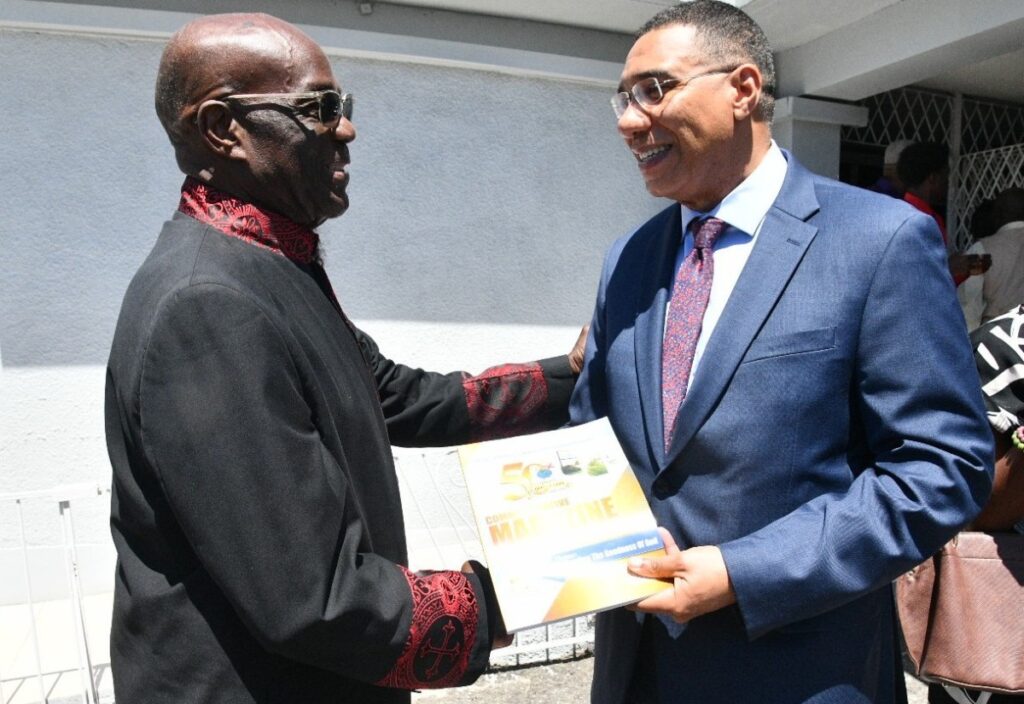
Faith Cathedral Deliverance Centre 50th Jubilee Anniversary
Greetings
by
Dr the Most Honourable Andrew Holness ON, PC, MP
Prime Minister of Jamaica
at the
Faith Cathedral Deliverance Centre 50th Jubilee Anniversary
on
March 22, 2026
——————————————————————-
Today I will not be preaching about dry bones. I will stick to the script that I’ve been provided, which is to bring greetings at this very August celebration of your 50th year.
Fifty years in the life of anything is a long time and it rightfully should be honoured and respected. Your founder, Bishop the Honourable Dr Herro V. Blair, and Bishop Dr Alma Blair should be specially acknowledged and recognized.
I had an engagement on Thursday last and it kind of went a bit too long, and so I was ordered to rest my voice, but I had to be here today. I just had to come. It is indeed a profound honour to join you for this historic occasion, the 50th Jubilee anniversary of the Deliverance Evangelic Association, a milestone that stands not only as a testament to longevity, but as evidence of faith sustained, services rendered, and lives transformed for over five decades.
Fifty years is no small achievement. It represents generations of commitment of men and women who answer the calling, who laboured in ministry, and who dedicated themselves to spreading the gospel and uplifting communities. It is fitting that this anniversary is observed under the theme, “Celebrating the Goodness of God”, inspired by Psalm 145 verses 5 – 7 because it is indeed the goodness of God that has carried this institution through seasons of challenge, growth, and renewal.
Today, we celebrate a movement that has ministered to the spiritual needs of the Jamaican people, strengthened families, and provided moral guidance in times when society has needed it most. Bishop Blair, your leadership and vision have been central to this journey. You have built a community of believers anchored in faith, discipline, and purpose. The impact of that work cannot be measured solely in years or numbers, but in the countless lives that have been changed, restored and inspired.
Brothers and sisters, as we reflect on this moment, we must also consider the context in which we gather. We come together in the aftermath of significant trials. Our country has recently faced the effects of Hurricane Melissa, a stark reminder of our vulnerability, but more so of our resilience. In times such as these, the role of the church becomes even more critical. The church is a place of worship, but it is also a place of refuge and hope as many Jamaicans would’ve gone to their church literally for refuge in the hurricane and indeed for a place of hope and shelter. It is the pillar of stability when circumstances around us are uncertain
Throughout Jamaica’s history, faith-based organizations have stood at the foundation of national development, not only in spiritual matters, but in education, social support, and community building. They have filled gaps where institutions were weak and they have strengthened institutions where they were strong. The Deliverance Evangelistic Association is part of that great tradition of the church supporting families, communities, and the state. You make us as a people stronger.
Your ministries, whether through evangelism, youth engagement, or outreach have contributed to shaping values, reinforcing discipline, and guiding individuals towards purpose. These are not abstract contributions, they are foundational to the development of any society that seeks to be stable, productive, and just. National development is not only about infrastructure or economics or policy. I preach a lot on these every day, but it is also about values, it is about the character of our people, and it is about the strength of our family.
And though I know from this platform, your pastors and church leaders do preach about values, character, and the strength of the family, it needs to be reinforced even in the secular society and in the government. It needs to be reinforced in policy because as you all feel, but may not have expressed it, our society, our values are under threat. Every single day it is assaulted viciously, sometimes to the point where you say maybe this is the new norm, it is just the way things are, it’s the new generation. It doesn’t have to be that way and while we don’t try to fight progressive change, we have to be so careful that the deterioration of our values doesn’t make us crass and angry.
Violence is being reinforced as acceptable in our society and it is having an impact on our productivity as a people, and ultimately, therefore, it is having an impact on our ability to grow as a society and as an economy. Our attitude to authority is also having an impact on our economic prospects. The value of earning, working for what you want; that value every day is being destroyed when we show images of people apparently achieving without working. This notion that you can get wealth without work, that you can be successful without sacrifice a deterioration of our fundamental value. By the sweat of your brow, you shall eat bread.
I am just using that as an example of how our value system is being assaulted every day, and it is the church that has, in my mind, the reservoir of moral authority to stand up and speak to it but governments and leaders like myself must also enter the conversation regardless of how we will be attacked for doing it but it is important. There was a time when the view was that maybe the government should stay out of these issues. There are social issues, and the society will find its equilibrium.
It will find its right balance because whenever you are trying to direct what is moral, you always get into the issue of are you trying to gain political advantage? And I have in my own leadership of the country, try not to get too much into the social issues, lest we be accused of trying to seek political advantage, but as we embark on a new phase of our journey, which is the transformation of the society and the rebuilding of the society, it is quite clear that no matter how well we manage the public financing without having the social ethics to support growth and development, the society will not develop, and there are some very important social ethics that we have to promote. I mentioned a few of them, the value of work, respect, resolving conflicts without violence, developing a pro-growth ethic, and you see this manifest in some of our communities. There are just some people who don’t take a pro-growth stance. They don’t clean up their yard.
You know people who are taking a pro-growth stand, no matter if they live in an inner-city area or an era where there is urban blight. They wake up every morning, and they sweep up their yard gate, and they take up the rubbish, and they don’t dispose of their garbage in a poor way. They ensure their children go to school. No matter how difficult it is, they make education a priority. They ensure that their children do not become a threat to the community, but you have others who just don’t care. They just don’t want to grow, and you, I’m sure, experienced it.
In Parliament on Thursday said that this is something that the state has to address and it’s not just myself alone as Prime Minister. The leader of the opposition also spoke to this matter in his budget presentation and I have said that I intend to reach out to him to work together to address it because I do fear that what made us great, we’re losing that kind of social ethic and we have to stem it, we have to address it, and the place to start, obviously, is here and in this regard, the church plays an indispensable role.
Jamaica’s progress, our growth, our stability, our resilience depends not only on what we build physically but on what we build spiritually and socially, and that is why partnerships between the state and faith-based organizations remain so important. Government can provide policy, government can provide resources, government can create opportunities, but it is institutions like yours that shapes hearts, influence behaviour, and sustain the spiritual needs of communities, and that partnership must continue.
As we look ahead, we are entering a period of significant transformation as a country, we’re strengthening our economy, expanding infrastructure, improving housing, building resilience against future shocks, but as we pursue these objectives, we must ensure that our development is anchored in values because development without values is unsustainable. Growth without integrity is fragile, and progress without purpose cannot endure. This is where the church must continue to lead, not only in preaching, but in example in promoting discipline among our youth, in strengthening family life, in encouraging responsibility and service, in fostering a culture of respect, accountability, and compassion, particularly for our young people.
The influence of institutions like the Deliverance Evangelistic Association is critical. In a world increasingly shaped by rapid change, digital influence, and shifting norms, young people need guidance; clear, consistent, grounded in principle. They need spaces where they can be mentored and inspired. They need examples of leadership that demonstrate integrity, perseverance, and faith. And they need to know that they have a role to play in the society, not only in the church, but in the future of the nation.
The young people present today, this legacy that we celebrate is not only to be admired, it is to be continued and I commend this church for its active youth programme and the integration of your young people in the leadership, management and administration of the trade. So, I say to the young people of this church, you are the next generation of leaders. You are the next generation of builders, and you are the next generation of believers and the responsibility to carry forward this work will soon rest with you. Brothers and sisters, a jubilee is also a time of reflection and renewal. It is a moment to give thanks for what has been accomplished, but also to recommit to what lies ahead.
For 50 years, this association has been a beacon of faith. The question now is, what will the next 50 years look like? That’s the reflection, that’s the thinking, that’s the recommittal, that’s the legacy that you will leave behind. How will this ministry evolve to meet new challenges? How will it expand to reach and deepen its impact? How will it continue to serve and change society while remaining rooted in timeless principles? These are the questions that must guide your path forward because the work is not yet finished. There are still communities to be uplifted. There are still lives to be transformed. There are still young people to be guided, and there is still Jamaica that needs to be strengthened. And in all of this, faith must continue to be your central pillar.
As Prime Minister, I want to reaffirm the government’s recognition of the important role the church plays in national life. We have always valued your contribution. We respect your mission. We welcome your partnership as we work together to build a stronger, more resilient, more peaceful, more loving, more caring, more productive Jamaica. And I extend heartfelt congratulations to the Deliverance Evangelic Association on its remarkable milestone of 50 years. May your next chapter be as impactful as your first.
God bless you and God bless Jamaica.