
Prime Minister Holness’ Acceptance Speech at the American Foundation for the University of the West Indies Legacy Award
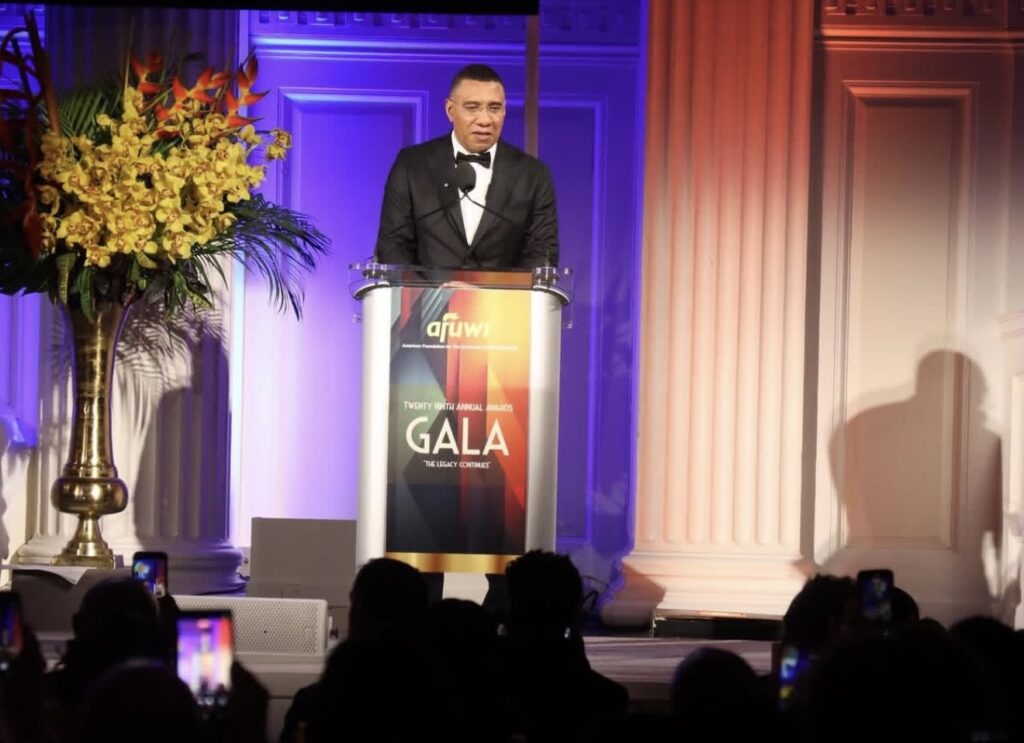
Acceptance Speech
by
Dr the Most Honourable Andrew Holness ON, PC, MP
Prime Minister of Jamaica
at the
American Foundation for the University of the West Indies
Legacy Award
on
April 17, 2026
____________________________________________
Thank you, Chancellor, Vice Chancellor and Chairman, for this distinct honour. It is indeed a privilege.
Before I begin my 20-minute presentation, let me congratulate my fellow honorees this evening. The journeys and the stories are indeed worthy of the recognition and the awards that you have received tonight. Importantly, they have not been about your own successes, but what you have contributed to the success of others.
Now, let me say it is always to be carefully considered when awards are offered to serving politicians, because they may send the wrong signals. They may send the signal of mission accomplished, or now the end is near. Let me hasten to dispel any such view. I accept the award not as the completion of a mission, as we view legacy. I accept the award as recognition of hard work in progress, for which there are tangible results for people to see and identify. So, if there are those who are of the view that this is an award to close out an era, no.
I say this because of the description of the honour, its legacy. Legacy is not what you receive; legacy is what you build, and we still have a lot of building to do in Jamaica and in the Caribbean in general. I’ve dedicated more than half of my life in service of the people of Jamaica, and indeed the Caribbean, and I am very humbled to have had this opportunity to be elected time and time again, so I stand here with the support of many Jamaicans, and I stand there on the shoulders of many Jamaicans who have gone before in service and sacrifice.
The journey of Jamaica has been a confounding journey. We are a country that offers such great potential. We are a country that has achieved so much, has contributed so much to the world, but any truthful analysis of Jamaica would conclude that we could have done so much more, so in this leg of the journey, it is about realising our true potential. It is about turning our ambitions into achievements and realising our true potential.
We were struck by the third most powerful hurricane in recorded history. Having been struck by a Category 3 hurricane a year before, it left a trail of devastation across the island. It was a disaster, but it also created an opportunity to build what should have been, not just to rebuild what was; an opportunity to build forward better. And so, we intend to grasp these opportunities with both hands and to work diligently, creatively, to build the Jamaica that we should have achieved, the Jamaica that should have materialised in generations past.
In order to do this, we need the University of the West Indies to be a critical partner in our development, and the University of the West Indies has played a critical role in our development. You have provided the economists and the engineers, you have provided the administrators and the lawyers, the technocrats, the scientists, but the chancellor said it best, we are in changing times. Not just that, but rapidly changing times.
We are in a time where disruption is the norm, where shocks are the norm, and we will be faced with crises after crises with greater frequency and greater intensity. We are seeing a change in the world order as we knew it to be; an order that is less forgiving, that gives less countenance to size or disadvantage, an order that expects all of us to stand on our own two feet and truly exercise our independence and sovereignty. It will require a change in our mindset, a change in how we as Caribbean people see the world and our place in the world. The thinking that prevailed for the last half a century cannot carry us for the next half a century. A new thinking, a new mindset has to emerge in Caribbean outlook. We need a cultural revolution in how we, as a people, view our economies, productivity and growth.
The vice chancellor said it in his unique way. If I may quote you, Vice Chancellor, I may not do it accurately but forgive me. I believe you said that the university needs the support of the government. When the government grows and gets more revenues, the government will give the university more support, and if the government doesn’t grow and doesn’t have the revenues, we understand, we will try and find our own way. But I believe there is another side to this model where our universities must take an instrumental position in supporting governments to grow.
We need a pro-growth culture in our societies, and that will come from taking more deliberate positions in developing new technologies, in taking positions on how we manage risks. We need a new culture of efficiency, particularly efficient bureaucracy. We need a new culture of innovation in our societies and a critical partner in developing this cultural change. This cultural revolution would be our university, the University of the West Indies, which has played such a critical role in securing our political independence, in guiding our political thought. Now, our university must play a critical role in securing our economic independence and our economic thought and guide us as a people to navigate these very different and difficult times.
So, I decided to accept the award to be able to have the opportunity to deliver this message from this platform. And you will hear from my speech that I still have a lot of work to do, and I intend to make myself available to the people of Jamaica and the Caribbean to continue in service for our great people.
God bless you all and thank you.