
NYU Stern School of Business Lecture
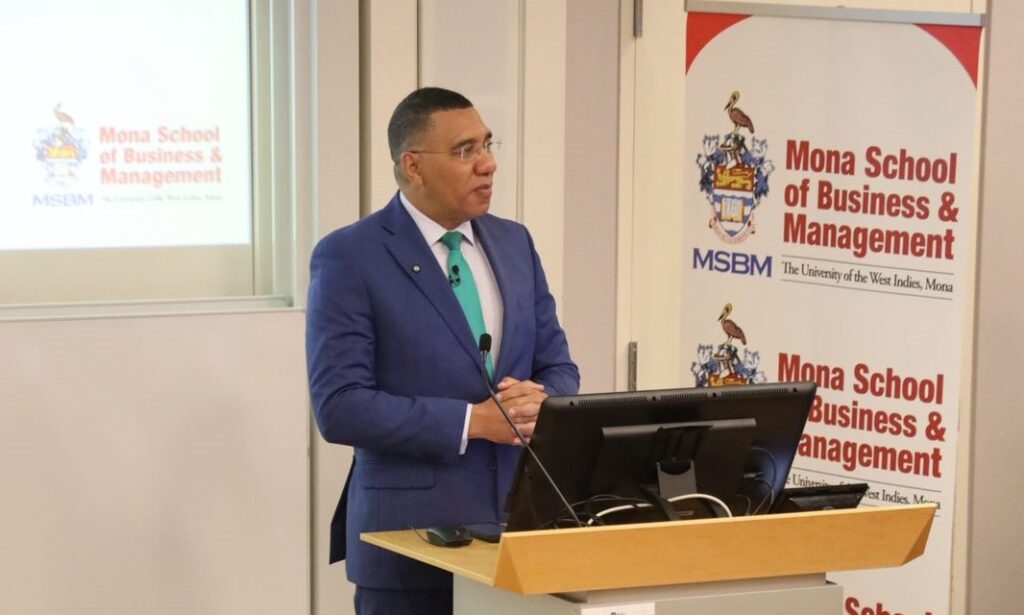
Remarks
by
Dr the Most Honourable Andrew Holness ON, PC, MP
Prime Minister of Jamaica
at the
NYU Stern School of Business Lecture
on
April 17, 2026
_______________________________________________________
Thank you for the invitation to address you this morning. It was such a great pleasure to meet your dean and Professor Statler. I’m looking forward to the conversation. I’m told that we are going to be talking about Jamaica’s fiscal journey and exploring some of the experiences that Jamaica has had over the last decade in securing our fiscal future.
Now, I want to begin by giving some context. Ten years ago, Jamaica was one of the most indebted countries in the world, moving from a national debt-to-GDP ratio of somewhere in the region of about 140% to today, just before Hurricane Melissa, we were almost cracking the 60% floor, so we have literally cut our debt in half, and for Jamaica, that is a significant achievement. In a sense, you could say that Jamaica’s experience could be considered a laboratory for other small developing countries that struggle with debt management, but our fiscal success is not merely about Jamaica being able to balance its books. It’s not only about being able to contain spending, it is more about trust; that’s really what it comes down to. In a strange way then, fiscal policy is about trust building. It is trust between the government and the citizens, trust between government and markets, and most importantly, trust between current generations and future generations; that’s what fiscal policy is effectively.
Jamaica now uses our fiscal success as a kind of currency. We use it as a credibility currency in global markets. We have moved as a country from viewing austerity, from taking fiscal responsibility as an imposition caused by the international Global Order, by our past of being colonised, to one where we take responsibility for our own destiny. In other words, the pursuit of fiscal stability is an exercise in true independence.
For the first time, we have exercised agency in our economic affairs. It’s no longer someone else’s fault. It’s no longer that we were trapped in debt. It’s no longer that the international order of things is so structured that it is unfair to small countries. It may very well be, but the truth is, if we are independent, then we can’t blame anyone else for our decisions. We must take responsibility, and that shift in mindset is a journey in and of itself, which we haven’t fully explored from an academic perspective, which would be very interesting to explore that.
Now, we are at the point as a country where we take charge of our economic outcome. We plan for disasters, we plan for disruptions, and we create buffers, and we recognise that at the end of the day, it is our decision and we take responsibility for that. What has happened in Jamaica is that we are now taking discipline as a development strategy, and I think that’s a major change because we’re no longer looking for development to come from the outside or from somewhere else. We are looking at development from the inside, being generated from our own efforts, so we have effectively then transformed discipline from being seen as austerity because that’s how we used to see being disciplined in our economic spheres as being austere.
Being disciplined is a pathway to sovereignty; that’s how we view discipline. That pathway is linked to some tangible metrics, lower and stable interest rates as a result of this pursuit of fiscal discipline, and exchange rate stability, which we have not had since our independence. In fact, Jamaica is the only country in CARICOM that does not have exchange controls. If you come to invest in Jamaica, you can repatriate your profit without challenge. I’m not encouraging you to, but the comfort that you can, should be welcoming to you; it should be an incentive.
But the biggest dividend from our journey in fiscal discipline is investor confidence. The truth is that persons who have invested in Jamaica and who are seeking to invest in Jamaica would see 10 years of solid policies that are predictable, policies that are balanced, and policies that have achieved great results. Our journey on fiscal discipline has resulted in tangible dividends, both in interest rates, in stability in exchange rates, and all our rating agencies have constantly reaffirmed or upgraded Jamaica’s policy positions. And that has not been the case in our 60-plus years of independence; that has just been the case since the last decade.
The other insight I would like to share about Jamaica’s journey to fiscal discipline is that institutions matter, and yes, leadership matters, but what has changed is that we have moved away from heroic leadership, messianic leadership, to institutions. In fact, the truth is that we have gotten into a lot of problems because of heroic and messianic leadership. Now, we are more focused on building institutions that are resilient, and I put it to you in this way.
I was reflecting on this before I made my budget presentation a few weeks ago, and the point is that Jamaica moved from saying, it’s the IMF’s fault. Our problems would be as a result of the Washington Consensus, as a result of conditionalities, and blaming international institutions, to having the IMF, the World Bank, and the International Financial Institutions being used as the endorsement for political support. In other words, governments move from blaming the IMF and blaming the World Bank to saying, ” Vote for us because we follow the policies of the IMF and the World Bank very well,” and that’s a dramatic shift in just the thought process of the Jamaican leaders and the electorate.
I believe the best way to put this is that the journey required good leadership, but good policy must outlive good leaders, and bad leaders must not be able to change good policy. I think we have achieved that in Jamaica, that the notion that we must be fiscally responsible has transcended any one leader, and it is now national policy instituted in law and protected by institutions. That’s a huge shift in the country, but we would think that the greatest threats would be a hurricane coming, and we’re forced to spend more. The greatest threat is the political economy.
Can this newfound perspective on being responsible in the management of public finances, can it withstand wage pressures? Can it withstand public frustration with the delivery of public services? Let me put it into perspective.
If garbage was not being collected in one of your boroughs, you would be calling your congressman or your local representatives, and you would take to the airwaves, and it would create political pressure, and they would have to respond. The same thing happens in Jamaica. Rural communities are frustrated with their roads not being repaired for decades, and they take to the airwaves, and they call their members of parliament, and they mount protests, and that creates political pressure. Now, how does the government respond to this?
The response of the United States is quite different in terms of the consequences, and the response of Jamaica, we have a very limited budget, a very tight budget. So yes, we could say we’re going to spend more on fixing roads, but the consequence of doing that is that we would have to borrow more or spend less on something else. And in spending less on something else, there goes another round of political pressure, then governments change as a result of saying, “hey, we are going to be fiscally disciplined”, against an electorate that is saying, “I don’t really care about you being fiscally disciplined, I want my roads fixed now or my garbage collected.”
Jamaica is the oldest black democracy in the world. We are a liberal democracy, and that means a lot to us in terms of our values. We have a very competitive politics, so the issue is, can this newfound fiscal discipline withstand the pressures of competitive politics? That’s the contemplation. Where we are now, I think we have answered that question. I don’t think we have answered it definitively, but having been elected a third time on the mandate of being a fiscally responsible government, one would think that the electorate in Jamaica is appreciative of good fiscal management and that this will continue into the future, but it has to be nursed by both government and opposition, and it has to be nursed by a continued, what I call, social contract between the unions, the government, the opposition, and the business community.
In fact, an important feature of Jamaica’s journey to fiscal security would be the implementation of what we call the Economic Programme Oversight Committee, which literally oversaw the implementation of our fiscal reform programmes. They reported to the public as to how the government was being faithful to the undertakings of fiscal reform, and that helped to build the trust of which I spoke earlier.
The other threat that we face is whether or not fiscal discipline will bring growth. It is not automatic. You can be fiscally disciplined, but growth does not necessarily come from that. Just by being fiscally disciplined, there will be a certain level of growth that is generated from that, maybe one to two, maybe even 3%, but that is not going to be sufficient to generate all the revenues to fix the roads, improve garbage collection, improve healthcare, security, and all the other issues and deal with disasters, which are a constant feature of our small island developing state. We need to be having growth in the region of three to 7%. It is going to be a huge jump to move from one to three to three to 7% in terms of growth.
The challenge is, if we maintain the fiscal discipline and we have political support, how long will it last if it does not generate growth, so the government has to, in a sense, pivot now to get growth in the economy, and that has been very challenging so far. Of course, the other challenge is that if you destroy fiscal discipline, you will not get growth so fiscal discipline is a necessary condition for growth, but it is not sufficient for growth and the government therefore has to find this delicate balance maintaining fiscal discipline, but at the same time figure out how to be strategic in increasing expenditures in particular areas that can generate growth. That I think is probably the greatest threat.
And of course, fiscal discipline has given us a very powerful asset in my estimation, and that is resilience. The Jamaican economy never had this feature of resilience before: the ability to recover quickly from a disaster or a shock. And we have had in Jamaica in the last 10 years several shocks, starting with the COVID pandemic, then we’ve had two hurricanes back-to-back, Hurricane Beryl, a Category 3 hurricane when it hit, and then Hurricane Melissa, a Category 5 hurricane, the third strongest hurricane in the world in the history of recorded hurricanes, and then we’ve had several other local disasters including unseasonal weather and in all of them, we have recovered quickly. From the pandemic, we recovered within two years, from Beryl we recovered in three quarters, and we are expecting that we will recover within two years from the impact of Hurricane Melissa.
Previously, for example, the 2009 global financial crisis, it took us 10 years to restore the level of GDP loss. Fiscal discipline has given our economy this strong feature of resilience, and we will continue to build resilience in our economy. Jamaica’s experience could be an example for other small developing states, and I believe, yes, there are many lessons to be learned, and we will certainly be exploring those in the question-and-answer section that will come after, but I would like to close on what I think, however, is the most important consideration in all of this.
Does fiscal discipline lead to human development? And the short answer is, it depends on what the government does with the dividends of fiscal discipline. Governments can choose to spend on education, improving healthcare, improving access, or it could seek to give incentives to businesses or invest in infrastructure or pursue technology. It depends on what the mix of government policy is; you can rest assured that we are being very strategic in what we do with the dividends of fiscal discipline in Jamaica.
First, we’re going to ensure that the country is safe and secure. We have to continue to build our ability to respond to shocks because that is what is the greatest threat that will increase our debt. Secondly, we have to make sure that the country is safe and secure, so dealing with violence and our high murder rate that’s a challenge, which we are conquering. For the last three years, we have had phenomenal reductions in all crimes, in particular murders. We’ve literally cut murders in half, and we continue to reduce that, so we are now on a trajectory to having a very safe and secure society. And then the next iteration of the use of the dividends from fiscal discipline will be to focus on health and education. In the next iteration, meaning within this term of our government, we will be pivoting to spending significantly on health and education. I think those would be the opening comments. I hope I have stimulated thoughts and questions.
Thank you very much for your attention.