
NaRRA Established as Jamaica’s “Implementation Machine” to Drive Reconstruction and Deliver Results
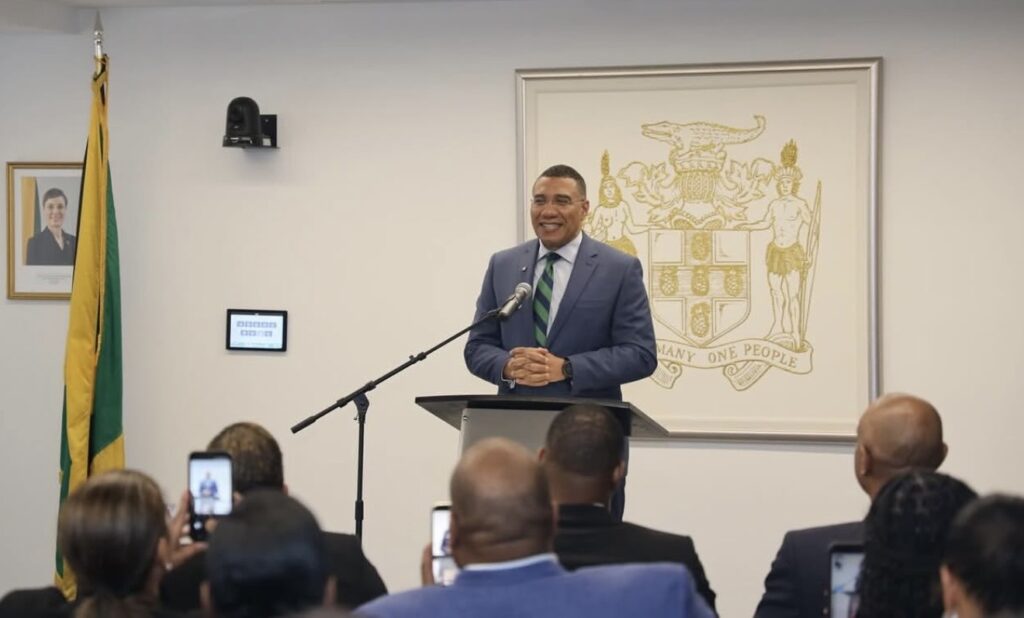
“NaRRA is not a political entity. NaRRA is not there to be a long-term institution. NaRRA is an implementation machine. Its job is to take policy and convert it into outcomes. It’s not there to win friends. It’s not there to distribute political spoils.” -Prime Minister Holness
Prime Minister Dr. the Most Honourable Andrew Holness has underscored that the proposed National Reconstruction and Resilience Authority (NaRRA) will serve as a decisive, time-bound mechanism to accelerate Jamaica’s post-disaster rebuilding, converting policy into tangible outcomes for citizens in the aftermath of Hurricane Melissa.
Addressing members of the Jamaican Diaspora at a Conference in New York last week, Prime Minister Holness provided an update on the country’s recovery, noting that Jamaica has successfully transitioned from relief and recovery into the critical reconstruction phase following what he described as “the most powerful to have hit Jamaica in recorded history.”
Despite the scale of destruction, the Prime Minister reported that essential services have been largely restored, with electricity, water, schools and hospitals now operational. He emphasized that this progress reflects both the resilience of the Jamaican people and the strength of the country’s disaster preparedness and fiscal management frameworks.
“The country is functioning. We’re back up and running after such a devastating hurricane…We officially closed the recovery phase last month, and now we are into the reconstruction phase,” the Prime Minister said.
Central to this next phase is the establishment of NaRRA, which is currently before Parliament for debate and approval. The Authority is designed to streamline bureaucratic processes, coordinate major reconstruction projects, and ensure that investments are executed efficiently and strategically.
Prime Minister Holness made it clear that NaRRA is an implementation machine, and it is neither a permanent institution nor a political instrument.
“NaRRA is not a political entity. NaRRA is not there to be a long-term institution. NaRRA is an implementation machine. Its job is to take policy and convert it into outcomes. It’s not there to win friends. It’s not there to distribute political spoils,” he emphasized.
The Prime Minister explained that the Authority will operate under a strict, time-bound mandate supported by a sunset clause, ensuring that it exists only for the period necessary to execute a defined set of transformative national projects. These include the rebuilding of critical infrastructure such as roads, bridges, schools, hospitals, and the development of new, climate-resilient communities.
Furthermore, he noted that Jamaica’s traditional public investment processes, while essential for accountability, have often resulted in delays that are incompatible with the urgency of post-disaster reconstruction. NaRRA will address this gap by accelerating approvals and execution timelines without compromising transparency or governance.
“The existing process can’t carry us through what we need to do here,” the Prime Minister said.
He continued: “NaRRA is not designed to circumvent or bypass for the purpose of facilitating corruption or lack of transparency. It’s not anti-competitive. It’s not exclusionary.”
The Authority will also incorporate a robust oversight framework modelled on Jamaica’s successful fiscal reform experience, leveraging independent monitoring and broad stakeholder participation to maintain transparency, accountability, and public trust.
Importantly, the Prime Minister linked the effectiveness of NaRRA to Jamaica’s strengthened fiscal position, noting that disciplined economic management in recent years has enabled the Government to respond decisively to the crisis.
“We are in a far better position to withstand shocks than we were before,” he said.
The Government has already allocated approximately J$10 billion in the initial phase of roof repair grants, supporting tens of thousands of affected households, with additional allocations to follow as reconstruction efforts scale up.
Prime Minister Holness emphasized that Hurricane Melissa, while devastating, presents a strategic opportunity to modernize Jamaica’s infrastructure and reposition the economy for higher growth.
The Prime Minister also called on the Diaspora to remain engaged and supportive, noting their critical role in national development and in shaping public understanding of the reforms required to accelerate Jamaica’s progress.
With the establishment of NaRRA, the Government is seeking to fundamentally shift the culture of public administration toward performance, speed, and results, ensuring that Jamaica not only recovers from Hurricane Melissa, but emerges stronger, more resilient, and better prepared for the challenges of a changing climate.