
Recover Better Conference Post-Hurricane Reconstruction Forum
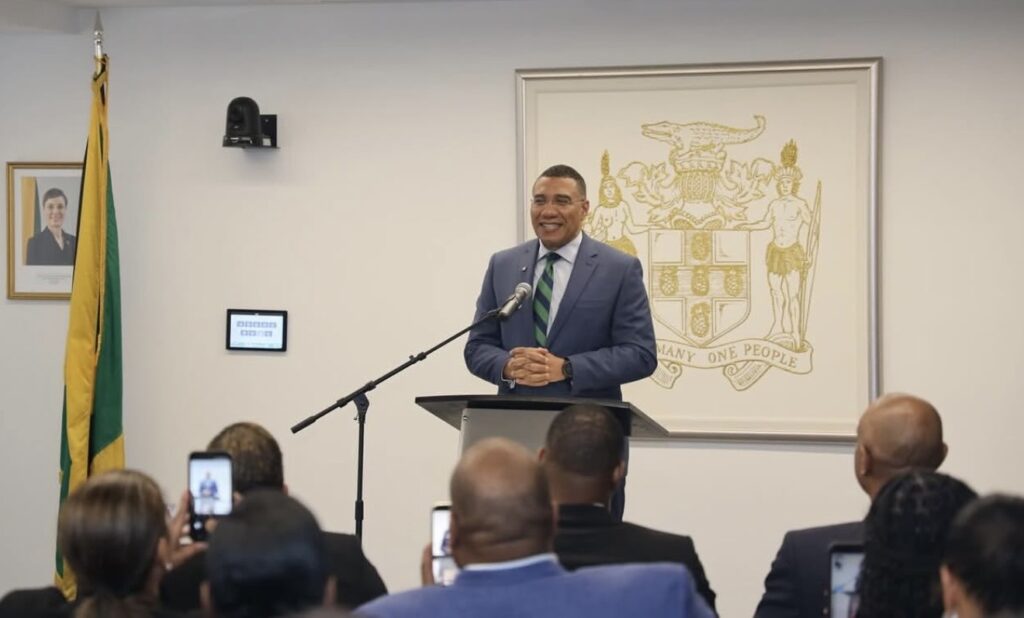
Keynote Address
by
Dr the Most Honourable Andrew Holness ON, PC, MP
Prime Minister of Jamaica
at the
Recover Better Conference Post-Hurricane Reconstruction Forum
on
April 16, 2026
________________________________________________________________
You will forgive me if I dispense with formalities. I believe I will make up for the time if I dispense with the formalities, but of course, allow me to acknowledge our permanent representative to the UN, Ambassador Brian Wallace, and our Acting CG, Mrs Bowen, and I want to thank you for filling the gap and standing in the breach for us.
You will permit me to just reminisce a bit because as I entered the consulate, I was about to ask for Alsion, and I know that all of you here would have her in heart and mind. She was such a wonderful soul, a force of nature, and she is dearly missed. I’m certain we’re moving through with plans to name this hall, this meeting room, in her honour. I think that was the last discussion we had. Of course, we will have to do something more than that for her, but knowing her, she wouldn’t want us to delay too long, and she would want us to move ahead with plans because she was just that person.
I know now you have been briefed thoroughly because I’m seeing the representatives from Jamaica here on what has been happening in Jamaica on the disaster recovery, on the establishment of NaRRA, but what I know about my diaspora is that sometimes you know more than the Jamaicans at home. Meaning that you are so vested that you follow the news, and because you’re not there, you make it a point of duty to go to the news sources to get the information, so you are very well informed. We understand, you influence the votes back home. When the call comes to you, it is not only asking for support, but it is also to complain, and when you call home, it is to, yes, we’re giving you some support, but we want you to do certain things. The connection of the diaspora is so important in the happenings back home.
Hurricane Melissa, the third most powerful hurricane, the most powerful to have hit Jamaica in recorded history. The only way to describe it is an atomic bomb of wind and rain, massive destruction from where it hit at New Hope until it exited the island in Falmouth and in St James, and the dislocation has been significant, but at the same time, the resilience of the Jamaican people is legendary, and we are recovering. No doubt, having been hit by such a powerful hurricane, we were wobbly at the start, as any country, any nation would be, no matter how well laid your plans are.
As Mike Tyson said, you have the best plans going into the ring until you are hit, and yes, we were hit by a really powerful punch, and we managed to get through the relief phase of the response, and then we came through the recovery phase of the response. I officially closed the recovery phase last month, and now we are into the reconstruction phase. There are lessons to be learned about the relief phase, the humanitarian phase; I wouldn’t say it is perfect, but to be fair to ourselves, we are not comparing ourselves to perfection. We’re comparing ourselves to other countries and to other situations, and relative to other countries, as the experts have said, our relief and recovery effort is world-class without question.
Obviously, you will hear the critique, as there must be in a democracy. The criticism is necessary to keep us grounded, keep us on our feet, and not to lose focus as governments want to do. We see the criticisms as necessary when they are constructive because in today’s world of social media, not all the critique is designed to be constructive. Some of it is just for destructive purposes, but the government filters and focuses.
Now, where we are at this stage is to accelerate the recovery, and the critical part of the recovery would be the restoration of electricity, particularly all the utilities, and we have done that in record time. We are about 99% restored in terms of electricity, water, hospitals, and schools; the country is functioning. We’re back up and running after such a devastating hurricane.
Is it as I said, perfect? No, there are still some challenges that beset us. One of them is the quick distribution of roof repair grants because an important part of the recovery is the restoration of roofs, because the main damage to households would have been the destruction of residences, particularly roofs. It is not a financial problem, so it is not that the government doesn’t have the resources. Let me be careful about how I say this… We’re not awash with cash, but we have planned in advance for the disaster, so we had some money set aside, and because of our good fiscal management of your resources, we were able to make certain budgetary allocations. So, it’s not an issue of the government not having the resources; it is an issue of the bureaucracy to distribute, and we experienced this during COVID, we experienced this during Hurricane Beryl, and we are experiencing this now.
The truth is that a large number of Jamaicans are unbanked; they’re not formally a part of the financial system, so they don’t have bank accounts to which we can readily send funds, and where they do have accounts, sometimes these accounts are inactive, so you may send funds and they are returned so this is a larger problem of informality in the society, and we have to solve the informality issue if we are going to be able to serve persons quickly in times of a disaster.
We have in place what we call the agenda of the digital society, and it is a very wide agenda, but just to break it down very quickly. One, we want to give all Jamaicans a unique national identification, and that is already established under the NIDS National Identification Project, and that is being rolled out. We are supporting new digital financial banking systems to allow for digital payments, that is not going as quickly as we would like. I see my friend here smiling. He knows everything about that, but we are progressing. We have technically, at this point, distributed all the grants in the first phase that we have allocated, and we will do another round of grants to rebuild roofs.
One of the things we’re picking up is that persons are getting the grants, but they’re not actually going to the hardware to get the materials, and so there are a lot of issues there. People have to wait to supplement what we are giving in grants with their own income. Some people don’t have a place to store the material, so there are all kinds of logistics issues. We are expecting that in the coming weeks, we will see an uptick in persons going to actually encash the grants to repair their roofs. Once that is done, then we will go into the second phase to get to those persons who we have assessed but they have not yet gotten their grant so we will make another allocation.
In the first phase, we allocated JMD$10 billion through the ROOFS Programme, and that covered just about 50,000 persons. We had assessed over 100,000 Jamaicans, 100,000 households that were destroyed, so we have another round of grants to make, and I want to assure all Jamaicans that the government is not finished in terms of the distribution of roof repair grants. We will do another round as we collect the resources into this new budget. We will make an allocation so I want to put everyone at ease that, yes, there will be some support coming from the government.
Just to rehash, I know you may have heard, we give a grant of JMD$500,000 for households that have been badly damaged, and that would help to restore at least one or two rooms in a house that has been totally destroyed. We give another grant of, I believe, about $200,000, and then another grant for $75,000 for persons who have just suffered minor damage. That part of it is moving along. I won’t say that I’m thoroughly satisfied that it is moving at the pace that I would want, but we’re going to put greater effort into it to ensure that all Jamaicans who are expecting to get some support and that they have been assessed and legitimately certified as suffering damage, that some support will get to them.
Why I’m here today is to talk to you about the reconstruction phase. And in the reconstruction phase, we are going to turn crisis into opportunity; that’s what this is about. How do we turn this super phenomenal, destructive event into an opportunity to grow and redevelop Jamaica? I know many of you who would’ve left Jamaica and would’ve had the opportunity to live in a first-world country. When you go back to Jamaica, you say, ” Oh, Jamaica is such a beautiful place, but why are the hospitals the way they are? Why did they build a hospital right on the seafront? Why are the roads built right on the seafront?” You have many questions about the infrastructure, about the public bureaucracy. You have questions about why crime is so high, and sometimes it leads to great frustration.
When you meet a Jamaican, and you get past the area of exceptionalism and the high level of patriotism, then you start to get into the complaints. Thank God for the high level of exceptionalism and patriotism, because if that didn’t exist, then the frustration, I’m certain, would have turned off many, but it is because you see the hope and the potential. It is because when you look at Jamaica as the oldest black democracy in the world that has contributed so much as a small island to global affairs, that the truth is it has provided you with an identity in a country where you could easily be lost, and therefore you are vested in ensuring that your home country, which provides you with an identity, does well and I believe that’s the root of the connection with Jamaica because Jamaica holds this promise of all the small countries and small islands, Jamaica could become the next Singapore.
But if you talk about Jamaica outside of economic terms, then you would be very proud of Jamaican democracy. Jamaican values are still very strong, so what we need to do is to merge our democracy with our economy. We need to use our strong principles and convert them into prosperity. How do we use our liberal democracy to create a growing economy? That’s the big challenge for Jamaica currently.
The truth is that we have been exceptional in culture, exceptional in our standing in foreign affairs, exceptional in academia and what we have contributed to the world, but we just have not gotten the economy right, and because we have not gotten the economy right, we’ve just not gotten the infrastructure right, the healthcare and all the other issues. So, where do we start with getting things right? That’s a question for the diaspora for our generation: where do we start? How do we get things right in Jamaica?
The first thing you have to do, make no mistake about it, is to get the economy right. And when I say the economy, in this context, I’m talking about a limited aspect of the economy, which is to get the fiscal management of public finance correct because for many years we struggled with getting fiscal management correct. Fiscal simply means what you collect in taxes, how you spend it, and how you manage borrowing.
Because a part of the Jamaican psyche and culture for a very long time was that we did not exercise agency over our financial affairs, meaning we didn’t take responsibility. There’s always a sense in our leaders that it was somebody else’s fault, that we were caught up in a global debt trap, that oil prices rose and threw our economy into turmoil, and that some foreign companies were coming to exploit us. It may very well be true, but we should never have stood in lamentation; we should have stood strategically.
It is only recently that we have had a kind of social contract to break this kind of, I call it, lack of accountability in the management of our fiscal affairs, to put in place very strong fiscal policies, a`nd the greatest impact of that is to reduce our debt from 147% of GDP to we were just about cracking the 60% of GDP. We’ve cut it more than half. We did that, and that’s phenomenal. Let’s be clear, that’s phenomenal. Very few countries have managed to do that, so the question for us is, how do we take the learnings from that experience and apply it now to other areas of the economy; that’s really the challenge.
The big challenge now for the economy is growth. We have managed the fiscal issues, and by the way, when we say we have managed fiscal issues, it also means we have managed the political pressure to spend without accountability. That’s essentially what it means to have fiscal discipline, because there are a lot of countries like Jamaica, the population wants so many things, and they put political pressure and governments come in and make promises that they can’t afford and they behave in a profligate way and then the electorate is confronted with either high debt or high taxes or both, and then they end up in political turmoil and then they go back again in a cycle.
We have managed, now, for the past decade to break that, and having broken that, it means that we are able to withstand shocks. I’m not telling you we can withstand every shock, but we are in a far better position to withstand shocks than we were before. Since we have transitioned now to a better model of fiscal management, how do we transition to a better model of growth? That is the real tricky question. How do we get growth?
We have been growing. We’ve been getting 1%, 2%, but we need to crack the 5% growth ceiling. How? One is a concentrated investment strategy, a growth-inducing strategy through investment, the other is to increase productivity and efficiency of the economy, and the other is innovation. We need to create new products, and then we need to increase the complexity of the economy, how all sectors work together, and the output of one sector becomes the input of another, and you really build a strong and moving economy that way.
Hurricane Melissa has provided us with the opportunity for growth that is induced by investment. That’s essentially what it has done, but not just random haphazard investment; strategic coordinated investment putting everything into a matrix, making sure that they’re related so that we can get synergies because it is the synergetic coordination of the investment that is going to give us the growth.
What is the biggest threat to investment in Jamaica? Well, first, there was the unstable fiscal environment. That is not a threat anymore. Let’s be clear, Jamaica is the only country right now. I’m not sure what Guyana’s situation is, so maybe Guyana may have changed their foreign exchange policy, but Jamaica is the only country in CARICOM that has a freely floating currency and has no foreign exchange controls, so as an investor, you can come into Jamaica and invest, and you can take out your profits. I don’t encourage you, reinvest your profit, but you see, that’s the beauty of it. Once an investor comes and they see that they’re assured that they can’t make a profit, and if they want to repatriate, it is highly likely that they will stay. Jamaica has that now, so for members of the diaspora who are looking on and persons who are interested in investing, this is a very important advantage that Jamaica gives.
The other obstacle, I would’ve thought, to investment in Jamaica would’ve been the issue of security and that cuts on many different levels. If you wanted to come and buy a home in Jamaica, you might be thinking about security. If you are investing in areas like logistics and so forth, where you need to be assured that your products, when they are shipped out, there is no unwanted intrusion of contraband, these are issues that you would be concerned about, but I’m pleased to report that the security situation in Jamaica has improved dramatically. In the last four years, we have cut murders by more than half. In fact, all major crimes are down. We’re continuing the trend of reducing murders and murder would be considered to be the main index of security because that’s the ultimate use of violence, and we have cut that in half.
The target this year is to go sub-500, so remember, we’re coming from the highs of 1,600 murders per year. Last year, we went below 700, and this year we intend to go below 500, and the intention is to bring it down to zero. And let’s be clear, if Jamaica matches its image of “Jamaica, no problem man, Jamaica easy, Jamaica Irie” with what’s actually happening on the ground, we wouldn’t have rooms to have tourists. Not just tourists, the number of persons in the diaspora who would come home, so that’s the intention. We’re making good progress there, and it is not a flash in the pan. We have had now three consecutive years of decline, and this year looks like it’s going to be a fourth consecutive year. Once we crack five consecutive years of decline, then we know that we would have totally eroded and eliminated those persons and organisations that are the purveyors of crime, murders and other dysregulated behaviour in the society, and we are going at this with great determination.
In essence, we have changed the risk-reward function for crime in Jamaica. I think the criminals understand, and we have a capable force. We have the intelligence, and we will bring them to justice, so that, I think, is no longer a major obstacle to attracting investment and getting growth.
What are some of the things that are still outstanding? One that we get a lot of complaints about would be the public bureaucracy; how long it takes to get anything done. Can I tell you that that is my greatest challenge, and I say that as the prime minister of the country. When I say this, I recall I made a speech about inefficiency and the dense nature of our bureaucracy and the response of a journalist, “Well, you are the Prime Minister, just fix it. Stop talking about it and just fix it.” Well, it’s not so easy because of the nature of our democracy. The very thing that I just said at the beginning, our liberal democracy, power is not concentrated in the hands of the Prime Minister only. There are independent institutions with independent authority. We have laws that we have made that we can’t easily change, and the laws that we have made are there for good reason because the laws are there to fight against corruption, and that could be a big threat as well to investment, so it’s a balancing act.
How do you increase the speed of the bureaucracy without increasing corruption in the system? It’s not a simple task because even when you propose new laws to expedite and do things quickly, there is great public debate and suspicion that what you are trying to do is to circumvent the existing laws, which brings me right back now to NaRRA, so that’s the challenge. I hope I’ve kind of put things into context.
NaRRA is not designed to circumvent or bypass for the purpose of facilitating corruption or lack of transparency. It’s not anti-competitive, it’s not exclusionary, and because of our history and our liberal democracy, it is important that stakeholders question everything the government proposes. But, you know, when I was in the opposition as leader of the opposition, we used to say the role of the opposition is to oppose everything, propose nothing, and bring down the government. That’s what the thought was, but we never acted that way.
No, I took the view that we must be constructive, so even in things like getting the IMF programme on board and getting all the legislation required by the IMF, we took a proactive and constructive approach and worked with the government to ensure that this national objective was achieved. So, there is a time and a place where the classic definition of how the opposition should operate should not apply, and that would speak to the maturity of the democracy. It speaks to building social partnerships, and that’s what we did to build the social partnerships to get us to good fiscal management to put in place fiscal rules. Now is such a time.
The reconstruction of NaRRA really should be approached as a national consensus, and I’m speaking here, I said it in parliament, that has to be the approach. We’re not saying that the bill mustn’t be criticised. I’m not saying that the bill can’t be improved and refined, but there is a space to dispense with political theatrics and performance and focus on the interests of the nation, and I think the NaRRA bill provides us with this opportunity.
The bill comes with a very short sunset clause, so it’s not going to be there forever. It’s a very limited period of time to get a certain set number of projects executed, and those projects can change the face of Jamaica. The question is also asked, then why not do it through the existing bureaucracy? I will give you a few examples. We have a programme to restore bridges in Jamaica. It is a programme in collaboration with the Government of the United Kingdom. We’ll be looking at a number of bridges across Jamaica that are in a really bad state of disrepair.
Now, the process for public investment in Jamaica starts with investment appraisal, then, when you have passed the investment appraisal, you go to the refinement on further project development, then you go to procurement, then you go to contracting, and then you go to execution. The first four stages are usually longer than the execution stage. You’re going through all of this, and an elderly gentleman trying to get where he is going, though the bridge is cordoned off and people know you shouldn’t go on this bridge, but he’s trying to get where he is going, he falls off the bridge, which is one of the bridges to be addressed by the programme, and dies.
Now, how do I balance this? Who takes responsibility? Can I fix the bridge without going through that process? Because the same people here will criticise me and say, I’m breaking the rules, but people literally are dying because we’re moving slowly; that’s the reality. The existing process can’t carry us through what we need to do here, and the existing process must address the things that are already in the pipeline to be done, so these new projects would displace. We want what is already in the pipeline to get done, the new projects and those that we pull out of the pipeline to get those done quickly, the objective.
There are questions about governance. There’s nothing that you do in a modern democracy where you do not consider the issue of governance. Governance means, at its basic, accountability; how are the public funds reported on, and how do we assure the public that the funds that you have provided through your taxes or through loans that they’re actually used for the purpose for which they were allocated? That’s the accountability and accounting part of it.
Then there are issues of fairness and equity. The people who get to spend the funds and benefit from the funds; why did you get the contract and not you? So those are equity questions; was it competitive, or was it because of who you know? Then there are the conflict-of-interest issues; are the people making decisions also having an interest in benefiting from the funds? And there are some other deeper equity issues as well, so governance is important, and governance starts from the minister, then there’s an intermediate body, which is the board in some instances, and then you have the executive, the person who actually takes the policy and converts it into the outcome.
Now, between the minister making the policy, that policy getting through to the board, to the executive, and then being converted into an outcome, there are many a slip between the cup and the lip. There are many ways in which policy, though well-intentioned, can go wrong. There are many, many, many issues. What we have learned is that the utilisation of the social partnership has created a mechanism of governance that is super effective because it brings the public into the decision-making process and into the oversight process directly and indirectly by having persons who are of high repute, known integrity, reporting on the activities of an executive for performance.
So, using the EPOC model, which you would know as the Economic Programme Oversight Committee, which was established to oversee the government’s implementation of the fiscal transformation of the Jamaican economy, bank stakeholders, private sector stakeholders, and unions all came together and formed an oversight committee to oversee what the government and the Ministry of Finance were doing and they reported to the public routinely and their credibility was essentially leveraged to ensure that the government stayed on track. We intend to use this model for NaRRA.
NaRRA is not a political entity. NaRRA is not there to be a long-term institution. NaRRA is an implementation machine. Its job is to take policy and convert it into outcomes. It’s not there to win friends. It’s not there to distribute political spoils. At the end of it, I want the highways to be built, the schools to be built, the new hospitals to be built, the new town centres to be built, and the communities that are to be relocated, relocated. That’s it. They have a clear mandate. It’s not to give a benefit to friends and company. It’s not to facilitate the diversion of funds. This is just to get the job done, and at the end of the day, when that is finished, the sunset clause kicks in, and NaRRA is no more; that’s it.
So, whoever is going to be the executive of NaRRA will understand that this is just a job that you have to execute with almost military precision. Get it done and you will have what we call the JAMRROC, the equivalent of EPOC, that will, at intervals set, report to the public that they were supposed to start the school or start this, that they haven’t. And of course, the executive director or managing director, whatever title is given, he is not going to be my friend. If the job isn’t being done, that’s it.
Now, I know there’s a great fear in Jamaica for this. There’s a great fear for this kind of arrangement in terms of how our public bureaucracy works, where it is totally outcome-determined. Because can you imagine if this were the model for all public entities, that it is solely a matter of how you perform, you keep your job by virtue of your performance, can you imagine? So, yes, I understand why there is great fear in some quarters about an entity like NaRRA because it is totally performance-based, and that’s what we need if we are serious about growing. We must transform our public bureaucracy into one that is performance-based and outcome-determined.
Right now, we are process-based. It doesn’t matter if the man drops off the bridge and dies. What matters is that we followed the process. I’m not saying you must tear down the process. Process is important, but we must move faster, and that’s what NaRRA is about: moving faster. So, I hope I’ve brought some clarity to what it is that we’re trying to do.
The hope is that NaRRA will lead to a transformation in the Jamaican public bureaucracy and how we view institutions. It is a credit to Jamaica that we believe in institutions. It is a credit to us that we have strong and deep institutions. Make no mistake about that, but the next phase of our development and the next generation of Jamaicans must appreciate that the world owes us nothing. They’re not going to tolerate our pace, and if we don’t move quickly, we will be left behind, so we need to get our institutions working much faster.
So, again, to this point, “then just change it, Prime Minister”. Every speech I give, every interaction, that’s what it is. It’s about building public opinion to effect change because that is the contract that we have in our society, that’s why we have a liberal democracy. The people’s views matter. My job is to explain why some of the views that are held are not consistent with the vision and the ambitions that you would want to see materialised, so that we can get the social change, and there is a process that we go through.
I’ve made this speech maybe 30 times already, but we keep doing it, and we keep doing it. Eventually, you will call your aunt in Jamaica and say you must tell them they must move faster, and then that gets into a song somewhere, they make a DJ sing about working for, and then you see the culture start to change, which then reinforces because that’s our democracy and that’s what we’ve been doing.
We are not trying to be bullies about this, and it does take its time, but I think NaRRA has given us an opportunity to accelerate this, and so what we have done is put certain things in place. For example, we have put in place a SPEED Programme. We have the integration of technology into our bureaucracy. We are doing all kinds of things to introduce technology to speed up our bureaucracy and to change the way in which we do business, and little by little, we’re seeing the change, but we want to make a big change now, and NaRRA is going to be that big change that we want so we look forward to the support of the diaspora.
We look forward to you interacting with Jamaicans back home and explaining to them the speed of thought that business operates here. I keep saying we have the fastest man and the fastest woman in the world in terms of the record; we should be the fastest people in business. I want you to see this, then in the bigger picture of what it is that we’re trying to achieve.
Let me talk very quickly about some of the things that we will be doing. You know how you complain about Spur Tree? Yes, we’re going to build a bypass around Spur Tree. In fact, we will have a new highway through St Elizabeth into Westmoreland. We’re going to do the bypass for Lucea and the other towns on the coast of Hanover. The Portland Bypass has already started. We’re going to create a new town centre for Falmouth and seek to move much of the activity off the shore. We’re going to move the Falmouth Hospital from where it is, which is right by the sea. We’re going to bring it inland. We’re going to do the same for Black River Hospital. We’re going to bring it inland. We’re going to build a new Kingston Public Hospital, that hospital is 300 years old. We’re going to do work on Sandy Gully. We’re going to build a new port in St Thomas. We’re going to do the logistic centres that we have said we were going to do for 20 years, and we haven’t done it in Caymanas. And Vernamfield, finally, will become a reality as our third airport. I can’t say too much on that because of existing contractual arrangements, but who knows? But what the hurricane has taught us is that both our airports are at sea level and therefore we need to have facilities inland on higher ground, so that’s strategic. We have to do that. That’s imperative, actually.
It’s a quite large register of projects, but they can be done. The loss estimated by our planning institute is US$12.2 billion; that’s a little more than half of our GDP. We have identified about $6 billion, so if we’re going to truly reconstruct and recover all that was damaged, and so forth, we would need another $6 billion. We’ve come up with a plan to crowd in private investment, that’s what we call the FAST programme, and we have said if you have a project, US$15 million or more, come to us. We will see how it fits into the matrix of projects because we want synergy, and you will get on the fast track for approvals and permits, and you will be linked into the financial network for loans and other support, including technical support.
We’re going to build this new highway. In building a new highway, we would’ve opened up lands that prior to were not accessible. Could those lands be used, let’s say for housing? If that is so, and the owners of the land now have accessible property, why not form your conglomerate? Let’s put you on with the NHT, and let’s see how we could develop your lands, but the synergy comes from in building the road; we know what the sewer and water requirement would be. So, instead of just building the road, we put in all the infrastructure and, better yet, we make the lateral connections. And while the road is being done, the housing construction is being done, so that’s the idea of kind of crowding in the investment. So, if you have US$15 million there and it’s burning your pocket, come to Jamaica with it. We have projects that make sense, and we will quickly approve for you to get started; that’s the idea.
The leader of the opposition was saying I’m coming to New York to beg money. I would always seek support for my country, and I totally agree that when we come to you to seek your support, you must be confident that when you give funds to the government, it is properly accounted for and properly used. There’s no question about that 100%, and one of the reasons why we have been criticised as being slow in spending the resources that we have is because we are following the processes to the T, because, as you know, our auditor general has been very active. And by the way, that’s a sign of a strong democracy. We have been very, very careful, very cautious in ensuring that whatever we use the resources on can be justified and it is accountable.
Just to be clear, because I’m not sure that it is in the domain here, that so far in total, Jamaica has received JMD$1.471 billion in donations, that’s about US$9 million. Remember what I said was the total loss, $12.2 billion. I’m not going to tell you what percentage the donation is relative to the loss. You can work that out. We are going to go to questions shortly, but I just wanted to say that in this figure of $1.47 billion would be donations in cash. By the way, this is just cash donations. This is not what you would’ve sent in the barrels, and the pallets, and the bags, and all the other things that you have sent, which is much, much, much more than the cash donation, just to be clear. But in the cash donation, some of this would’ve come from governments that would have contributed: the Government of China. Many of our CARICOM countries and so forth would’ve given funds to ODPEM directly, so the JMD$1.4 billion or US$9 million is not only what is given from the diaspora.
Just to be clear, 17,000 people donated on the platform, so you know it’s widespread. The large number of persons from the diaspora would’ve given what they could, so we are very appreciative. I want to use this opportunity to say thank you. And what we have used it for, most of it has been used to support what we call the government-directed roof repair programme. We use it to buy the materials to replace the roofs. So far, between the JDF, the Government of Guyana, and other entities that have contributed, 400-plus roofs have been repaired so far, and the programme is ongoing. Some of it will be used to buy equipment because that is specified by the donors, so we will be using it to buy heavy equipment that will last for the next disasters to come, so that is in the resilience building. This is not money that is going to not have a lasting impact, so I want everyone to be assured that the funds that have been given are being used for good purposes and well accounted for.