
11th Biennial Jamaica Diaspora Conference
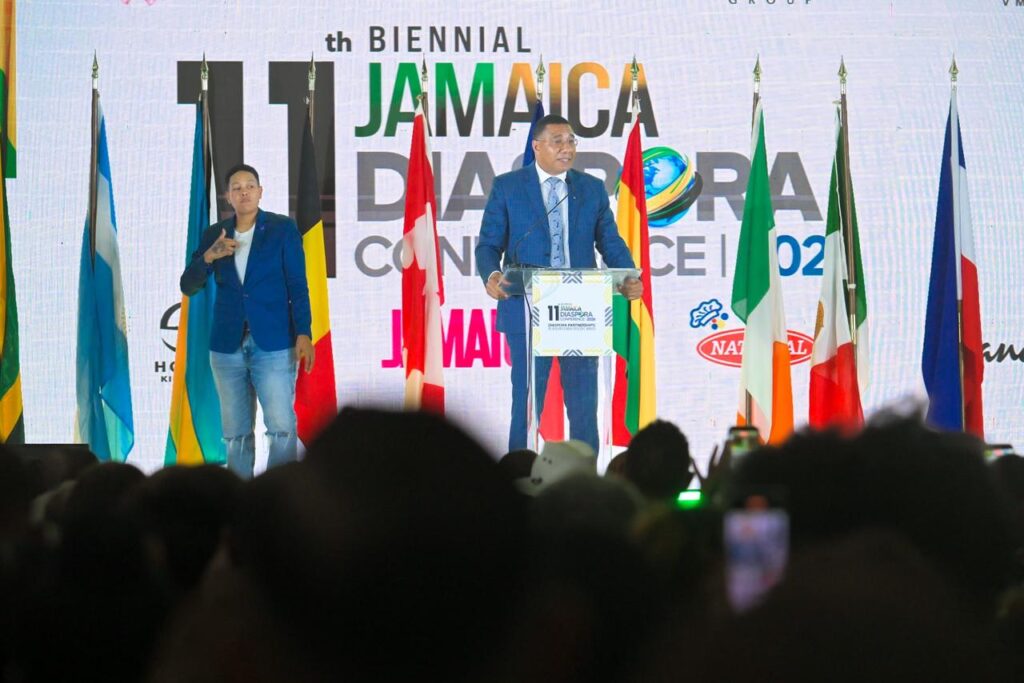
Keynote Address
by
Dr the Most Honourable Andrew Holness ON, PC, MP
Prime Minister of Jamaica
at the
11th Biennial Jamaica Diaspora Conference
on
June 16, 2026
—————————————————————————–
‘No weh no better than yard!’ I just felt that a while ago. I mean, isn’t Minister Johnson Smith such a wonderful minister? I believe she’s the best minister of foreign affairs, but I think she gave my speech.
Bishop, the Honourable Conrad Pitkin representing His Excellency the Governor General,
The Speaker of the House, the Most Honourable Juliet Holness,
Dr Horace Chang, our Deputy Prime Minister. We affectionately refer to him as the President of the Republic of Montego Bay
And of course, my dear friend, Mr Mark Golding. Mark, how could I forget you? It was not always the case at these events that the leader of the opposition was invited to speak, but as this event evolved into more of a national event rather than a government-sponsored event, it became the protocol that the leader of the opposition, which is a constitutional position, quite a unique thing in constitutional innovations to have the office of the leader of the opposition written into the constitution. So, Mark, we can never forget you, and we’re always happy to have you here as leader of the opposition.
That’s how we do it in Jamaica. That is the strength of Jamaican democracy. Don’t let anybody fool you about Jamaica’s democracy. There is no other country whose democracy is as strong as Jamaica’s. Believe me when I tell you that. I have always said that Jamaica is the first Black democracy in the world, and I have not been contradicted successfully so far, but it is the truth. It is something that we can be proud of. And listen, democracy is not a sanitized exercise. It can be brutal but many of you are from countries where the brutality of the democracy is probably worst, so you well understand that what you read in the papers and on social media, it’s just part of the democracy.
Let me welcome you all back home, back to Jamaica. I am very happy to see you, and I’m very pleased to see a super packed room. I mean, you look good. There is an energy among Jamaicans, and you can feel it even before anyone says a word. It’s warmth, its spirit, it’s the memory of collective struggle, it’s the swag, it’s the assertiveness, it’s the ambition. I think that’s the word that describes us; ambition, and I feel it and see it in this room.
Over the past eight months, Jamaica has carried grief, loss, worry, and hard work. Hurricane Melissa tested us, but the Jamaican spirit held and held strong. When Melissa made landfall on October 28th last year, it came as a Category 5 hurricane. It’s the strongest storm to have hit Jamaica, and it is the third strongest hurricane on record. In a few hours, communities built over generations were wiped out. The call went out and you answered. From the United States, the United Kingdom, Canada, Panama, all over wherever there were Jamaicans, wherever you planted roots, you responded. You sent funds, you organized relief, you spoke up for Jamaica, you called home, and you checked in, that made a world of difference. So before I speak about plans, programmes, financing, or reconstruction, I want to begin with the simplest thing we do in Jamaica, which is to express gratitude, ‘tenkie.’ Let me see the real Jamaicans who understand that. That’s what my grandmother used to say, “Thank you.”
Thank you for proving again that distance has never weakened the bond between Jamaica and Jamaicans abroad. And this is why the theme of this 11th Biennial Jamaica Diaspora Conference, “Diaspora Partnerships: Rebuilding a More Resilient Jamaica,”, already has flesh on it. You acted before the conference banner went up. You moved before the speeches were written. You showed what partnership looks like when we are tested. This week gives that partnership more structure, more focus, and more work to do. I’m happy to hear that there are projects already structured for communities that have been affected by the hurricane. Thank you for your service and your contribution.
In six years, Jamaica faced COVID-19- that’s almost a distant memory, a global supply chain crisis, the war in the Ukraine, food and fuel shocks, Hurricane Beryl, Tropical Storm Rafael, Hurricane Melissa, and now another Middle East war. All of this created pressure on our country, whether it is in energy, supply chain; everything. And so, for a small open economy, Jamaica as a small island developing state exists in a very brutal space and we face increasing, overlapping, and greater intensity events. That is the nature of the challenge we face but yet Jamaica has held, and we have held up very well.
Unemployment is at a record low. We’re moving from as high as 13% ten years ago to now just about 3.5% the last figures that came out. It’s a massive reduction. It has pushed us now, believe it or not, to practically full employment, and businesspeople and employers will tell you that we now have another problem, a different problem, that we just can’t find enough skilled labour to carry through the growth agenda. It’s a good problem to have, but it’s a problem nonetheless, and I’m hopeful that this will be teased out a little bit more in the conversations that you will have in the sessions to follow. Inflation is back within our target band of 4 – 6%, and we have kept within the target band except for the COVID period for the last decade, and that is exceptional for a small island developing state where inflation was a real challenge for our economic management.
Now there’s one thing that I know Jamaicans are very sensitive about and for many years we have just felt devalued by it. And what’s that? That’s the devaluation, depreciation of our currency. For the Jamaicans who are from the era of the ’60s and ’70s, we recall parity and when the Jamaican dollar and the US dollar were almost equal, and then two to one, and then it just kept sliding and the sliding of the currency is almost a personal devaluation of our worth.
Well, for the last five years or more, we have had a stable currency. I want you to reflect on that and how huge an achievement that is. Not talked about too much, but I thought I would place it in the minds of our diaspora to consider that. That’s a huge change in the Jamaican situation. And by the way, the currency is a freely floating currency. There are not many countries in the Caribbean or even regionally that have a freely floating currency, and we do that whilst maintaining the highest level of reserves in Jamaica’s history.
There were times when we didn’t have the 13 weeks of foreign exchange reserve, which is usually a kind of test benchmark as to whether or not the country can survive and purchase the goods and services that it needs. We have now the highest levels of reserves ever, and as our minister of finance likes to term it, it’s the rent money that is what guarantees that we are able to truly run Jamaica.
Another thing to pay attention to is that when Melissa struck, all three major international credit rating agencies reaffirmed Jamaica’s standing, and Moody’s even upgraded us. Now, that’s a major achievement. I mean, the rating agencies don’t only look at our financial situation, they take a very comprehensive overview of the country including the economics, the social, the governance, safety, peace, democracy. All of these issues are placed in the algorithm, if you will, of the review, and a determination is made on the country’s rating.
Now, it’s one thing for the rating agencies to come up with a rating or to reaffirm or to improve your rating. What we want to do is to translate that rating for the average Jamaican to appreciate the improvement. So, whilst we celebrate the ratings, we acknowledge without fear of admitting that we still have a lot of work to do. We are not here bragging; we’re acknowledging what we have done and acknowledging that there is still much more to be done.
But the credibility of performance is an asset. Jamaica did not always have this asset of credibility of performance. For many decades, we were viewed as the basket case. Today, we are viewed as the case study. And we leverage that asset of performance and asset of credibility, and we mobilized US$6 billion in reconstruction financing. We were never able to do that before, but we were able to do that now and that is what credibility buys. It buys us time, it buys us trust, it buys us speed, especially when families cannot afford delays.
So, the leader of the opposition is quite right. We must focus on getting the families who are still in distress after Hurricane Melissa. We must focus on getting them back on their feet, regaining their economic independence so that they can pursue their well-being and prosperity. There is no difference in strategy. There is, however, the question of how, and that is the intersection at which Jamaica finds itself. How can we do it faster, better, stronger? We have utilized the dividend from discipline, and we now have the financing to pursue our recovery and resilience building, but now we must push forward quickly.
I was having a conversation recently with a Jamaican businessman, and he pointed out that the speeches I have been giving about efficiency and productivity in the Jamaican economy, he says, “Prime Minister, you are talking to only a certain level of people, and only a certain level of people will agree with you.” His view is that most Jamaicans, though they may have an instinctive understanding of what we are saying about our country doing things more quickly, more efficiently, he’s of the view that Jamaica needs a cultural revolution for efficiency and productivity. I thought it would be a good place to drop the idea at the Diaspora Conference because many of you live in societies where efficiency and productivity is the number one thing, and accountability both go together. It works as a system. We are therefore fighting a battle here of culture and we are going to need your help in guiding the conversations about the changes that are needed at every level of the society to become a more efficient player on the global stage.
And I say this to you; my speech is prepared with two pages of salutations. Everyone comes up here and reads the salutation. You would probably go about maybe 10 minutes if you were to take everybody’s greeting so I started to do this thing. I’ll greet the most senior representative in the room, go down maybe up to four, and then I would say, “And all nice and decent people”, just to take the edge off anyone else who was not acknowledged. But in an efficient society, that wouldn’t be a challenge. The protocol officers preparing this would abbreviate, we would pay more attention to the minutes, but it’s cultural almost. But you who live in these societies where everything is time-bound, you need to have that discussion with your grandmother and your mother and your brother, people who believe that for something to be immortal, it must be eternal. And we have that culture, if it didn’t take long, it wasn’t well done.
I’ve said it in the opposite way that would have not evoked the applause. If I said it a different way, maybe it would have but you understand what I’m saying but it’s such a great contradiction. We are the fastest people in the world so we need the cultural revolution in the way in which we do business so that we can match the speed on the track with the speed on doing business. We must become the fastest economy and society in the world to do business, and we definitely need to develop the kind of social movement towards that.
Listen to these few words that I’m going to say. In a speech to the Jamaica Chamber of Commerce, I said Jamaica could become like Dubai or Singapore. Maybe it is just the exceptional ambition being a Jamaican, but I truly believe we have all the characteristics and assets to achieve that ambition. I truly believe it but we have to wrestle with our culture and our value system. Our value system must change. We must move from seeing work and service as servitude. We must never forget our history of colonialization and exploitation, but we must move from victimhood to agency. We must believe that we have it in ourselves to take charge of our destiny and chart our course and achieve for ourselves. That is what it means to be independent. We must move from the consumer mentality to the producer innovator mentality.
It is not going to be by edict. It’s when the musicians start to write songs about that. The music is such a powerful part of our existence. It is the cheat code to unlocking our culture, but it can start with you, you who have experienced this, you who understand when I say efficiency is a resource like oil, like bauxite, like tourism; efficiency.
People are moving to countries that it’s not just sun, sea, and sand. They are moving to countries that have some other S’s as well, not what you’re thinking; safety, security, seamlessness but they’re also moving to countries that are efficient and so we need to add that to our value proposition. Jamaica, the efficient, productive country. This is why we have implemented the NaRRA, the National Reconstruction and Resilience Authority.
Ambassador Major General Antony Anderson is here. I hope you have a booth here today. You will be speaking because I’m sure that there are many members of the diaspora who would want to interact with you to learn a little bit more about NaRRA, including the FAST aspect of NaRRA. FAST is a part of NaRRA. It’s the Facilitated Acceleration of Strategic Transformation, where if you have a project of US$15 million or more, and it fits within the reconstruction and resilience framework, it’s a private project but it fits within what we’re doing, so we may be building a road and you have some lands in proximity, let us know if you are going to develop the land so we can know how to size the sewage, the water, the utilities, and to help you get the approvals and to start the project so that way we crowd in investment into the government train line of investment.
It’s still in its developing stages. We will announce the board of JAMRROC, which is the oversight body and the executive director is already in place. He is standing up his offices now, and we’ll be recruiting staff. We’re giving ourselves a very tight timeline of about three months to have everything established and operational but as a past military man, he will have multiple lines of efforts into this, so who knows, maybe he will come in at two months. At that there should just be a salute. We want to encourage you to use the NaRRA platform and the FAST platform to look at the investments that could come.
I want to remind you very quickly of another development in Jamaica, which it’s being talked about, but sometimes it is overshadowed. Over the past three years, Jamaica has made real progress in public safety. In 2023, homicides fell by 8%. In 2024, they fell by a further 19%. In 2025, they fell by 42%, and as of May 2026, murders are down a further 22.5% compared to the same period last year. Taken together, homicides are down by 67% over the past four years. These are not just numbers, they are lives saved, it’s a child who did not lose their father, communities where people are beginning to breathe a little easier, businesses that can now open later, young men who are alive today because violence did not take their lives.
The progress has come obviously because of stronger law enforcement, better intelligence, community work, but the progress has really come because we have transformed the Jamaica Constabulary Force. The JCF is now the model institution in the region for law enforcement. We have deployed in other countries that have requested our assistance, which we gladly give because we have learned some hard lessons, the men and women of the JCF, but those lessons have to be shared. A part of that lesson is that the criminal network is connected. Please forgive what I’m about to say. The criminals have representatives in the diaspora as well and so as they become more transnational, the criminals, the government of Jamaica has increased its transnational cooperation with other countries and security forces to make sure that criminals have no place to hide.
We have especially increased our cooperation with the government of the United States, which has resulted in several important initiatives and changes. And recently you would have seen some very high-profile arrests taking place, both on the lottery scamming front and on the interdiction for the illegal importation of weapons into Jamaica and we will continue to cooperate with the United States and other countries on security matters. And we are cognizant that as security operations are stepped up in the Eastern Caribbean, criminals and their networks will seek to divert more into the Northern Caribbean, but we are preparing and we are prepared for them.
We have now today a Jamaica where the JCF is well-funded. We haven’t said this too often, but we have almost tripled the national security budget over the last decade and that has increased the capabilities and capacity of the JCF. For the first time in its history, the JCF is now at its established strength of fourteen thousand plus. Before they hovered at 12,500, sometimes even less. Now even with attrition, we are at our establishment. The JDF similarly, we have almost doubled the size of the JDF. And the focus of both organizations, it is not merely the kinetic operations which make the news and how effective they have been at interdicting, intercepting, and unfortunately sometimes those who challenge would have lost life, but the key to the JCF and the JDF is to create a space where communities can flourish, yes, but where businesses can grow and flourish as well.
As members of the diaspora, when I interact with you, one of the first things you point out to me, you say, “Prime Minister, I would love to come back, but the crime”. As you can see, we’re getting that under control. It is our intention to bring our murder rate down to the regional average, which is 15 per 100,000, which would mean that we would have about 500 or less murders per year, and we will continue to push until our murder rate is zero. That’s the ambitious objective, but an ambition, nonetheless.
Then you raise the issue of healthcare and so we have a big plan in place for healthcare. Under NaRRA, we will be rebuilding four hospitals, including starting the reconstruction and strengthening of the KPH, the Kingston Public Hospital, to turn that into a modern health facility. We will be shortly opening the newly refurbished Cornwall Regional Hospital, and shortly thereafter or probably at the same time the Northwest Children Adolescent Hospital here in Montego Bay so we are making the investments in our healthcare.
But one of the big issues for members of the diaspora is housing. I know, I’ve read the horror stories of members of the diaspora sending back money to Jamaica to build the fancy mansion, and then to their terrible surprise upon landing hoping to have the enjoyment of the beautiful facility, when they turn up, either there is no house or a shack. We have read the horror stories.
The housing market in Jamaica is expanding, and it is expanding rapidly, particularly in the private sector and I encourage all Jamaicans overseas to participate here in the real estate market in Jamaica. Get your second home here, or even your first home, get it here in Jamaica. That will help to drive the economy and in a strange way, that will also help the NHT to refocus its effort on providing low-income and affordable housing to those Jamaicans who can’t afford the prices in the private housing market. I think the diaspora can play an incredible role in supporting the private real estate market, and I encourage all of you here to buy a piece of Jamaica in the private real estate markets.
So, ladies and gentlemen, it was a great pleasure being with you. You have been a lovely audience, and I hope that I’ve been able to take you through the emergence of Jamaica as the place of choice to live, work, do business, raise families, and as I like to say, retire in paradise.
God bless you and thank you.