
Handing Over Ceremony for Malvern Housing Development
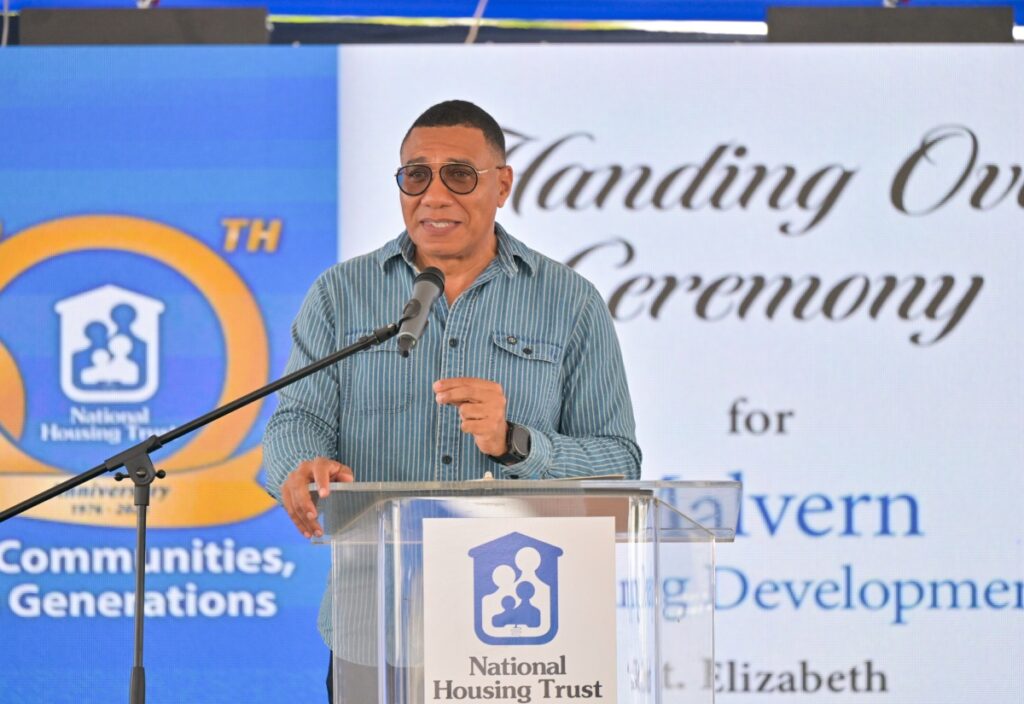
Keynote Address
by
Dr the Most Honourable Andrew Holness ON, PC, MP
Prime Minister of Jamaica
at the
Handing Over Ceremony for Malvern Housing Development
on
June 4, 2026
——————————————————————————————-
Thank you, Dwyane for your usual mastery of the ceremony.
Let me thank Reverend Father Olando Gayle for your thoughtful prayers.
Let me acknowledge Mr Franklin Witter, the Honourable Minister of State in the Ministry of Agriculture and Member of Parliament for this fortunate constituency, and he is joined by Member of Parliament Andrew Morris from the adjoining constituency to give some support.
His Worship the Mayor Councillor Richard Solomon, the Mayor of Black River and he is joined by other members of the municipal corporation.
I see Councillor Simpson and Councillor Holness who is my cousin.
And of course, the National Housing Trust, the team that is always faithfully at these ceremonies. Let me acknowledge your Chairman Mr Linval Freeman and your Managing Director Mr Martin Miller.
Other stakeholders and representatives of the private sector
And let me specially acknowledge the beneficiaries, the persons who will be claiming this land as theirs and building on it. I’m so very much happy for you today.
And you would not mind me making special acknowledgement of the Hampton School. I want to commend them on the choice of entertainment of the song. We’ve been to events like these before, and we have seen cultural items presented, and we clap because we want to encourage our children. We see the effort that they made, but in the back of our minds, we wonder whether or not it was appropriate for the event. It met the standards that we all want to maintain, but this time, I can say genuinely from observation, the audience was satisfied that the selection was appropriate and delivered at the highest standard.
I’m pleased to be here in Malvern, St Elizabeth, for the handover of these serviced lots by the National Housing Trust. Today we handover land, but we are also handing over a foundation for families to build, to settle, and to grow on. A serviced lot is more than a plot of land. It gives a family a legacy to call their own. It gives them roads, drainage, electricity, streetlights, and the confidence that their investment is being made on proper ground, in a planned community with the basic infrastructure already in place. When a family begins to build here, they are not building into uncertainty, they are building into order.
For many Jamaicans, owning a home begins with owning land. It begins with a piece of Jamaica that they can call theirs, a place to build slowly. Some will build quickly, but whatever you do, build carefully and always build within your means. I’m surveying the audience to see the reactions of those who will be owning land here. Whatever you do, build within your means.
This is how wealth is built in real life; one lot, one title, one foundation, one family at a time. The Malvern subdivision is located about 15 kilometres southwest of Santa Cruz. It was originally developed by the Jamaica Teacher’s Association, and I see some representatives of the JTA here. I have a very long and strong relationship with the JTA. They are my good friends. This was originally developed by the Jamaica Teachers Association Housing Cooperative Limited and comprised at the time 108 residential lots. After the National Housing Trust assessed the infrastructure, it found that more work was needed to make the development suitable. The Trust then assumed responsibility for completing the infrastructure works, along with the 30 residential lots that remained available at the time.
After further assessment, the NHT reduced the number of serviceable lots from 30 to 27 because three lots had serious flooding concerns. Now, that was a responsible decision. Sometimes we see developments where the developers are well aware that there are concerns with the lots, and they still sell them, but you will not have that happen with the NHT because the NHT is a responsible developer and in an event it will come back to cost them because the NHT can’t run.
The NHT is always there so they have to make wise decisions, and so whilst there would be significant reason to make the three lots available, once we make a proper assessment that these lots will not serve the people who buy them, we’re not going to put them up for sale and so I want to commend the NHT for that. We cannot build housing policy on wishful thinking. We must build on sound assessment, proper engineering, and respect for risk. If land is likely to flood, we must say so. If a lot is unsuitable, we must accept that evidence. Families should never be encouraged to put their life savings into a place that may later be exposed to loss, damage, or distress.
Today’s handover is also a statement about standards. The works completed here include paved roadways with curbs, street names and traffic signs, storm water drainage systems, electrical distribution infrastructure, and streetlights. Martin, there’s no pool, no gym, no jogging trails, we’ll have to talk about that with the new homeowners. Obviously, these days, the recreation areas and jogging trails are becoming almost standard features for housing developments.
The development cost just over $100 million and that investment is visible on the ground beneath our feet. I want to recognize the project team, which would include the Rural Water Supply Limited, which provided pre-contract civil engineering support, Donovan Simpson & Associates Limited, they were the land surveyors, the NHT project management team, the NHT engineering and contract monitoring department, and the contractors who brought this development to completion. The public sees the ceremony, but the team lived through the long road that made this possible. The surveys, the approvals, the procurement, the supervision, the corrective decisions, and the follow through; that work deserves acknowledgement.
Now, to the selected beneficiaries, I offer my congratulations. Of the 27 service lots, one was reserved for special groups under the NHT’s Special Benefits Order, and 26 eligible contributors were selected. Almost 70% of those selected are women. Women in Jamaica frequently carry the daily weight of holding families together, planning for children, managing household costs, sustaining long-term goals even when resources are stretched. Housing gives that discipline somewhere to land. It converts quiet, consistent effort into lasting assets. It is fitting that this scheme reflects that reality in its beneficiary profile.
Now, the income profile of the beneficiaries also tell an important story. Five selectees qualified at 0%, and this is a point that I need to emphasize that the benefit of the NHT comes, yes, from its undertaking to develop land, it comes from the provision of a mortgage, but the more long-lasting effect is it allows persons who qualify to access a mortgage at 0%. That’s a huge subsidy. Five persons of the 26 will have a mortgage 0%. Five qualified at 2% and twelve qualified at 4%, and four qualified at 5%.
The benefit of the NHT, it’s huge when you compare it to commercial mortgage rates. That means that the majority of beneficiaries are receiving support at rates designed to keep the cost of ownership within reach, and that is what the NHT was created to do. It must serve contributors. It must help working Jamaicans move from rent to ownership, from uncertainty to stability, from aspiration to possession, and it must keep doing that, especially in rural Jamaica, in towns, in farming communities, in growing centres, and in places like beautifully cool Malvern.
Most of the selectees are between 41 and 60 years old. I’m looking at the selectees, and I couldn’t tell. They all look very young. Some may have wondered if this day would ever come, some have waited their entire life for this day, but today, your dreams are coming true. Important to note that four of the new landowners are between 19 and 35 and the beneficiaries, the occupants now represent Jamaica. They represent in terms of the livelihoods and professions. They are accounting, administration, clerical workers, teaching obviously, security, health, safety, housekeeping, childcare, and other forms of service. These are people who work, who contribute, and who are now getting their chance to own a piece of Jamaica.
St Elizabeth has long had a strong relationship with the National Housing Trust. Since its inception, the trust has delivered approximately 1,019 housing solutions in this parish across communities such as Elim, Lower Works, Rahime, Santa Cruz, New Market, Glencoe, Bellevue, Phoenix Park, Gays Land, Meadows, Appleton, Leeds, Balaclava, Balaclava Heights, and Brampton Manor, and that record will grow.
The NHT’s current housing plan for St Elizabeth includes six projects, including Malvern to be completed by 2031. Together, they are expected to bring approximately 1,993 housing solutions to the parish, and these include Friendship Oaks 1 with 256 serviced lots, Friendship Oaks 2 with 248 one-bedroom units, 59 two-bedroom units, and 443 serviced lots, the Holland Estate with 540 solutions, Luana with 360, and Kensington with 60. This handover is part of a larger programme of delivery in St Elizabeth.
Housing policy must do more than count units. It must create communities that last. It must support families who want to build steadily. It must give rural parishes a fair share of national investment, and it must connect housing with roads, drainage, water, electricity, safety, and access to services. The NHT has also been upgrading housing schemes. Under their scheme upgrade programme, 109 housing schemes have been identified across the country, and 60 have been rehabilitated so far.
In St Elizabeth, three housing schemes have reached practical completion with expenditure of 83 million Jamaican dollars. Lewisville in New Market received road rehabilitation works. Lower Works and Jerusalem also received road rehabilitation and general rehabilitation works, particularly to their drains. This work matters because communities must never be left to decay after the keys have been handed over. Government must assist in the maintenance, but the citizens, the residents, you who will become new homeowners, sometimes the perspective is, “I’ve paid so much for the house or the land, and once it’s finished, that’s the end of any expenditure on the house.” Nothing lasts forever. Concrete deteriorates as well. The paint will fade and strip. You have to constantly maintain your house in order for it to keep value. I say this again to those of you who will be homeowners here. Your plan must include maintenance of the structure that you build.
As I was driving in, I was very impressed by the community. It’s clear that in its heyday this was one of the top tier areas to live in. You could see the plan for the area, not to mention the lovely vista that you have of the sea, of the plain, and how cool it is, but clearly over time the verges have been left unkept, the fences have fallen down, persons have neglected to maintain their front yards, trees have been allowed to grow and get out of control, and I did pass a garbage collection truck on my way up. It passed me going down, so councillors there seem to be a service here.
I know I’m going to immediately be corrected that it is not adequate, it doesn’t come on time, it doesn’t come frequently. I will accept and appreciate that, but there is a service here, obviously, but it is clear that the level of maintenance of the community space, residents controlling their own waste and managing how it is disposed, it’s not sufficient to move the garbage from your kitchen and throw it on the roadside with no care of whether or not dogs or other animals will come and disturb this garbage and have it strewn and spread all over the place. And then you come out and you drive past it and say, “This is not my problem. This is the NSWMA problem or the parish council problem to come and pick it up.” That mentality must end in Jamaica.
I was expecting a clap of acknowledgement but i understand. I know, and I will never contest, we don’t have enough trucks to collect the garbage. We don’t collect it as frequently as we should. No one disputes that. We’re working towards that. Five years ago, we had 60 trucks. We made an investment to purchase over 100 new trucks, and we’re coming again with another amount so over time, we build it up, but does that mean that when you throw your garbage out, that’s the end of your responsibility?
Have our values as a society deteriorated so that we have become immune to a sense that when we see garbage strewn all around, it has an impact, a negative impact on us to motivate us to the point that we do something about it, or we just leave it there? And that is the concern that as your prime minister I have when we speak about the deterioration and degeneration of our values. Cleanliness and good public sanitation, it’s not just a matter for the government, it is a matter for each citizen. And not just in these communities, all across Jamaica we see waste all over. It didn’t just materialize. Somebody threw it there or someone was careless in how they disposed of it.
As you build your community, because this is now a new community with a new culture that can be rooted from the start, you must make a pact to ensure that your community is clean, that the road leading up to your community is clean. Your action, citizens action, the civic action is good and powerful instead of saying, “Why don’t you come and collect my garbage?” We know, we are working on that but let us properly containerize and properly dispose of our garbage.
We’re going to be building many lovely houses here but the beauty of the house, it is not just at your front door and inside, it’s not just the lovely tiles and bathroom fittings and chandeliers that you will have, it’s how the road looks coming into your property, how your verge looks, how your sidewalk looks and so as we celebrate home ownership here today, let us all commit to a new civic standard of personal responsibility in keeping our space clean, and this new community can have that culture rooted. And so I appeal to you, I implore you to consider that as you look towards your new home.
Let me thank you for your attention so far. I have another hour to go. There is a lot of talk about the NHT and the NHT being deprived of resources by virtue of the government extending legislation to have fiscal support for the budget from the NHT and I will repeat the point that I have made over and over again. The government does not take the funds from the NHT lightly. We understand what the resources are dedicated for, and were it not a situation that required it, the government would not have done it. And it is worth noting that the opposition did it and said the same thing, that the situation required it, and the situation does require it.
However, we must be clear that the funds that have been taken from the NHT have not impaired the NHT in its ability to respond and to deliver benefits for the citizens, and I want to make that absolutely clear. During the recovery process from Hurricane Melissa, the NHT has already processed and distributed over 5,078 home grants, that’s about 1.974 billion Jamaican dollars, each grant about 500,000 Jamaican dollars. One of the things I find very amusing as a politician is that if you could give 95 persons something, they could get a grant or get access to something, the 95 would say nothing, but the five who didn’t get will be louder than the 95 who got and so the impression would always be given that nothing was done.
I’m sure you have not seen one homeowner who has got the grant come out and say, “I have gotten the grant.” You’re not going to hear that, but I’m certain that you have heard people say they haven’t got the grant. The latest one that I have seen is someone saying, “Yes, I got the grant, but by the time they take GCT out of it and I have to pay transportation… I guess it is what it is.
It should be in the public domain that not just what the government has spent, which is almost over $60 billion already. The NHT has spent almost $2 billion on grants. The NHT gave six months moratorium on mortgage for 36,000 mortgagers in the affected areas; that’s huge. They didn’t have to pay a mortgage for six months, and I was just told that the NHT has waived the peril insurance premium that would be attached to the mortgage for the period of the six months. That’s huge again, but you’re not going to hear that. Nobody is going to make a TikTok video saying, “Thank you, NHT,” or “Thank you, Government of Jamaica.” You won’t hear that so that is why we have to have these ceremonies to put the information in the public domain so the public discourse can be balanced.
The NHT provided 213 special loans to persons who wanted to change their zinc roofs to slab roofs, and that was in the amount of 669 million Jamaican dollars; significant. The NHT has processed so far 3,835 insurance claims totalling 7 billion Jamaican dollars in claims. Of course, there is a deductible excess so even though the claim is for 7 billion dollars, there is a part of it that the insured will have to stand, and so you may end up paying somewhere maybe about 6 billion dollars or so in that region. The NHT has paid out of that claim 2.85 billion Jamaican dollars.
Now, they don’t make the payment all at once. The payment is staged, so effectively they have paid out almost half of the insurance claims, and I think this is a point that we should pause at because the NHT is a very good example of an entity acting swiftly. Insurance claims aren’t processed that quickly, but the NHT has done a very good job, and I want to point that out to the country and to challenge the private insurers for which claims have been made on them, and for which I have had many letters and people writing to me to say, “My insurers, they have come, they have assessed, but I can’t hear anything. Nothing has been paid to me yet. I’m still in the negotiation.” I believe that they should pay you very quickly. Paying up the insurance coverage, paying up the insurance is critical to the national recovery, so I want to commend the NHT for being quick in making the insurance payments, and I want to challenge the private insurers to speed up the payments on the claims. That is an important part of the recovery from Hurricane Melissa.
Another contribution of the NHT to the recovery is that NHT has spent over US$29 million to purchase 2,500 semi-permanent modular housing solutions. Yes, 1,200 of these housing solutions are already on the island, 300 will be here by Friday, and the remaining 1000 we expect to be here by July. These units will form the basis of the government’s response for persons who must be relocated from areas that have been significantly damaged or for persons who have lost everything and are not able to rebuild.
The NHT has identified five clusters, five areas in which these units will be deployed, and units that have to be deployed randomly across the island, those will be done through the Ministry of Economic Growth and Infrastructure Development. The NHT is also making a contribution to the building of the bases on which these semi-permanent modular housing solutions will be put. And I want to state it here; there was some concern that the Government of Jamaica did not spend $1.4 billion that was gifted to it.
Now, any accountant, anyone who understands finance will immediately look at that and say, funds are fungible so that shouldn’t be an issue in the public domain, but we make an issue of it. The government may not have used that $1.4 billion, but it spent almost $67 billion on all the things that people needed. We took a decision that the resources that were contributed would be matched with needs that are tangible, visible, traceable, meaningful, and lasting. We make no excuse for that, and that is what distinguishes my administration from administrations of the past. We make wise financial decisions.
Any donor who has contributed to the hurricane relief in Jamaica would be proud to see these homes being erected and the bases being pointed to. It’s quite different from saying, “Well, all of it was used to buy food” or given as a grant where nobody’s going to come up front and say, “I got it.” There is no testimonial. The house that is erected, it is there, it is visible, and it is very important that we do it because there are persons who are vested in trying to paint the administration in some way that the resources that were donated would not be used. Well, there you have it, the resources are accounted for, the resources are there, and you will see what the resources were used for. I thought I would use this opportunity to point that out.
These 2500 units will be deployed heavily, most of it, I think, based upon the needs. A large part of it will be deployed right here in St Elizabeth. Your brothers and sisters who are on the coast in Parottee, an area that was badly damaged which I toured, which is quite clear that the cost of reconstruction there would be quite higher than the houses that you’re trying to save so we have already indicated to the people of Parottee that that area has to be relocated, and we will do it in such a way that their livelihood will be preserved, the value of their asset will be preserved, but most importantly, their dignity will be preserved.
It’s not going to be an overnight process. It will be a process that involves them at every step. They can be assured of what we are doing. And so, the NHT, the UDC, the municipal authority, all of them will be working together and in this relocation, NaRRA will play a critical coordinating role in ensuring that everybody’s working on the same script and everybody’s working quickly to ensure that the people who have been dislocated will get the benefits. Some of these housing units will also go to the shelter in providing housing solutions for those persons who were in the shelter in Petersfield and so again, the NHT ought to be given some credit for supporting that relief effort of those citizens who were in the shelter for this very long time. Bases have already started to be constructed, and the houses will be deployed there. The NHT has also identified some clusters in Westmoreland as well. I believe two clusters, that you will be building houses using this semi-permanent solution.
Finally, the introduction of these housing solutions into Jamaica is going to be carefully studied. We want to see whether or not these solutions can be deployed widely and a financing mechanism can be used for them. I have an inner-city constituency, and I well understand the need for housing. There might be a family of seven, the son grows up, becomes an adult and he wants his own room, he goes and he buys a couple sheet of ply, some two-by-four and some zinc, and he finds a little place, and as we say, he kotch up, and that becomes his home. But multiply this all across Jamaica, and then you begin to see what Jamaica looks like. It’s not aesthetically pleasing, it’s not secure, it’s not resilient, and you can’t really claim to have an asset. But more than that, it can’t be financed. He couldn’t go to a bank and say, “Lend me on this” but if we were to find a building solution that is within the price point of persons who can’t afford some of these other structures, and a financing plan could be put beside it, then we could start to change how Jamaica looks as people begin to seek housing solutions.
We’re going to be studying it very carefully. There are some issues. People have said that when these have been deployed, it creates trailer parks and all kinds of things, but there are other models where they have worked, and we can ensure here that it works so we will be carrying out not just engineering and architectural studies on it, but we are going to look at the sociology of it. How are people’s lives changed, how are people’s behaviour changed by having access to these kinds of housing? We’re going to study it and then see if it can be rapidly deployed.
Ladies and gentlemen, you have been such a wonderful audience. Thank you for listening to the NHT lecture.