
NSWMA Long Service Awards Ceremony
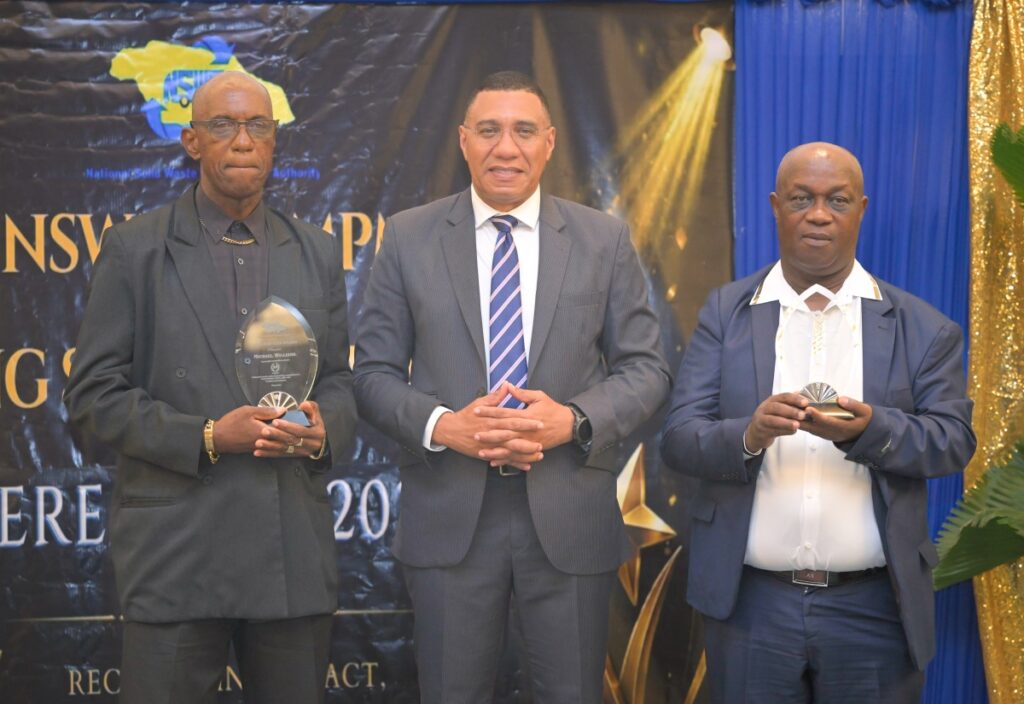
Address
by
Dr the Honourable Andrew Holness ON, PC, MP
Prime Minister of Jamaica
at the
NSWMA Long Service Awards Ceremony
on
June 4, 2026
——————————————————————————————————–
Allow me to acknowledge your minister, the Honourable Desmond McKenzie, Minister of Local Government and Community Development, and other members of the Cabinet who are here.
Let me specially acknowledge as well the Minister of Finance who is here,
Minister Donovan Williams
Mrs Natalie Neita Garvey, Member of Parliament and Spokesperson on Local Government representing the Leader of the Opposition
Mrs Marsha Henry Martin, Permanent Secretary in the Ministry of Local Government and Community Development,
Chairmen of municipal corporations who are here.
I notice the Mayor of Kingston and St Andrew is here, and I also did not see our Minister of State in the Ministry of Foreign Affairs, the Honourable Alando Terrelonge. Normally I would be used to you at the head table, sir. I was about to mention that you are in bad company.
And Member of Parliament Damion Crawford.
I’m surprised by the very high level of government representation that has turned up today. I’ve been to other events where I scarcely see any government or opposition representation, but it shows you how important you are, and I take that as a very good sign. It’s good to see all of you here.
Mr Omar Sweeney, Chairman of the National Solid Waste Management, and other board members who are here.
Mr Audley Gordon, Executive Director of the National Solid Waste Management Authority,
Awardees and other members of staff of the NSWMA and the MPM
Representatives of the media,
Ladies and gentlemen, it is indeed a good evening.
I am pleased to join you for this Long Service Award ceremony. Today, we honour workers who have given 15, 20, 25, and 30 years, and more, to the service of Jamaica. Some of you have spent most of your adult life in this work. You have worked before sunrise. You have worked in the rain, in the dust, in the heat. You have worked during floods, during hurricanes. You have worked through disasters, through difficult years when resources were short, and the recognition was even shorter. You have worked when the country noticed, and you have worked when the country forgot to notice, but I also want to say clearly your government sees you, your Prime Minister sees you, and today, on behalf of every well-thinking Jamaican, I say thank you.
Public sanitation is among the most essential public service in any country. I want to emphasize that word, essential. It is sometimes used casually, but here it is used precisely because if you stop, everything else stops. The markets cannot operate, and the tourists begin to complain, the hospitals face higher burden, and the country smells of neglect.
Public sanitation protects public health. It protects our children, it protects our schools, our homes, our businesses, our tourism product, but most importantly, our national image. A visitor may come to Jamaica for the beach, the music, the food, or the warmth of the people but they will leave with an impression of our country if your work is not effectively done so the work you do has significant national value. It has economic value, it has health value, but it has human value; it speaks to the dignity of the country. That’s what it comes down to, the dignity of us as a people, and that shows how important your work is.
For those receiving awards for fifteen years of service, you are now among the firm foundation of this organization. You have stayed long enough to know the work like the back of your hand. It is now in your bones, as they would say, a part of you. You have seen the pressure, and you haven’t cracked under the demands. The early mornings and the hard days, you are stronger for it.
For those at twenty years, you have given consistent service across seasons, administrations, disasters, and changes in leadership. Institutions survive because people like you keep turning up. To put it this way, if tomorrow all the people who served twenty years or more decided, “I’m not coming to work,” and I’m not encouraging that, the organization would be crippled, and in fact, it would be very difficult to recover because you represent the experience of the organization.
For those at 25 years, you are the experienced leaders. Whether your title says it or not, younger workers learn how you carry yourself. They learn from you. They watch how you solve problems. That is, they watch how you use experience. They watch how you speak to residents. They watch how you treat the equipment, the team, and the task. You are teaching even without knowing it, and that teaching shapes the organization.
And for those at 30 years and beyond, you are institutional pillars. You helped to build the NSWMA to what we know it as today, and in fact, many of you would have started under MPM. Some of you served before the fleet was what it is now, before the systems are what they are now, before the country had a fuller understanding of how central waste management is essential to national life. Your service built this organization.
Long service also tells us something about character. It takes discipline to remain. It takes sacrifice to serve. It takes loyalty to give decades of your labour to work that is demanding and too often underappreciated. Many of you who have families who have also carried the weight of your service. They have adjusted to your hours. They worried when you worked through storms. They understood when duty called so today, I also salute your families. Their support helped to make your service possible.
And the government’s duty is to respect this sacrifice in practical ways, and that is why we continue to support greater stability in the sector. Permanent employment matters. And just before I came up on stage, I sought an update from your executive director, and I asked him how many workers have now formally been made permanent on the staff of the NSWMA and he says, “Well, you know, the commitment is to ensure that all who qualify are made permanent, but up to today, over two thousand employees have been made permanent” so it’s not just talk it’s substance and it is a genuine show of how much we value and respect you. It gives workers a stronger footing. It gives families more certainty. It keeps experienced people inside the system. It builds the capacity of the institution. A country cannot run essential services on uncertainty. The people who keep Jamaica clean deserve dignity in work, they deserve fair treatment, they deserve the chance to plan their lives, support their children, and retire with pride. We have also been working to improve the tools available to the NSWMA.
Over the years, the government has supported fleet expansion, including new compactor trucks, motorcycles for enforcement officers, and pickup vans for fleet and enforcement operations. And after the recent hurricane recovery demands, ten new tipper trucks were provided in December to strengthen emergency response and cleanup capacity. That investment matters because waste management becomes even more urgent after a disaster. Fallen trees, broken furniture, damaged zinc, spoiled goods, blocked gullies, and bulky waste can quickly become a second emergency after the first emergency has passed. Jamaica learned that after Hurricane Melissa.
Recovery is about roofs, it’s about water, electricity, healthcare, and schools, but it is also how quickly we can clean the community and remove debris because it becomes a health risk, and it also blocks connectivity, traps communities, breeds vectors, and therefore a strong health risk. And therefore, what we learned after Hurricane Melissa is that we have to develop the capacity not just to deal with everyday municipal waste, but to deal with the debris that a massive hurricane can generate and we had to deal with it and deal with it very quickly, and I want to commend the NSWMA for how they have managed to remove the debris. And we saw that in operation in Black River specifically, where the entire town and corridor to Black River was cleaned. Again, commendations to you and your team.
The NSWMA sits right at the intersection of national recovery and the hurricane response. In fact, the NSWMA is a first responder to the disaster. As we enter the hurricane season, preparedness must now guide action. This week, the NSWMA launched Operation CALM. Yes, another acronym but acronyms are important to quickly convey a particular strategy or effort. Yes, we are always launching operations to expedite sanitation efforts or to clean. Almost every year we have a bulky waste removal exercise, and I can tell you, being a member of parliament myself that we do a bulky waste exercise in our constituency maybe three times a year and maybe a week after it was done, it is as if it was never done.
You know that we will clean today. We will send out notices that the truck is coming. Residents will put out their bulky waste. We will go through, we’ll clean up, and you feel good, and yes, we have done the cleaning, and then the very next day, on the same road, someone else will come and they will put out a couch, a TV, or they will call you and say, “MP, why you never send the truck?” That time they know the truck came and all, but the strategy is to turn it around on you and then you say to them, “No, but the truck came.” And they say, “But MP, I didn’t see it. Send it again.” You know it because you are the ones we have to call and say, “Go to this housing scheme,” or “Go to this road.”
The NSWMA has launched Operation Calm, an effort aimed at clearing flood-prone communities of bulky and solid waste, advising residents of their responsibilities, using community leadership networks, and maintaining a visible presence in those communities throughout the season. This is born of the learnings; the experience of Hurricane Melissa so let’s not wait until the flood takes the debris and deposits it in the drains and roadways. Let’s try and clear the debris before the floods come.
An important part of the operation is advising residents of their responsibility, so there will be a significant public education campaign attached to Operation Calm. That is the right approach. Preparedness saves lives. A blocked drain can flood a home; a pile of waste can become a hazard; a community that waits until the rain starts has already lost time. So, I urge citizens to work with the NSWMA to put outside the waste from your home in a proper fashion. And I have noticed in almost all communities across Jamaica, from inner-city communities to upscale communities, that somehow the residents feel that once they have taken the waste pass their gate and they have left it in a container or tied in a bag outside their gate, it is no longer their responsibility. It’s the strangest thing.
You will drive through a community, and you will see the most well-appointed house. The best manicured lawns, the well put together buildings but very little attention paid to securing the waste that they have disposed of. It is left at the mercy of stray animals, of the wind, of persons of unsound mind to take that and to have it strewn all over the streets, plastics are allowed to be thrown everywhere; and then, of course, the view is that the NSWMA will come and clean and collect all of this, because that is the role of the sanitation worker. Yes, it is the role of the sanitation worker to clean the streets, pick up the garbage, but it is your civic duty to ensure that your waste is properly bagged and securely contained where it cannot be disturbed and create a further public nuisance or health nuisance.
Now, I already hear the retort, “It’s not my fault the truck didn’t come,” or “It’s not my fault, I did my part. I put out my waste, but the truck took so long to come that the cat got to it”. There has to be a national conversation about how we treat the public space, particularly in how we dispose of our domestic and municipal waste. Yes, without question, government cannot argue the point that we don’t have trucks enough to cover the entire Jamaica. The trucks don’t come on schedule and on time; we can’t argue that point. We don’t have sanitary landfills. We don’t have enough transfer stations; we can’t argue these points, but it is precisely because we don’t have the resources, it is precisely because the government is short on the resources that citizens have to do much better in how they control, contain, and dispose of their waste. It is not therefore an excuse.
There are laws regarding the duties of citizens to properly dispose of their waste. The fines are very low, and there is rarely any enforcement, but as we move into a new dispensation of orderliness in Jamaica, let me assure you that that will have the attention of the government. The strategy for order has never been fully articulated in the way I’m about to do it now, but the first line of effort in the strategy of order is to bring violent crimes under control, and the ultimate violent crime, which is murder, and that strategy has worked very well.
Today, our murder rate is the lowest it has been in over thirty years and we have been doing that for four years now so it’s not a one-off event. It is a strategy executed almost now for a decade, which is bearing fruit That strategy is then followed up by order in public spaces, and the first line of effort in that strategy is to get order in traffic. And we have passed a new Road Traffic Act, and I know there are many complaints about the enforcement of the police, the adjustments that have been made in the ticketing system, and the courts have been far more active in prosecuting road and traffic incidents and we’re seeing good results. We have improved the ability of the police to issue tickets, and they issue hundreds of thousands of tickets per year.
The next line of effort is to address the disposal of waste in public spaces, particularly travel waste. People in moving about their business, how they dispose of the waste. When you’re finished drinking your favourite juice, do you hold the bottle until you see a receptacle, you dispose it there? Or do you immediately just throw it on the ground or throw it through the window of the car? Is it an excuse that there is no receptacle and therefore you have to throw it down anywhere?
We’re going to be tackling this business of travel waste, and the same system that has been developed for ticketing road traffic offenses is going to be the same system with some modifications that will be used to ticket persons who are improperly disposing of their waste in public spaces. I’ve been at these platforms long enough making these controversial statements long enough to know when they are not immediately understood or accepted because in the back of everyone’s mind is, could I be punished? Could I fall victim to this? Does this mean I could get into a confrontation with a policeman because I threw my bottle on the road?
Unfortunately, yes. But it also means that you could now change your behaviour and keep that bottle with you until you have an appropriate place to dispose of the waste. The society can’t improve unless we all agree to change our behaviour, and it is the last thing for me to want to do to stimulate behaviour change by enforcement of some punitive action. We would much rather stimulate behaviour change by reasoning with you, as I’m doing now, pointing out to you that your behaviour is inimical to your own interest, and that if we agree to change the way in which we behave, the quality of life that we experience would improve.
So, I am not here threatening greater penalties; that’s not what I’m doing. What I’m trying to do is to get you to think about how we can achieve the better Jamaica that we all want. Unfortunately, sometimes when we speak about the better Jamaica, it is as if the better Jamaica is going to happen to you by some miracle and not you creating the better Jamaica by changing your action.
I hope I have stimulated some thoughts on that. These things don’t get covered or carried in the media because they’re not controversial maybe enough or newsworthy enough, but these are the important things that should occupy our news space. These are the things that are far more important to the life that we enjoy, the simple thing. Can you imagine if every child, if every taxi operator, if every motorist, every cyclist, everyone in the market were to decide without any form of enforcement that I am not throwing my plastic bottle on the street, I’m going to wait until I find an appropriate place, how much cleaner Jamaica would look without the expenditure of one additional dollar?
The question is, how do we get this done? It has to be public education, and it has to be a bit of enforcement. And there are those who feel it will never happen until they go to other countries and see that other people do this second nature quite naturally, that other people would feel offended if they saw their friend, their neighbour, their relative do that. They would stand up and say, “Don’t do that”. It tells what has happened to our society, that it has become normalized to throw our waste in the public space. It’s no longer an indignation to us and that is what we have to do when we say we need to change the values of the society because it was not always that way in Jamaica. Bits of paper lying on the ground, pick them up, pick them up; that was the basis of it starting in our schools with our children. Our parents couldn’t see us do that and not say anything but now nobody says anything, so we need to get back to that time when cleanliness was seen as next to godliness.
Clean communities require partnership. No agency, however, no matter how well-led they are, can clean a country by itself. Its citizens are important to any effort to clean the country. Public education is therefore an important part of public sanitation. Behaviour matters, awareness matters, enforcement matters as well, and as I said, the law must have teeth because the careless actions of a few cannot continue to endanger whole communities.
So, to the management of the NSWMA and MPM Waste Management, I thank you for the work you are doing to strengthen the organization, support your teams, and improve service delivery. Expectations are high, the public is often impatient, nevertheless, you must continue to raise the standards.
To the awardees, today belongs to you. You are the backbone of public sanitation and public health in Jamaica. You are among the workers who make ordinary life possible. Your work may begin in the streets, but its effects reach the hospitals, the schools, the hotels, the boardrooms, and our churches.
In fact, your work supports the entire economy. I want every awardee here to leave with a full sense of pride. You chose service. You stayed the course. You helped to keep the country clean, safe, and functional. The government will continue to support the NSWMA and its workers. We will continue to support better systems, better tools, and stronger workforce stability, and we will continue to affirm the dignity of your labour because every honest worker who serves Jamaica deserves respect.
Congratulations and thank you.