
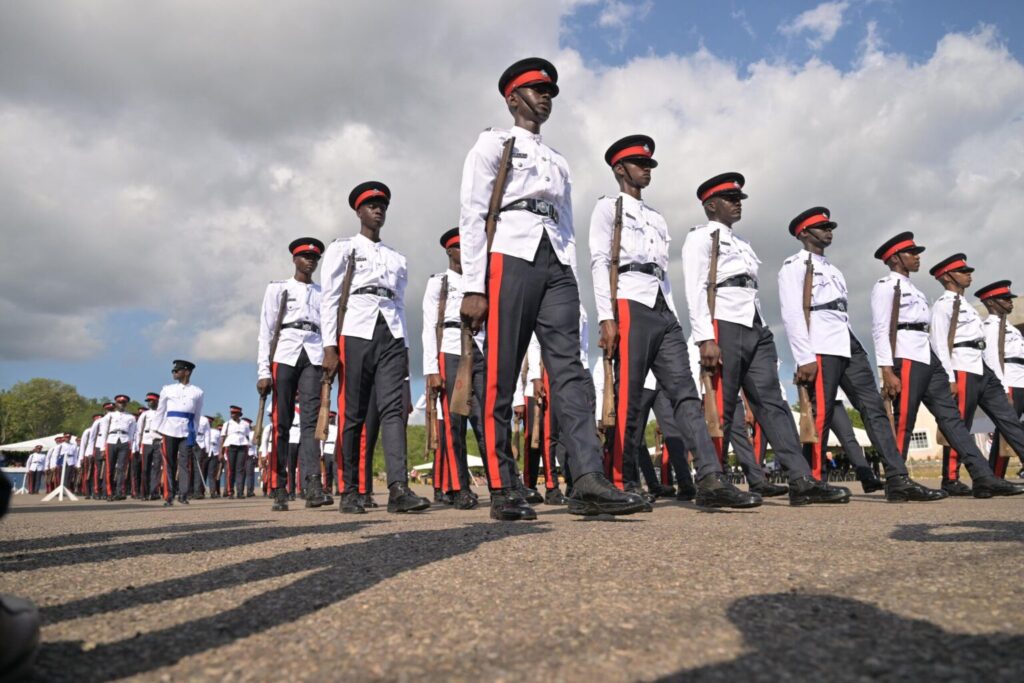
JCF Passing-Out Parade of Batches 161 and 162
Keynote Address
by
Dr the Most Honourable Andrew Holness, ON, PC, MP,
Prime Minister of Jamaica
At the
JCF Passing-Out Parade of Batches 161 and 162
National Police College, Twickenham Park, St Catherine
On
January 21, 2026
———————————————————————
Thank you, Master of Ceremonies,
Detective Sergeant Shermaine Hassock, and Sergeant Selvan Smith and Pastor Dr Gary Buddoo-Fletcher, Force Chaplain for the invocation,
Allow me to acknowledge a long list of officials:
The Honourable Pearnel Charles Jr, Minister of Labour and Social Security,
Dr Kevin Blake, your Commissioner of Police,
Deputy Commissioners of Police, Mr Merrick Watson, Assistant Commissioner of Police in charge of Training and the Director of the National Police College,
Councillor Claude Hamilton, representing the mayor of Spanish Town,
The Honourable Icylin Golding, Custos Rotulorum of St Catherine,
Officers and other members of the Jamaica Constabulary Force,
Members of private and public sector entities,
And of course, graduates of Batch 161 and 162, and your families and well-wishers gathered,
Representatives of the media,
Ladies and gentlemen,
Today marks a milestone not only in your lives but in the life of our nation. You stand there at attention in uniform as the newest ambassadors of law order and public trust. You have chosen a path that demands courage, discipline, integrity, and service above self. It is a noble commitment and Jamaica thanks you. Your graduation comes at a pivotal moment. It is no secret that Jamaica has had its security challenges, violence, organized criminal networks, cybercrime, and general public disorder now compounded by the demands of post-disaster recovery, but we are not the Jamaica of old. And that is not just because we have achieved such a sustained and significant reduction in violence over recent years, it is because we have invested heavily in you the members of the JCF.
Underlying that success is a deeper truth that the state, especially its institutions, have become stronger, more disciplined, more united in purpose, and with a clear determination to build a safe and secure society. Every institution in Jamaica and indeed exemplified by the JCF is going through a process of reform. I use a better word, e-very institution in Jamaica is going through a process of transformation. Indeed, Jamaica exemplified once again by the JCF is modernizing, and the JCF stands at the centre of this national transformation.
A modern Jamaica requires a modern constabulary. That is why your training has been different from any generation before you. You represent a new standard, one that embraces innovation, embraces technology, and embraces the principle that policing is not only about enforcing the law, it is about earning legitimacy, honouring rights, solving problems, and earning the trust of every community in which you will serve. You are only the second cohort trained under the new competency-based training curriculum, a major reform that shifts policing from a larger technical craft to a fully professionalized discipline. The curriculum is student cantered and built around the competence required of an officer in a modern democracy, critical thinking, conflict deescalation, ethical reasoning, human rights, community partnership, and intelligent use of digital tools.
Policing today cannot rely solely on command presence or traditional tactics. It demands nuanced situational analysis. It demands that officers ask not only what is the problem, but they should also ask, why is the problem happening here to these people under these circumstances, these conditions, and they should be proactive demonstrating leadership in asking, and how do we fix it together. These are the questions, the leadership, the principles that we expect from our modern police institution.
You have been trained to think, to assess, to analyze, to innovate, and to adapt. You have been equipped with the skills required to manage the complexities of 21st Century law enforce. You have also been exposed to blending learning models that use digital tools, scenario-based simulations, online modules, and interactive teaching techniques. This supports the JCF strategic priority of improving efficiency through technology.
Technology is no longer an optional tool in policing, it is fundamental to crime fighting, intelligence gathering, and community engagement. You are entering a force where Jamaica Eye Analytics, body worn cameras, and I want to emphasize here that the JCF embraces wholeheartedly the use of body worn cameras. The leadership of the JCF has been very proactive in securing the best technological platform and ecosystem to support the full deployment of body-worn cameras, but the JCF, like all other public bodies are subject to the rules and regulations that guide how we procure this well needed equipment and so they have already secured by my last check, a thousand or so cameras and others are in procurement.
The government will supply the necessary budget to ensure that all formations that require the use of body-worn cameras are so equipped. So, I make this announcement here in the hopes that the public concerns that have been expressed in various media and in various quarters can be allayed. It is the intention of the government to provide the security forces with all equipment that they need to ensure that their policing is transparent and that there is a process of capturing data, capturing their interaction to make it evidentiary and to make it prosecutable so that we can ensure that there is confidence and trust in the actions of the police.
Technology, as I was saying, is no longer optional. It is fundamental and that is why we are investing in Jamaica Eye, we are investing in body-worn cameras, we are investing in equipment to assist the police in digital case management, and we are using data to drive intelligence based policing and this will include the acquisition of several C5 centres, one of which we are well down the road to installing and implementing in our police force. Once that is installed, the C5 centre, you will see even greater reduction, but more than that, sustainable reduction in crime. So, I want it to be clear that yes, we have invested heavily in training and doctrine, management and administration, but we are also investing heavily in technology to make sure that we have a 21st century policing force.
Technology is a force multiplier, but what drives the direction of the force is our values. You were trained with an intentional emphasis on human rights and respecting our constitution in policing. This is not an abstract concept. It is the foundation of legitimate authority. Every Jamaican, rich or poor, powerful or vulnerable, deserves to be treated with dignity and as your prime minister, I demand that every one of you here who will wear the uniform and ascribe unto yourself the authority of the state as an officer of the law, that you must treat every Jamaican with dignity and respect for their rights.
A modern police force embodies restraint where necessary, empathy where appropriate, firmness when essential, and fairness at all times. You must protect life, property, and liberty, and you must do so with equal vigilance for all. A Jamaica that is safe but unjust is not the Jamaica we seek, and justice without security cannot flourish. You are therefore entrusted to hold the balance.
As you go out to serve the public, remember, it is not the gun that you will carry, it is not the technology that you have, it is not the uniform that you have that gives you the authority, it is the values that you embody and represent. And the people, when you go amongst them in your communities, they will be able to determine, they will know whether you come carrying the principles and the values that you have gotten in your training or is it that you come to gain respect by fear.
I appeal to all the graduates here today and to serving officers that while we are experiencing significant reduction in crime, we must move to a new phase in our development, and that is the phase of sustained peace, where you get compliance without the need to use force. You get compliance because your force, your organization of resources is respected, not from fear, but because the values and principles that you espouse are trusted and clearly seen by the citizens.
Today, you will receive diplomas in general policing. After you successfully complete your probationary phase, you will earn associate degrees reflecting the professionalization of policing in Jamaica, recognizing that modern officers are trained, educated, and held to high academic standards. I keep saying that the JCF of today is not the JCF of 10, 15, 20 years ago. The JCF of today is a spectacular, phenomenal, well-trained organization in which every Jamaican can be proud. The JCF of today is an intelligent organization and as you come into the ranks of this transformed institution, you must come in with a mindset of building the organization, improving the organization, deepening the organization.
As I inspected you, as I inspected your ranks, I took the time to stop and speak to a few of the graduates, and I asked a standard question, what were you doing before you joined the JCF and why did you join the JCF. I’m sure that they did not know I was going to ask these questions, but they would suspect that the question of this thought would be asked and so they were drilled and they would say, “Good afternoon, prime minister. Officer 2614. I joined the JCF because I wanted to serve my country and make a difference.” I agree with you. I appreciate that. It is the right answer to give, but I also appreciated the young lady who said I joined the JCF because I wanted to set an example for my child because ultimately that’s what it comes down to. It is every officer recognizing that they have a duty to their family, to their country, and to the community to be an example.
I also appreciated the young man who said that before he joined the JCF he was a farmer, but while he appreciated farming, he wanted to do something else with his life and he found that the JCF was the right institution for him. And I also appreciated the youngster who told me that he was at home for a few years and then he decided to join the JCF and I further inquired of him and he said, Prime Minister, my father was a policeman, my uncle is a policeman, and my brother is a policeman so he’s continuing the tradition of law enforcement in his family.
Gathered here today are representatives of every aspect of Jamaica, of communities in Jamaica, of experiences in Jamaica; you are Jamaicans and you are in a position of leadership. Do not let down your family. Do not let down your community. Do not let down your country. The uniform you wear represents authority over 150 years of history; the country cannot be transformed without a strong police force. And I stand here today to say, yes, you are ambassadors for the new Jamaica. Wear your uniform proudly, embody the values and principles that you were taught. We are depending on you; we are relying on you.
I want to highlight something else that distinguishes batches 161 and 162, your work in community-based projects. The JCF’s philosophy of community-based policing is not a slogan. It is a strategic commitment to be present, accessible, helpful, and trusted. Crime is not only solved by law enforcement alone. It is reduced when residents become partners, when young people see officers as role models rather than threats, and when communities believe that justice will be served fairly and promptly.
Policing is at its core a people centred service. Society does not fear officers who stand with them. Communities do not turn away from institutions that treat them with respect and criminals lose power when citizens trust the police more than the fear retaliation. Your effectiveness will depend as much on your character as on your competence, not just your tactical skills, but on your ability to build effective relationships with the people you serve in the communities you serve. The Jamaica you enter today is rebuilding, but we are rebuilding stronger, and you are a part of that strength. The safety of our disaster affected communities depends on your professionalism, your vigilance, and your willingness to serve with compassion during the long and difficult months of recovery.
As I read that line, I reflected on one of your officers in the day after the passage of Hurricane Melissa, and his men and women serving with him, cut off from all communications, no electricity, their station damaged, the entire community destroyed and flooded out, but no one abandoned their post. They were there wading through the water coming to meet me at the helicopter, still maintaining law and order, providing shelter in the police station with everyone else. There was no electricity at night, but they were still there policing. They were not fighting crime, they were keeping a community safe, and that is what it means to be an officer of the law, to be a first responder, to be first in the line of any threats to protect and to serve. And I’m sure the nation, based upon all that I have seen, is grateful to the JCF for how they operated during the passage and the months after the passage of Hurricane Melissa. The JCF is to be credited, and you are not permitted to laugh, including the commissioner walking around with his ache pretending to cut pathways through. You are not permitted to laugh, including the commissioner who was there on the first day after clearing pathways and leading his men to create access.
As you take your place in divisions across the island, you will meet different realities. Some communities remain deeply affected by the legacy of crime and gang violence. Some areas experience high levels of social distrust. Others rely on the police as the only steady institution in their lives. Your uniform gives legal authority, but only by your conduct will you earn moral authority. In every interaction, you must respect the law you enforce, you must model the discipline you expect of others, you must reject corruption in all forms, and you must represent the JCF with honour. People must see integrity reflected in your choices. Jamaica does not need officers who follow the crowd. It needs officers who lead quietly, consistently, and by example.
There is a lot coded in this line, and I think I will indulge myself to give even further elucidation. There may be certain values in the society, certain expectations of our officers to behave in particular ways, and while it may actually be happening and we see these things in front of us on a daily basis, these are not the principles and values to which the JCF aspires. And officers, regardless of what the common knowledge is and the common understanding is, and the common behaviour is, and the common expectations are, you must always aspire to the highest standards in particular when you wear your uniform. When you wear your uniform, you must act according to the values and principles of the uniform no matter what is popular, no matter what is going to get your likes, no matter what other people think. You represent an institution that has values that it is placing before the public. It may not meet them all the time, but it must continue to aspire to them, and you must not undermine it regardless of how people think it is popular.
Graduates today is a beginning, not an end. The oath you take will follow you into every station, every patrol, every investigation, and every community action. You have joined a vocation, a calling to protect the innocent, uphold the law, resist wrongdoing, and advance justice. The measure of your career will not be the rank you attain, but the lives you protect, the conflict you diffuse, the trust you build, and the communities that thrive because you stood your ground.
As you march pass today, I saw the pride in your faces and a lot of sweat, but I saw the pride. You represent a force moving towards excellent. You represent a country determined to become safer, stronger, and more resilient, and you represent the hope for the future where Jamaica’s children can grow up free from fear.
On behalf of the Government of Jamaica and the people of Jamaica, congratulations. Serve with honour, serve with discipline, serve with courage, and serve with unwavering commitment to making Jamaica the safe, secure, and just society that our people deserve.
May God bless you and may God bless the Jamaica Constabulary force.