
NSHP Handing Over Ceremony- The Brook, Stony Hill
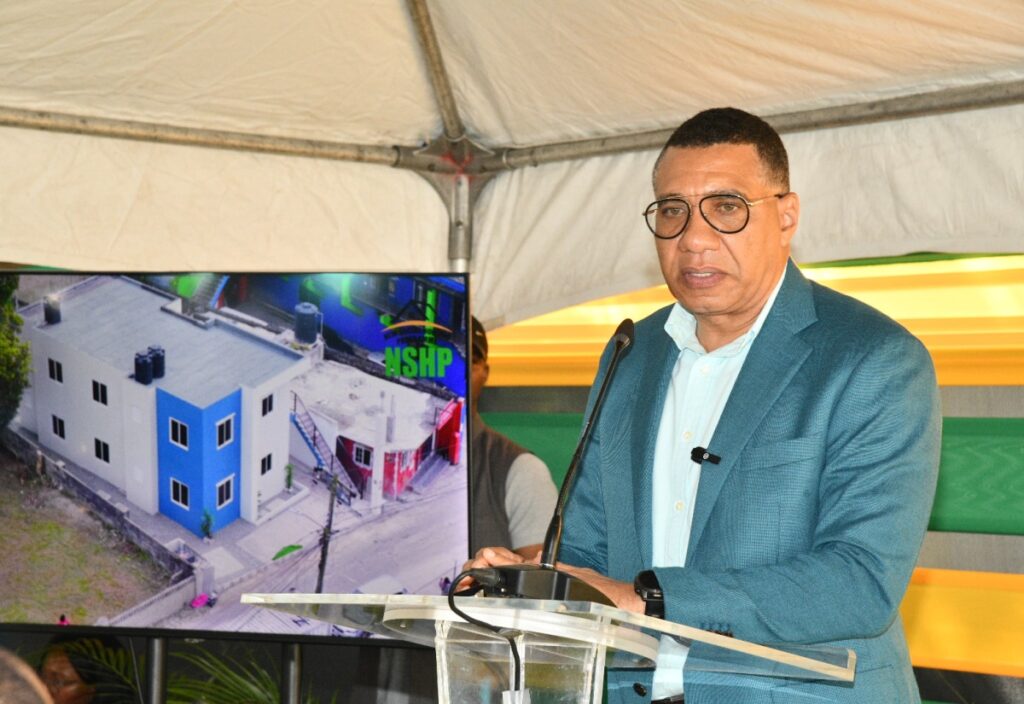
Keynote Address
by
Dr the Most Honourable Andrew Holness, ON, PC, MP,
Prime Minister of Jamaica
at the
NSHP Handing Over Ceremony- The Brook, Stony Hill
on
January 30, 2026
———————————————————————————–
Representatives from the Ministry of Economic Growth and Infrastructure Development,
Representatives from the police,
Representatives from the media,
And of course, you, the wonderful people of Brooks Level Road in West Rural St Andrew, in the lovely town of Stony Hill and Seaview Road
And I have to also acknowledge the beneficiaries of these lovely multifamily homes that have been constructed here.
Now, just to give some context. This is being done under a programme called the New Social Housing Programme. And what is social housing?
Social housing is the provision of housing solutions by the government to worthy beneficiaries, either partially subsidised or fully subsidized. And what do we mean by subsidy? It means that the beneficiary gets the benefit, which is the house, for a price that is not fully the cost of the house, or they pay nothing for the cost of the house. It doesn’t mean that the house is free. Somebody pays for it. Who pays for it? Everybody pays for it. It’s your tax that pays for the house so then why should somebody get it at half price or no cost at all? They get it because when you pay your taxes, you are saying the government must provide services with the taxes, and some of these services that are provided would be your garbage collection.
Now, this raises a controversial issue, which I’m going to just tease it. How is garbage collection paid for? It’s almost directly connected to your property tax, but if somebody doesn’t pay the property tax, the garbage shouldn’t be collected? Think about it. But because there is a social issue there, that if you leave the garbage uncollected, you’re going to have a health problem, so really, everybody should pay their property taxes so that the garbage can be collected, but are you not going to collect the garbage for the people who don’t pay because you’re going to have a social issue? It’s called a public good. So too, families who have nowhere to live, elderly people who have nowhere to live, because they can’t afford a house, means they shouldn’t get it?
That is why it’s called social housing. It is the social consciousness of the people that sets a standard of what nobody should live below, that says we should use our taxes to maintain that standard for everybody. Now, this is called an aspiration, meaning something that we all want to do, but we don’t always do it because there are a lot of people still in Jamaica who want to get a house, they can’t afford it, and there are still many places where we are not able to collect the garbage efficiently, but we are aspiring to do this.
We’re putting the programmes in place. We use your taxes to buy more garbage trucks, to build more houses. We’re not doing it at the pace that you would like, not because of negligence, inefficiency, or corruption. Clearly, there are those issues involved, but the real issue is that our economy isn’t growing as fast so that we are getting the level of taxes that can deliver the level of social services that match our aspirations, what we would like to see, our ambitions as a people, but it doesn’t mean that nothing is happening.
And so, for many Jamaicans looking on, it is a matter of perception versus perspective. They look at the cup with the water in it, and for some, they look at the cup, and they say the cup is half empty, and for others, they will say the cup is half full, but it all depends on where you are casting your eyes. If you are looking to the bottom of the glass, then it is half empty, but if your eyes are cast up and you’re looking to the top to aspire to the top, then the cup is half full, and the outlook determines your destination because if you are focused down and looking down, that’s where you’re heading. If you are looking up, that’s where you’re heading, and that is the contention in the country. Some people have a very negative view, and that’s where they’re heading. Others have a very positive view, and that’s where they’re heading.
So, I say to all Jamaicans, things may not be what we want them to be, but what you have to judge is the direction of travel, and on all metrics of how the country is performing, we are heading in the right direction. We are heading up, we are matching our efforts to our aspirations, and it is very important that the national mood remains positive, because people say almost every speech I give, I talk about the economy as if I don’t pay attention to the emotional things, the social things, the spiritual things. Of course, I pay attention to all of that, but there are some people who feel that the economy is just a cold, hard place that doesn’t care about them and that they’re not a part of it, not true.
The economy involves everybody. Everybody here is a part of it, and how you think, how you act as economic agents, determines the economic outlook and outcome. If you are positive, if you’re innovative, if you’re law-abiding, if you’re caring, then you will have a growing economy that caters for all the people that’s productive, and that’s what we want to do.
The New Social Housing Programme is designed to focus on those persons in our society who don’t have any income, so they wouldn’t be able to afford a mortgage to purchase a house. They are elderly, some people are retired, they used to do domestic work, they don’t have any pension to get. Maybe they paid some NIS, so they get a little something every month. Now, we have put in a programme called the Social Pension Programme, where if you weren’t working and you didn’t contribute to NIS, you get a little something each month. It may not be a lot, but from zero to one, it is a lot of percentage increase. Half empty or half full?
The programme is designed to focus on those people, pregnant and lactating mothers who have nowhere to live. In this specific case, we also focus on persons who are homeless because of either some environmental issues, the flood came and wash out the house or the gully bank- which nobody should be living on any gully bank, collapsed and the house gone, or in this case, the house was destroyed by fire.
There are three families I gather who were made homeless. They lived here where we are and their house was destroyed by fire, I believe, in 2023, and many of them had to live in the destroyed premises. It must have been a harrowing experience for them. Your Member of Parliament would’ve seen the situation, and she would have applied to the New Social Housing Programme.
Now, what the programme does, the programme has to first justify that the people who are benefiting from the house now actually deserve the benefit because you have some people, they’re not needy, they’re just greedy, and they will do everything to pretend that they are needy, but they don’t really need it, they’re just greedy so the programme has a very robust system of beneficiary identification. They go through and they do what is called a social investigation. They go to the communities, they talk to the community members, and then say, is it really true that this person has no income, they’re not working, they are shut in, they can’t afford a house, they check that there really was a fire that burned down the house, and it’s that somebody burned down the house to get a house.
You understand why we have to check? Because it’s your taxpayer money, and because you have a conscience that say people should be living in a minimum standard, and so we have to make sure that the circumstances match what you would consider as a legitimate cause. And once we establish that, then the second thing we have to establish is where can we build the house. Now, this programme does not have land. What we do, which distinguishes us from the NHT or the HAJ or any other arm of government that is building houses, we have no land and I want that to be clear, and so when we build anything on land that doesn’t belong to us, what we build doesn’t belong to us, doesn’t belong to the government. It belongs to the people who own the land. Do you remember that lie that they were telling about the government is going to take your land? Bwoy di dem people lie eee sah? But a lot of people don’t understand, and that is why I have to take my time and go into the details and explain because ignorance is wicked out there. People just hear things and run with it and don’t stop two minutes to just check it out. We don’t have any land in the programme so the land that we are building on here don’t belong to the government.
Another issue now, before we can build, we have to check out who owned the land because the government can’t just a build on people land without permission. If the beneficiary doesn’t own the land, then we say to the beneficiary go and get permission. In these circumstances where it is a tenement yard situation, as we say in Jamaica, there are three families, 12 individuals living on the small plot of land. I am not aware of the circumstances if one of the families own the land or they got permission or somebody owned it passed away, and they were living there and they’ve been just living there for years. I don’t know what the circumstances is but what I do know is that we are not going to put one block on the land until we have something in writing that we can carry to court that protects the interest of the beneficiary and your money as taxpayers. Can you imagine we build on the land, give it to the beneficiary, and then the owner turns up and say, no this is my land and therefore this lovely house is my house. The person who you as a taxpayer wanted to get the house wouldn’t get it because by law, the house belonged to the person who owned the land so that’s why we go through a very rigorous process, and it sometimes take a long time to ensure that we know who owns the land and there is permission to use the land and permission for the beneficiary to occupy the structure that is placed on the land, and so we would’ve crossed that hurdle.
Now, once we cross that hurdle, then we have to check the land to see that we can actually build on the land because not every piece of land should be built on or can be built on. We have a view in Jamaica that we can build on any piece of land, so people go and build on gully bank, they build in river course, some build in the river itself, some build on slopes like this. We are very skilled engineers when it comes to that, but in today’s world where the weather is becoming more of a factor in human habitation and the safety of human habitation, we cannot continue to just build anywhere and build anyhow.
Nobody can tell me about the need for shelter and for proper housing. I understand that. And what has happened in Jamaica is that the overriding need to find somewhere to live has escalated much faster than the ability of the government to provide affordable opportunities for people to achieve formal housing. Informality has just run wild. What informality does, irregular settlement of land and squatting, is to place a limit on the potential and proper development of your area. I don’t know if you know this, but if you go into a community that has been informally settled, when you go and say I’m ready to formalize and regularize this community, nothing is left for road. No space there for people to have any recreation, no little park can go there. Everybody put their boundary here, houses close beside each other, chaos. You can’t bring water there; it’s a cobweb for electricity wires and then it is a headache.
In other words, what it would cost to have formally laid out this community would be far more to go and regularize the community after it is informally settled. And what we have been doing as an administration is to try to speed up the formal development so that people don’t have to go and settle communities informally and to bring them in at a kind of reasonable price and to provide the social housing for those who just have no opportunity to own a piece of land or a piece of house in Jamaica, that’s what we’ve been working towards.
The New Social Housing Programme has a benefit to it that we don’t speak of too much, but every one of these houses that we have built acts as a symbol, an example of how we should seek to construct housing in communities. Notice, when you drive on this road, the first house you’re going to see is this one. The first house you’re going to look at is that one because it is aesthetically appealing. You don’t have to have rundown house in inner-city or low-income communities. You don’t have to build shacks. You can build things that are pleasing.
Now listen to me, when you put up structures that are aesthetically pleasing, it lifts the area. It lifts how you feel. It lifts how the built environment looks, and you feel better about yourself and your community so I’m certain that a lot of people now are going to be looking at this and say I wonder if I can do something similar, so it begins to improve the standard. Just that one house will begin to improve the standard because every lot on this road could potentially have a structure that look like that. This structure is accommodating all the people who lived there before comfortably. No hurricane can blow that down. That is a strong structure.
What we are doing with the New Social Housing Programme is trying to also lift the standard of housing design and construction for the average person, and we won’t be able to do this all over Jamaica, but we are certainly going to do it as far as we can with as many people as we can. I know there are a lot of people saying when will it be my time, I want one too. I know. The good news is that we’re going to expand the programme. We’re going to build it at scale. We’re going to increase the budget for it. We now have a very good system. We understand how to do it. We have over 80 units now under construction, we’re going to rapidly expand that next year. Over a thousand persons have benefited from this, more than that, but we estimate it according to who we have had as the beneficiaries, but it is probably one of the most successful programmes of government in housing.
This particular house is part of what we call the big yard/ tenement yard upgrading, and we have about seven projects now under the Tenement Yard Programme. This is a small tenement with three. In Downtown Kingston, in Central Kingston, we have a project with 21 families in an area that for many years was neglected and I’m sure when that is open, those 21 families that were living in substandard conditions, they will be happy. I have two in my constituency, they’re going on quite fine, and there is one I believe in Minister Tufton St Catherine West Central, and there’s one going on in East Central. There are a couple others around, and we’re going to be doing more. There will come a time in Jamaica where we improve the housing stock to have every house built solidly properly in a formal structure that you can have a title to your house, that it becomes an asset for your family that you can pass down from generation to generation.
Everyday there is something new and better happening in Jamaica to replace under this government. Every single day, that is replacing what is broken and bad in Jamaica. We need to increase the pace of it for us to transform Jamaica, but I must end my presentation by saying to you, 10 years ago, Jamaica was considered the murder capital of the region. Today, I’m telling you that this month will be the lowest month in murders for several decades. That’s a big transformation. Don’t let anybody tell you nothing, and everybody benefits from peace.
Ten years ago, or more, unemployment was over 13%. Today’s unemployment, the last figure was 3.1%. No doubt after Hurricane Melissa it might have a little bump up, but we’ll get back down again; the people don’t remember that. The debt of the country was way up to almost 151% at one point of GDP. We were almost 60% before Hurricane Melissa. We’re going to bump up a bit, but we’re going to get back down so let’s not say the cup is half empty. Every day, drop by drop, we are filling up our cup and God will continue to bless us and our blessings will overflow.
Give God thanks. Blessings.