
Official Launch of the WIHCON Chester Creek Development
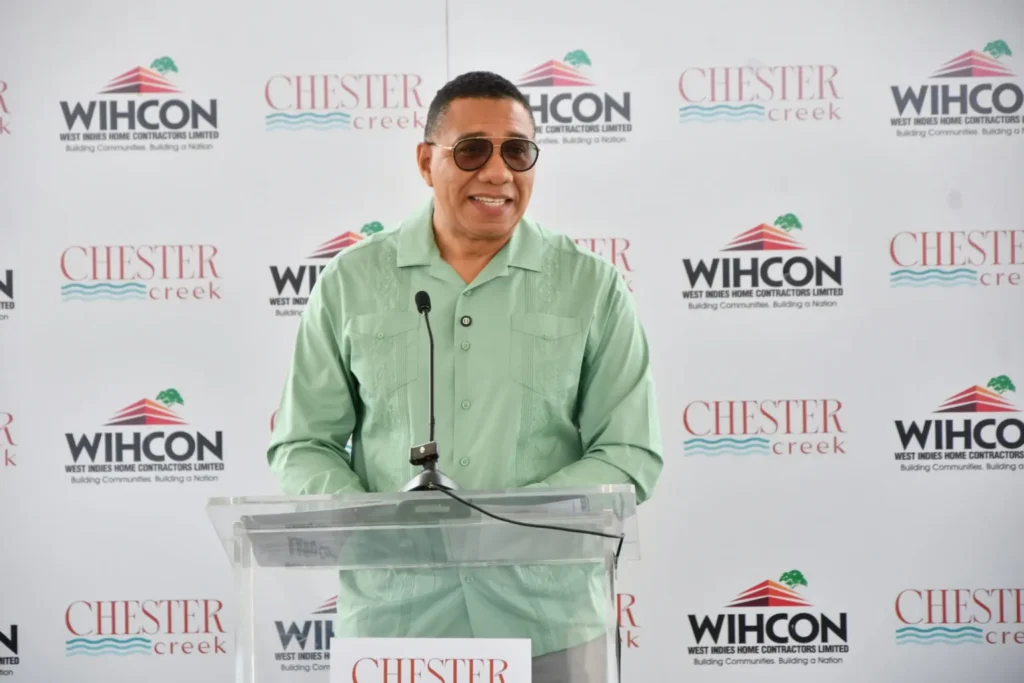
Keynote Address
by
Dr the Most Honourable Andrew Holness ON, PC, MP
Prime Minister of Jamaica
at the
Official Launch of the WIHCON Chester Creek Development
on
March 3, 2026
——————————————————————————
Allow me to establish, again, the formal protocols.
Dr Alfred Dawes, Member of Parliament for Southeastern St Catherine, the area in which this project is undertaken. If I were to make a commentary on Dr Dawes, I always knew he wanted to be in politics and in fact, he could have very well joined me in politics, more anon.
Mr Renair Benjamin, my schoolmate. Was I before you, or were you before me? I was your head boy. St Catherine High School is the largest single-shift school in the English-speaking Caribbean. From that school, there are many, many Jamaicans all over locally and abroad holding all kinds of positions, and they’re doing very well, and so that is my route to commending you, Renair, for doing very well in your role as a councillor.
My friend Joseph Matalon, Chairman of the ICD Group,
And my other friend, Peter Melhado, Chairman of WIHCON and other executive members of WIHCON who are here,
Executives and representatives of the private sector
I see representatives of banks and suppliers in the sector.
Civic stakeholders who are here
Homeowners and members of the community,
Members of the security forces who are here
And members of the media, good afternoon.
I start with an apology for my time of arrival, but I’m certain you all know that my job is one where things just arise, and you have to address them as they do, so thank you for your patience.
Today, we mark an important moment, not only for the families who will soon call Chester Creek home, but for the continuing transformation of Portmore and Jamaica into a modern country with modern residential facilities. This launch reaffirms our national commitment that every Jamaican should have access to safe and modern housing, and that communities can be designed with dignity and opportunity. And I use the term dignity because when you enter this housing development, what strikes you is orderliness; number one, very important, uniformity.
Now, things can be orderly, but not uniform; that’s fine, but we see uniformity here. We also see an opportunity for families to own a piece of Jamaica, but I gather that these houses are also built with the possibility for expansion at the back, so an opportunity to grow families. They are also built with amenities, and I take this opportunity to commend. WIHCON and the ICD Group for being essentially the foundation contractors in this regard.
The WIHCON Group and the ICD Group, long before we had high-rise buildings, long before the causeway was built, they have been building Jamaica as contractors, and so this housing development represents a continuation of this great legacy, this great history of building well-designed homes for Jamaicans. And so I want to recognise the leadership behind the ICD Group and WIHCON. I want to recognise Mr Joe Matalon, Chairman of the ICD Group, and I want to recognise Mr Peter Melhado, Chairman of WIHCON. And I also want to recognise Mr Marvin Campbell, you would say the new generation who is carrying this legacy. And I want to also acknowledge their good corporate spirit because I gather that they’re not only building here and putting in place amenities. Nowadays, when we speak of amenities, that automatically includes a swimming pool, I gather, and a jogging trail, but I also understand that you are repairing or upgrading some courts. I believe it’s a netball court that’s close by next door, and that you have assisted in putting in some traffic signals that have assisted the community greatly; another signal of their good corporate citizenship, which is good.
Chester Creek sits squarely within our national objective to diversify housing supply, create options for young professionals and working families, and to reduce the barriers that prevent first-time homeowners from entering the housing market. Now, I know whenever I speak about housing, it is against the backdrop of Hurricane Melissa. Yes, there are still thousands of Jamaicans who are without proper shelter. They may have their four walls around them, but they don’t have a complete roof on top of those walls.
Whenever I’m on a platform speaking about housing, I have to do this with the sensitivity in mind that there are still thousands of Jamaican families who are without proper shelter at this time, but the launch of Chester Creek takes place against a backdrop, not so much of the destruction of Hurricane Melissa, but more so against the backdrop of a phenomenal recovery from Hurricane Melissa and I’m pleased to report that this recovery has outpaced expectations, indeed outpaced the recovery of our peers who have been hit by similar hurricanes.
For electricity, I can say that we are 98% restored. For water, we are at 97% restored. Agricultural output has rebounded more quickly than anticipated, and perhaps most encouragingly, inflation has come in below what we had anticipated, and this has enabled the Bank of Jamaica to reduce its policy interest rate to 5.5% in February 2026, which is a huge deal. We are at a position where we can officially close the recovery period. You will recall that at the end of January, we closed what was considered the relief phase of the disaster response.
The Cabinet received a report yesterday on the electricity sector and on the water sector, and so I am announcing officially that the government will be closing the recovery phase of the response. And all it means is that the government’s emphasis will now shift to another phase of the response, and that phase is the reconstruction phase. Mind you, all three phases were operating simultaneously, but where the government placed its emphasis would be in the initial weeks after the disaster. It would’ve been on getting relief supplies, humanitarian supplies out to displaced families. Then, after we have closed that, then the effort would be on getting the electricity grid up, the water grid up, students back to school, and hospitals operating; that’s the recovery phase, and so we can say we have successfully closed that phase, and now we are moving into the reconstruction phase.
There is one element of the response which straddles both phases, and that is housing so clearly the restoration of roofs will continue into the reconstruction phase, and that is because we are still distributing the ROOF’s grants, which are having an impact on the housing and roofing and shelter situation, and I’m told that over half a billion dollars of grants have been dispersed nationally. Now, that’s a huge sum, but it is still not sufficient to treat with the entirety of the problem.
I want to use the opportunity to remind those persons who are beneficiaries of the grant to use the grant for the purpose for which it was given. Grants range from JMD$500,000 for persons who have severe damage to JMD$200,000 for persons who have moderate damage, and JMD$75,000 for persons with minor damage. We recognize that in the aftermath of the hurricane, you don’t only need to restore your roof, you might need to replace a bed, you might need to replace a stove, you might need to buy uniform for your kids, and so what we have said is that of the grant amount that is given, you can use up to $75,000 for these general purposes, except for other things like going to the bar or party, or beauty supplies, or these kinds, no. Use it for the things that are important to your recovery. The remainder of what is left should be used exclusively for the restoration of your roof.
I have asked MOCA, and I have tasked the Ministry of Labour and Social Security to do audits of persons who have received the grant to ensure that what they have got the grant for is what they have used it for. This is why we took the time to do an assessment of damage. Assessors were out in the field, they would’ve taken pictures of the houses, they would’ve interviewed the beneficiaries before, and therefore, there is a record, a basis on which we can check and compare. So if you receive the grant and then we come and check and nothing has been done to the roof, then that’s cause for action so I encourage everyone who is receiving the grants to use the grants for the purpose that they are given.
It is a lot of money that the government has taken from the budget. It is your taxpayers’ dollars, and I’m certain you are vested in ensuring that the funds are not wasted. And then there is a huge hue and cry to say we didn’t get anything, or what we get, we have to use it for something else, so we need to make another allocation again. That will not happen because that will throw the country into economic chaos, and that is why we are imploring, urging, encouraging persons who have received the grants to use them for the purpose of recovery. I think I have made the point there, and I should also say, as a side of how the recovery is going smoothly in most instances.
The Bank of Jamaica has also revised its projection for full economic recovery downwards from, I believe it was three to four years, now they’re saying we can recover within two to three years so that shows you how the recovery has been managed, and we hope that the reduction in interest rates will translate into lower rates in the actual retail commercial banking system. I see representatives of banks here, and I want to encourage them to pass on the reduction in the policy rate to the consumers.
Now, I’m aware that whenever I talk about housing, there is usually this issue about the government taking $1.4 billion from the NHT, and sometimes the conversation takes place without context, and sometimes I have to wonder if the people who are speaking about it remember the genesis of it. This is not our doing, and if you look at the history of taking funds from the NHT for other purposes, again, it would not have been of my doing.
Generally, if you are going to take funds from the NHT, it must be for a defensible purpose. And I recall when former Prime Minister PJ Patterson announced the national education programme. It was a major reform programme for education, and it would’ve been funded by taking the seed resources from the NHT. I believe at the time it was something in the region of about $5 billion, sometime in 1994, that this had started, and I remember when these resources were being voted on. There was a huge debate in parliament. At the time, I was the opposition spokesperson on education, and I supported the use of the NHT funds for education. In fact, I shouldn’t say this, but I’ll say it. When the vote came, I abstained because I thought it was important for education transformation to happen. I thought it was a critical national objective because without that, the country would be in a really bad state, and we were in a really bad state when you looked at our literacy rates, our passes at CXC and the effectiveness of education, and so I thought it was defensible to use those resources for education.
Again, when that was done, that huge transfer from the NHT, that wasn’t the JLP government. That was done under the PNP, but it was a defensible position. In 2013, thereabout, I believe, my dates might not be as accurate, but somewhere around that period of time, to close the fiscal gap/ the deficit, the then government decided that they would take $11.4 billion from the NHT. My administration raised objections to it, but we did not pursue it further than the objections that we raised in public because we had to look at the bigger picture, and the bigger picture would be what would be the impact of not having the resources.
So whilst you can’t stop people from being politically convenient, it’s the nature of democracy. You make the political points, but there has to be some honesty in politics in the political debate. The government isn’t taking the resources from the NHT for reasons that are not of national importance and concern. And yes, we acknowledge that these funds are contributed on the basis that they will be used for housing, and this cannot continue forever. The government has to use these resources to strengthen our economic base so that we don’t have to take the resources out of the NHT. And so when these matters arise within the public domain, the public has to understand, yes, there are surface political arguments which political parties are constrained to make to offer the alternative position, but every Jamaican should seek to understand the issues more deeply than what is presented on the surface because ultimately, if you don’t take the resources from the NHT and you have a massive deficit, you have to fund that deficit and the only options that will remain to you in funding the deficit is either to cut the services to you or raise the taxes.
I find that the public is getting far more understanding of what we call the economic issues. I think people are beginning to realize that there are no secret funds anywhere from which the government can deal with deficits. I think the public now understands that the international communities not coming to rescue us. I think the public now understands that borrowing is not an option and therefore we have to make wise choices with the resources that we have.
I will address this matter in a more comprehensive way in the budget presentation, but I thought I would interrupt on the conversation which I see emerging in the public regarding the use of the $11.4 billion. And in summary of that point, we acknowledge that these resources are for housing. We acknowledge that this cannot continue forever. We are using these resources to strengthen our economic position so that we will be able sometime in the near future to use those resources for the purpose for which they are dedicated. And we also acknowledge the right of every Jamaican to be critical of positions that the government takes, but we urge Jamaicans to exercise deeper reasoning when these arguments are presented.
The alternative argument to the use of the $11.4 billion is that this money should be used for housing. That’s the logic of the argument, but the question that we must ask is, was it used for housing when it was there sitting on the balance sheet of the NHT? In other words, how could we have taken the $11.4 billion if it was being used for housing in the first place? You see the logic of what I’m saying, that you can’t just accept surface shallow arguments presented for political convenience. You have to analyze them very carefully. This is because of a fundamental problem of the housing market in Jamaica.
I make the point that I just made not for not to score political points, it’s a logical point that I want you to consider. The deeper point I want to make to you is that the challenge with housing in Jamaica, it is not financing. Joe Matalon pointed out that the NHT, which celebrates 50 years this year, when it was established profoundly changed the housing landscape in Jamaica. It is seen as one of the enduring legacies of Michael Manley. I endorse it, and I don’t speak about the NHT without acknowledging Michael Manley’s role in forming the NHT and in establishing the NHT as a trust.
I want to make one other point because again, arguments are only presented on the surface; the public doesn’t get the full context. It may surprise you to know that the NHT was established out of the NIS. In other words, the initial resource base of the NHT started from an allocation from the NIS. Should we have said that pensioners’ funds should not have gone into the NHT? Again, be careful of superficial political arguments that do not elevate our understanding of history.
Again, I’m not making those points for political reasons, I’m giving you some logical points. The problem with housing in Jamaica, yes, it’s a financing problem, but just getting financing is not sufficient to solve the problem so financing is a necessary condition for housing, but it is not sufficient. The big problem we have in housing today is what we describe as a supply side problem. The financing of housing, that’s a demand side problem. You don’t have the money to effectively demand the housing. Everybody wants to buy a house, that’s demand, but to make that demand effective, you have to have money. You have to be able to get a mortgage, you have to be able to pay that mortgage, you have to find a deposit; those are financing issues, and the NHT is there to help to make the financing of your housing purchase easier.
The surprising thing, however, is that the more you increase financing for housing, in other words, the more you make it easier for people to be able to purchase houses in the face of limited supply of housing, what you end up doing sometimes is driving up the price of housing. Everybody sees that point? In other words, you’re creating more effective demand, but you’re not actually meeting it with the supply. You don’t have enough houses on the market and so what happens is that everybody competes for the limited houses that are there and it’s a real competition.
Was it you, Joe, who told me that you started at $31 million? Yes, there is some inflation, but if you look at the inflation over the period of time, it is not as much that would’ve driven up the price to where you are now, which is, I gather, $33 or $34 million, somewhere thereabout. What has actually driven up the price more is that there are persons who will come in to Joe and Peter and say I love this house and you have it at $31 million and he said, I don’t have anymore and he said i will give you $33 million for it and that’s the competition for housing, and it is happening right across the housing market as we speak.
What is government’s role in all of this?
We have to secure the financing. I think we have largely addressed that part of it. I will give some figures in my budget debate to further clarify these points, but the real issue for us now is to build housing at scale. So, I gather this project is for 300 houses, we need contractors and housing builders and developers who will take on 10,000 houses at a time. We are not there yet. WIHCON would be probably one of the few contractors who would be able to take on housing developments at that scale. They have the experience, they have the history, they have it within Portmore, but there are not many other contractors who could build at that scale.
I’m thinking immediately, maybe one or two more, but even if we had the contractors who could build at scale, the other constraint is the land. We don’t have enough land that is concentrated in one particular area as Portmore was, which allowed for building out at scale. Bear in mind, I can hear the retort, you have land all over Jamaica. Not every land is suitable for housing, and if you build on those lands, you increase the cost of housing.
For example, if you build on lands that are far away from where people work, the cost to people who buy that is going to be higher. They have to pay more in public transportation and all kinds of things but more than that, we can’t build the house in the middle of nowhere. We’re going to have to provide roads, bring electricity, bring sewage, bring water. The cost is going to go up.
Why Portmore became the sweet spot for housing was its proximity to Kingston and the construction of the Causeway Bridge. Further, it was uncontested land, there was nobody already living here. It was a low-lying swamp, which the government reclaimed. Now think about government trying to do this somewhere else where people have already started to build, some have already started to squat on the land illegally. You find all kinds of irregularly settled communities. You’re going to have to negotiate with them. Then you have to find place to put those who you will have to relocate.
The challenge for us as we seek to solve the housing problem is to solve the supply side of the issue. How have we started to do that? We have started to do master planning of entire communities and the first of that major master plan would be the Bernard Lodge community here again in St Catherine, Portmore, the parish, and that is going very well.
I’m not going to speak of other projects while I’m here, but if you get a chance, you should go and see what is being done in the Greater Bernard Lodge Development programme, similar to what was done in the Greater Portmore programme, and we have launched the Greater Innswood Development Programme.
Greater Bernard Lodge will give us anywhere from 10 to 15,000 houses depending on what the developers do with the lands that they have. They have the densities there that they could go up to 15,000 houses. I’m encouraging our developers to take a look at Innswood when it is finally brought to the public. They should have the capacity of anywhere from five to 10,000 houses there, and that’s the level of housing output that the country needs.
The beauty of doing the master planning is that we bring lands that are already in proximity to urban spaces, so we lessen the infrastructure need. We build the infrastructure, so the developer does not have to take on those costs. We reduce the approval time because these parish councils are not always easy to deal with as the Portmore municipality. I had a different experience with not just with Shooters Hill, but with other projects, but anyway, municipalities have to find revenues, and they have to ensure that developments meet the best interest of their constituents.
I do, however, believe, as I’m addressing this matter of municipal planning authorities, that they should not see themselves as obstacles. They should not see themselves as a bureaucracy that’s difficult to navigate. Instead, they should see themselves as enablers. If I were the mayor of any parish in Jamaica, any major town in Jamaica, I would be knocking on the doors of developers and say I have lands here, or I know of lands here, come and let me put together a council of development where your development is fast tracked. That’s the approach I would like to see taken by the municipalities. You make more money for your municipality that way than the other way, and that in essence is the purpose of local government.
The purpose of local government is to stimulate the local economy to use your regulatory authority in a way that promotes sustainable development. It shouldn’t be adversarial and so I use this platform to make that appeal, especially in the reconstruction phase that Jamaica is now going into. We need fast approvals.
The government is addressing the supply side problem, and these problems are not addressed instantaneously. It takes time to find the land, acquire it, or established ownership. It takes time to bring in the contractors and to build the infrastructure, but what you can be assured of, is that we are not approaching the problem of loosening supply side constraints in a sequential way, meaning you do one and then you do the other, and then you do another. We’re doing all of them simultaneously so you will see a period of maybe low housing output and then all of a sudden, it jumps because you have gotten all the elements coordinated and correct and so that is what will happen in housing. We are moving towards large scale housing.
The other elements of loosening the supply aside from land and infrastructure and contractors, would be innovation and there is much innovation taking place across the world in housing. You’re seeing factories that are turning out complete housing solutions these days. They’re not building institute on site; they’re putting them on flatbeds and carry them to locations and assembling them literally. The assembly housing is the current housing trend, and we are seeing new materials being used, materials that are as strong and give you the protection as block and steel that can withstand hurricanes and earthquakes. The question is how do you get these new technologies into Jamaica?
Usually when you start to deploy technology, you have to be able to deploy them at scale in order to make a profit. And so again, solving the land issue, solving the infrastructure issue so that we can be large numbers of housing will attract persons who are investing in these new housing technologies. These are the strategies and the approaches that we are taking.
Ladies and gentlemen, I want to thank you for listening to the Chester Creek lecture, but I’m certain that as a result of it, you have a better understanding of the challenges of the housing market. And indeed, by having a better understanding, you are a much more erudite citizen, and you have a better understanding as to how to exercise your civic duties in these matters.
So again, let me thank the developers, WIHCON and ICD. Let me acknowledge the support that you have gotten from the municipal authority, from your bankers First Global, and from the supply chain of building materials. I gather both Tankweld and ARC are present. It’s very important that there has a democracy in that balance. And again, let me wish the homeowners happiness, prosperity in occupying your new home. I know it’s a major investment, but it is the best investment you will make in your entire life.
God bless you and thank you.