
Official Opening of Little London Police Station
Main Address
by
Dr. the Most Honourable Andrew Holness, ON, PC, MP,
Prime Minister of Jamaica
at the
Official Opening of Little London Police Station
On
November 28, 2025
—————————————————————————————–
Nice and decent people, it’s good to see all of you, and we give God thanks that we are alive despite the challenges, despite the damage, despite the fact that some of us have no roofs or no homes. We have lost loved ones and friends. We have seen our lives changed, our livelihoods destroyed, and for many there is great uncertainty, but I’m hopeful. Indeed, I’m confident that we will rebuild and we will rebuild better than before, and I also want to just thank all of you for coming out to this event. You could have chosen to be elsewhere, but you have chosen to participate in this ceremony.
It is an important exercise in the restoration of normalcy. Yes, we could decide to stay home and be depressed about our conditions, but we could also decide to say even if I don’t have any water or some of my Sunday best was destroyed, or I probably can’t find a proper pair of shoes, I’m going to try to return as quickly as possible to normalcy, and these ceremonies could be considered as part of the normalcy; the daily routine, the things that we do like getting back to school quickly, going back to church. As quickly as possible in our own way, let us try to return to our normal activities.
I make this point because I know that there are the constant naysayers, the nit pickers, those people who will find the iota of negativity in a world of positive to say why am I opening up a police station when right around and close by there are persons without roofs, I should have taken the money we used to fix this new police station and fix all the roofs, and I see a few people in here by just reading their eyes that they were thinking that. Just look out for it. You’re going to see somebody come with it.
There is a very complex art now of communicating with the population because there’s nothing that you say, no matter how verifiable or how factual, that there will not be a deliberate attempt to confuse, obfuscate, misdirect, and sometimes outright lie about what you say or do, and you oftentimes have to wonder if it is not a deliberate attempt to sow the seeds of discord and discontent in the minds of the public. And so, when I speak, I speak recognizing that there is this deliberate attempt in the society to sow discord and discontent.
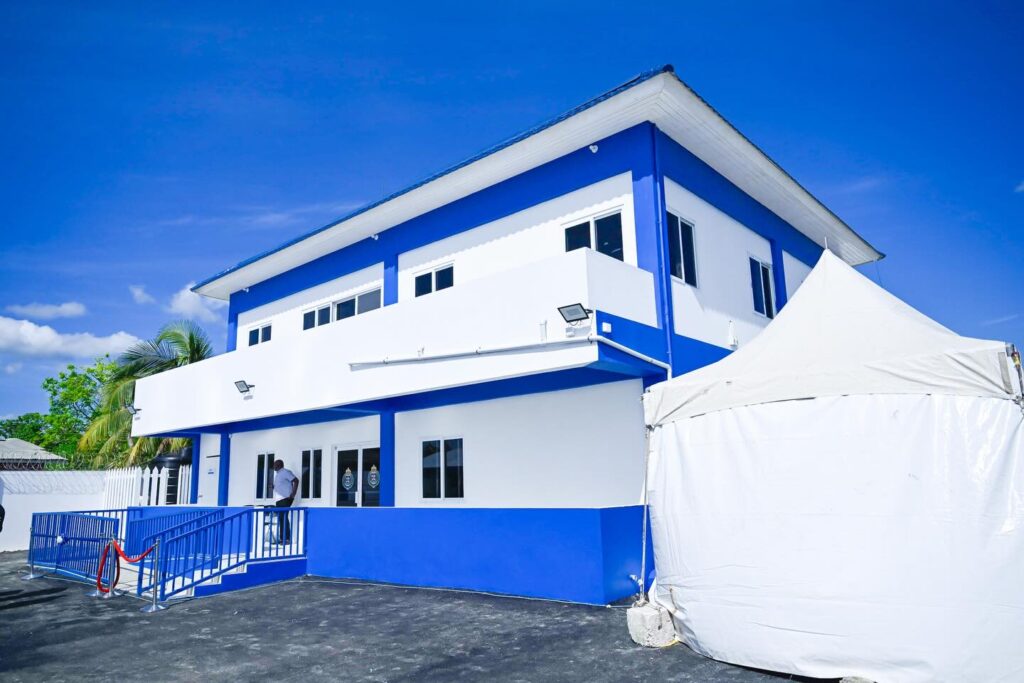
So, for those who will want to criticize the opening of a police station in the midst of a disaster recovery process, this police station was conceptualized in 2017 in a partnership programme between the NHT and the Government of Jamaica, that where the NHT is involved in building communities, housing schemes and housing developments- in this case there are two housing communities/ housing schemes that are in proximity to this, one of them is Mais Muir and the other one is Meylersfield, and so the idea is that the NHT’s role is not just to build houses, it is to build communities and an important part of the community is the security. And therefore, the NHT has invested in several of these police stations. I can count to a number of them in Clarendon, in Portland, in Stony Hill, all over and so the little London Police Station became a candidate, not just because of proximity, but because it was destroyed by fire some time ago and the police officers had to serve you from a very small rented space that was not fit for purpose and that would’ve impacted the delivery of the security service to you and so this police station would’ve been completed in such a timely way that it coincided unintentionally with the passage of Hurricane Melissa and the trail of destruction that it left behind.
So, what should I do as Prime Minister? Should I leave it there and not open it? Should I not call the public’s attention to this wonderful development which will be brought into the service of the people now, not just for their security, but also for the recovery process? And so that is what we are doing here today, which gives me a very good segue into some other issues that since I have your rapt attention and you want to hear me speak for an extended period of time, I will oblige you.
Hurricane Melissa is a one in a hundred-year event for Jamaica. We have never been hit by a hurricane of this magnitude with this destructive force. Hurricane Melissa is probably in the top three of the strongest hurricanes globally. There has been no other hurricane that has hit Jamaica that has caused as much damage as this hurricane. So far we estimate that it is about $8.8 billion in damage, and as you drive along the coast coming in from St Elizabeth into Westmoreland you can see the damage and the damage is not just to our physical assets, our police stations, our courthouses, homes, businesses, our churches, our schools, our roadways and bridges, it is also to our forests.
I had the opportunity to fly over parts of the Cockpit Country, and it is just a trail of broken trees. That, of course, will do damage to our agricultural ecosystem which will take some time to renew itself. Thankfully, it will renew itself. It is estimated that 51% of our forests were destroyed in this hurricane so it is a major impact.
Now, the hurricane also revealed certain things about our society, and one of them would be how we choose to build. There are those who will say that we construct by virtue of the most affordable and accessible materials available to us, but I want to start to place in the minds of the public that whatever you choose to build, there is a better way to build it. As I came in on the coast and I looked at some of the houses, and I encourage you when you’re driving you could do the analysis as well. You would have one house right here, its roof is gone, and right beside it there’s another house of similar quality, its roof is intact. As you drive around, you go and observe it.
So yes, a Category 5 hurricane is likely to destroy many roofs, but the impact of the destruction can be reduced if when you are building you utilize not just the available material, but the available construction knowledge that is tested, tried, and proven and simple to deploy that can preserve your investment in your home. Hurricane straps, proper roof design; all of these are things that you can do. The other thing I would say to you as well, we’re all going to want to build, but we have to also exercise greater discernment in where we choose to build.
I know it’s a touchy subject. I know it’s a sensitive subject, but again, it will be said we have to build where the land is available. And so, yes, I do acknowledge that and yes, Government does have a role in ensuring that there are opportunities available for you to build and acquire land and houses in places that are safe. But the extent of damage that is done when you look at it as well, is that you have houses and communities that are in places that I am certain now they’re saying maybe we should not have lived here or built here: riverbanks, gully banks, riverbeds, steep hills, unstable soil.
These are things that as a people, and I’m saying it with the greatest of understanding of our history, the dispossession of our people with assets and land, all of those things, nobody understands it more than I do but at the same time we all have a duty and we can all make the right decisions that if we don’t live in environmentally and ecologically sensitive areas, the impact of the natural disaster on us would be less.
The third thing I would want to point out from Hurricane Melissa:
- how we choose to build
- where we choose to build
- our understanding of the world in which we live
We’re going about our lives every day and on the radio, you will hear somebody talk about climate change and you will say, what is this climate change? The climate changes almost every year. We have summer and well, we don’t have winter, but we have Christmas time when it gets very cool and we have spring, so the climate is changing, but that’s not what we’re talking about when we’re talking about climate change. What is happening to us, and most Jamaicans are oblivious to it, is that the climate is getting hotter. Our oceans are getting hotter, and that hotter ocean is creating more energy for more destructive storms.
If you were to take the number of Category 5 hurricanes that happened in the last 20 years and compare them to the number of Category 5 hurricanes in the 20 years prior to that, you would see that in the last 20 years there are significantly more Category 5 hurricanes occurring doing significantly more damage so the climate in which we exist as human beings is becoming more and more unfavourable to the old traditional ways of how we choose to live. As citizens, responsible citizens, you must now factor into how you choose to live the impacts of the climate. In other words, are we likely to have more hurricanes? Are we likely to have more tropical storms? Are we likely to have more drought? Are we likely to see sea level rise taking away some of our coastal lands?
Now, if that is the case, if you are likely to see more storms and hurricanes with greater intensity overlapping- I give it to you in this way, so you understand exactly what I’m saying. Last year we had Beryl, and after Beryl for almost four or five weeks straight every day we had rain. And then after that, a few months later, we had drought and then hurricane, come again, Melissa. What’s going to happen next year?
You know that almost every year for the last 10 years we have had a tropical storm or two. Sometimes we have had some flooding, we don’t even know where it comes from so, I’m saying to you that as we live our lives, we must now incorporate this issue of how the climate is behaving. And listen to me now, the climate is not going to change for you. You will have to change to adapt to the climate or you will have to put up strategies to mitigate, make the impact less. Those are two key messages I want to bring to you.
My other message is, so if it is the case that the climate is changing, and yes, there is the global institutions trying to slow down climate change but more on that, I am now focusing on what you can do to cope with climate change, which is you have to consider where you build and how you build but I think we all have to accept that in our lifetimes and in our future, we are going to be hit by another disaster. There is going to be another disaster so the ability that we must have is not just to adapt and to mitigate, the other ability, the other quality that we must have is this quality of resilience, that you get hit by unexpected exogenous shocks, you get knocked down, but you get back up, you put on back that sheet of zinc on your roof, and you stand up and you start back your life again. You return to normalcy, but the resilience is not just taking up the sheet of zinc and tacking it back on, the resilience is to say if another shower of rain or blow of wind should come, that sheet of zinc is gone again so here is what I am going to do. I’m going to put on that hurricane strap, or I’m going to change the kind of roof, or I’m going to move from here; different grades of things that you can do, but your actions have to be considering now how to be resilient, and I just put it to you in this context.
Hurricane Beryl just glanced Jamaica, but it hit Clarendon and parts of Manchester and St Elizabeth very hard. What if Melissa had gone back to the same path? Would those persons who recovered from Beryl, would they have been able to withstand Melissa? These are all considerations that we will have to put into the way in which we live. We have to consider it.
The fourth item that I would say on this is that you have to be now so careful of the information you consume because here I’m giving you a different perspective on the challenges that we face, which maybe you’ve never thought of it in that way before, but then there are others who will tell you some other nonsense, “the storm is manmade” and some people believe it and then they would say we’re trying to fight them for their land and so how is that going to impact you, your resilience, your ability to adapt and to mitigate, your ability to survive in this new situation that confronts us so you have to manage the information that you have. You have to manage that information.
This police station, it is more than just an investment in security. As I landed in Black River 24 hours or less after the passage of the hurricane, practically the only functioning institution that stood apart from the hospital was the police. I want to commend the police, the JCF and their very close partners, the JDF. In Black River, the Coast Guard base was destroyed, and the Coast Guard had to take up refuge at the police station, which was also partially damaged and as I landed, I saw the senior superintendent there. He made his way wading through water to come and greet me, SSP Minto and his team, and they were there maintaining order in the rain, in the wind and I think that all Jamaicans feel very proud of our security forces, both the JDF and the JCF in the service that they gave. But I use this opportunity as well to make this other point to you.
I was watching an interview with a foreign station immediately after the aftermath of the hurricane, and a lady was being interviewed, and she said she don’t see anybody. She hasn’t seen anyone except someone from the Lacovia Police Station. Haven’t seen anyone from the government, but she saw the police. Now, it tells you how people think and why I have to open this police station because somehow the country may think that the police station just materialized, that the government had nothing to do with it, that the government that you elected didn’t make a policy decision that ensured that this police station came to a reality, that the government did not invest in the police force to build the moral of the police force that when disasters like this would’ve struck, they understand what their role is and they stood up.
There were other disasters and there were other events, and it was not always the case that the JCF was in a position to stand up but we have invested more than $90 billion in our security forces over the last nine years, and as a result of that the murder rate is now down 42% this year, 21% last year, and 7% the year before to now we can for the first time in over 30 years, almost 40 years, look for a murder rate that is below 700. Yet there are those who would want to say no, Government doesn’t have anything to do with that. It’s some magic that it happened, but yes, you’ll always have people talk nonsense.
What you worry about is the people who believe it. It’s called confirmation bias. They already had it in their mind never to accept anything good that the government has done so they just want to hear some negativity to reaffirm their already negative positions. But the only way to challenge that is to keep doing good, to keep showing the facts that are indisputable, and it is indisputable that you have a far lower murder rate today than you had in the last 30 years. It is indisputable that the JCF stood up as a strong unit.
I saw my commissioner of police, and I say my commissioner of police as a citizen of the country, proud of my police repairing their police stations, not waiting, they’re going out there and repairing their police station. More than that, taking care of their members. I received a report yesterday at the National Security Council from all the security forces, the JCF, the JDF, Customs, MOCA, and what they did was to assess all their members who had damage in the hurricane, and they’re mobilizing internally to assist them. They have looked at all their infrastructure and facility that is damaged and they’re moving rapidly to see to it’s repair. Why? Because they want to be able to continue to serve the public. Every policeman, every soldier is so proud of their institution, proud of the uniform that they wear when they stand up in the public square upright, shoulders squared
Even in a hurricane, I saw the team from St James foil attempted robberies in the hurricane. You know they could have decided to stay in the station and lock it, as was the old jokes that used to be told about our police stations, but our new JCF, they decided that they would go out there, be present, be felt, serve and protect. That didn’t happen by magic. It happened because the government made an investment and gave confidence and support in policy and direction to our security forces and we are now reaping the benefits of that.
But not just that, many of the police stations became the centre of activity in the communities that were destroyed. I toured several of them, and that is where they were getting internet. People gathered to get their internet, gather to get their phones charged, gathered for safety. That is where many of the distribution hubs were stationed. This police station, God forbid any future disaster, is built for sustainability and resilience. It will have its own backup power. It is built, as you can see, very firmly, strong and it will be able to serve this community as an area that you could consider to be a first response and secure area in the event of a disaster.
Lastly, I’ve seen a lot of talk about generators. Now, one of the things that the government asked for, and you have to understand how disasters work, countries who are going to assist usually have a pre-prepared list sometimes of things that they will contribute or donate, but oftentimes they will say to the country in distress, what is it that you need the most? And so, we have a needs list, and we put that needs list up and we communicate that to our partner countries, and one of the things we emphasized was for generators, and that’s standard. You would need generators, but what do you need the generators for? 900,000 persons were impacted by the hurricane. We would say that of that 900,000, maybe about 150,000 were severely impacted so they are now without electricity, without water, house might be down, roofing is gone. Now, the number of generators that we got, the last time I checked was somewhere in the region of 600. The commander of ODPEM will give you the specific figure. Now, how do I share up 600 generators to 150,000 people?
No, I’m telling you the nonsense that they talk and you wonder what they went to school for, and you wonder if they’re doing it deliberately to sow discord. You can’t share up 600 generators for 150,000 people or 42,000 homes. It is not possible. So, what do you do with the generators? The first thing you do is you want to give it to areas where its use will be multiplied.
For example, police stations that now don’t have generators, you give them generators because that is where the people go for safety and security. I toured Falmouth and when I passed Falmouth, I was wondering what is over there. It was the police station, and everybody gathered the police station trying to get internet, trying to get their phones charged and just being in a place that’s lit and safe so you want to make sure that your emergency responders get them. And so, what we have done, we have put a policy in place, so we are saying whatever we have gotten, we’re going to use it for resilience building. You remember that word that I said that if you get hit, you get back up stronger. We got hit so we give the police, the JDF, the Fire Brigade, your municipal buildings, the hospitals; we give them generators and that is where it is going.
Now, it’s not just a gift that they’re going to get, they have to account for it and not just to say I signed a receipt to say I received the generator, they must provide us with a plan as to how this generator is going to be operated and how it is going to be replaced when it reaches the end of its useful life so that they will always have the backup capability going from here on in and that’s what we have done.
What some people would’ve done if they were the government is to just take it and give it to them friend and give it to them company and nobody would benefit. That is what they’re trying to do. That is why they’re saying that nonsense, because they believe that they would get political power by saying I would give it to my friend and company, and there are those who are not thinking who would follow it.
My government doesn’t do that, and that is why this government is recognized. There has been no other time in Jamaica’s history when we have been hit by any disaster and the level of support that has come, it is incredible. No other time, because we are a smart government. We’re a thinking government. We’re a compassionate government, that’s it.
The generators are used to build resilience, but there’s one other way in which we’re going to use generators. None of these that are given, but I see so many pictures of persons giving out packages and it is becoming almost the in-thing now on social media, everybody’s giving out a package. I think in the initial days it’s necessary, but I’m also very concerned about the dignity of our people. I don’t like my country to be shown as people running to get food, fighting over a package and those kinds. I don’t like that and it creates a kind of mentality that is not Jamaican. We are independent people at heart. We are independent, we’re not supposed to be doing handout, handout, handout. Yes, we are in a place where we need to do relief, but we must never give up our dignity so if you have to give, just give that quietly. Help the people who are in distress preserve their dignity and the people who are in distress, remember your dignity, which is why I announced a week ago that we are going to transition from giving out of packages because it’s becoming highly political; who never get, and if you go to a man place and then him say how you never call me to go give package with you, and you only give to that.
Look, the funny thing is this, the amount of JLP people who call me to say PNP MPs get package and don’t come to them. And I said, look, I don’t want a political issue, don’t bother make no noise over that. It is disgusting that persons would want to make political issues over the distribution of aid. We have to bring an end to it then, because some people can’t help themselves. They can’t resist it, and so we are going to shift from the distribution of food packages to giving persons coupons or cards that they can go and buy the stuff that they need.
Now, shops are not up yet and that is why early in the day we said we are going to help the shops stand up back and for shops to get back up on their feet, they need electricity. There are some communities that are not going to get electricity right away, so what they will get, we will loan them a generator so that when they get back electricity, we can take that back and give it to another shop. That is how you save money, because what we’re going to do here is not from the generators that are donated. The Government of Jamaica will buy these generators so it’s taxpayers’ money and we have to use it in the most efficient ways. We couldn’t take donated generators and give it to business to use, no. Donated generators either support government resilience or we give that to NGOs or churches or so but the ones that we purchase, we use that in business for people who are going to make profit from it, and they will have the option after if they want to buy it, then they can buy it. If not, then we give it to somebody else to use because we are thinking government.
The unthinking people who are selfish and just looking for benefits for themselves, they will think another way and those are the people who got Jamaica into problems. It is that kind of thinking that put Jamaica into problems. It is my kind of thinking that has taken Jamaica out of problems, and it is one thing that you will see about me, me no fraida nobody! All who want to talk, make meme, gwaan. Me will go with you toe to toe. Every nonsense you talk i wil respond to it. And as you would’ve seen with the government, man come out with foolishness, we respond, nothing no go suh. And as many memes as they can make, I can make it to so it’s going to be war because we cannot allow the people who peddle nonsense, the people who tell lies, we cannot allow them to win so we will have it out.
As I have said, it is not just managing the disaster, it is managing the false information, and we have to go to war with that. Too much false information distracting the people when we need to have a positive mindset for recovery. So, I urge everyone here today, let us have a positive mindset for recovery. For all the people who are vested in creating lies and rumours, I urge you to think as well about your country and what you’re doing. There’s nothing wrong with being critical, but there is everything wrong in being untruthful. Everything wrong in being untruthful.
My friends, I want to thank you for being such a wonderful audience. It gives me great pleasure to open this station. It is a symbol that the government continues. It is a symbol that we are still making progress. It is a symbol that we are returning to normalcy, but it is also a symbol that we are building forward better.
God bless you and thank you.