
Opening Ceremony of the 50th Regular Meeting of the Conference of Heads of Government of CARICOM
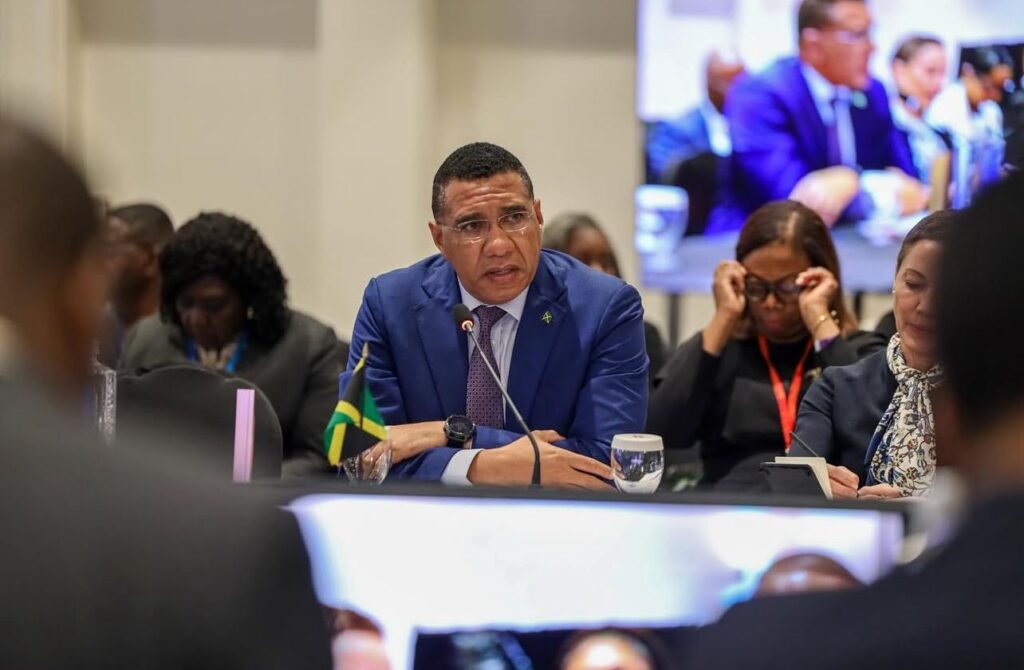
Remarks
by
Dr the Most Honourable Andrew Holness ON, PC, MP
Prime Minister of Jamaica
at the
Opening Ceremony of the 50th Regular Meeting of the Conference
of
Heads of Government of CARICOM
On
February 24, 2026
________________________________________________________
Her Excellency Dame Marcella Liburd, Governor General, and the Honourable Dr Terrance Drew, Prime Minister of St Kitts and Nevis
Colleague Heads of Government,
Dr Carla Barnett, Secretary General of CARICOM
Excellencies
Ladies and gentlemen, it is a good evening in St Kitts and Nevis.
Let me first extend sincere appreciation for our gracious host, the Government and people of St Kitts, under the able leadership of your Prime Minister, Dr Terrance Drew. I am grateful for the warm hospitality and the excellent arrangements put in place to facilitate this meeting.
I also warmly acknowledge my colleague heads who have been re-elected and newly elected since our last regular meeting in July, the Honourable Philip Pierre, Prime Minister of St Lucia and the Honourable Mia Mottley, Prime Minister of Barbados, the Honourable Godwin Friday, Prime Minister of St Vincent and the Grenadines. Heartiest congratulations to you and best wishes for a successful tenure.
Friends, it is a privilege to address this 50th Regular Conference of Heads of Government of the Caribbean Community. Fifty years or fifty meetings of this body represent far more than institutional continuity; they tell a story of political maturity, determination, and a shared conviction to Caribbean civilisation, but anniversaries also demand honest reflection.
We meet at a time when the speed of global change is outpacing the speed of regional coordination. Climate shocks arrive faster than our financing mechanisms, criminal networks adapt faster than our institutions, technological disruption is reshaping economies faster than our regulatory and skills frameworks can adapt; these challenges do not wait for us to be comfortable to align policy resources and action. The question before us, therefore, is not whether CARICOM can endure, for we have and we will, but whether it can deliver for our people with urgency and relevance in a rapidly changing world.
For decades, an idealised narrative around Caribbean integration, while well-intentioned, has framed perhaps unrealistic expectations within our respective populations. It has also perhaps unintentionally diminished the genuine strengths of our existing arrangement, an association of independent states bound not by uniformity, but by shared purpose, mutual regard, and a deep history of collaboration.
CARICOM is not and has never claimed to be a political union. Our treaty does not mandate a singular foreign policy or a supra-national authority, and because we are sovereign states each accountable to our own electorates, we will at times assess risks differently, sequence priorities differently, or interpret geopolitical opportunities differently. That is not evidence of the weakness of our association. This is the natural expression of sovereign democracies navigating an increasingly turbulent global environment.
Too often, differences in national perspectives are portrayed as fractured, threatening the regional project. I submit that they are nothing of the sort. While there are undoubtedly circumstances where one voice has and will work for us to great effect globally, variations in national perspectives is not a liability to be feared. It is a resource to be harnessed. The measure of our integration should therefore not be uniformity of position, but effectiveness of cooperation.
Indeed, our diversity of economies, political traditions, development strategies, and governance approaches is one of CARICOM’s most underappreciated strengths. Each member state functions as its own laboratory of democracy, able to test policy innovations that others can study, refine, and adapt. This is not divergence; it is distributed regional problem-solving. I offer Jamaica’s approach to security as the first example.
For decades, we have confronted levels of violence more severe and more persistent than elsewhere in the region. It has forced us to develop responses, legislative, operational, community-based, and technological, that may now offer lessons for sister states encountering emerging criminal threats. Our region’s variability, therefore, is not an optical to integration. It is integration, practical, organic, and rooted in shared learning rather than a forced concept of uniformity. Still, even as sovereign states with sometimes differing priorities, there are core challenges, such as regional security, that bind us together and demand deeper cooperation.
Organised criminal networks are increasingly sophisticated, technologically enabled, better armed, and not constrained by national boundaries. This week’s events in Mexico exemplify that, left unchecked, such networks can grow powerful and brazen enough to challenge the state itself. The Montego Bay Declaration on Transnational Organised Crime and Gangs, adopted during Jamaica’s chairmanship, marked an important step in establishing a unified regional stance. This work must continue through intelligence sharing, joint operations, interoperable border management systems, and strong alignment with regional and international partners. There is also the closely related matter of territorial integrity.
As small states with vast maritime spaces and strategically important geographies, we each face pressures, external claims, elicit incursions, and evolving geopolitical interests that can challenge the sanctity of our borders. While our approaches may differ, our commitment to the principle is shared. Every member of CARICOM has the right to decide how best to defend its territory and maritime domain, and it is reasonable for them to expect the solidarity of every member state to that end.
During our tenure as Chair, Jamaica placed significant emphasis on regional security. We strengthened collaboration with CARICOM, deepened engagement with Interpol, and advanced coordinated efforts on border management and intelligence sharing. On Haiti, we reaffirmed that CARICOM has a critical role in supporting the political, humanitarian and security pillars of the recovery. Jamaica remains fully committed to the work of the UN Security Council, endorse Gang Suppression Force, the Standing Group of Partners, the Eminent Persons Group, and the OAS in supporting a coherent and sequenced pathway towards stability.
Friends, we must address the situation in Cuba with clarity and courage. Cuba is our Caribbean neighbour. Its doctors and teachers have served across our region. It’s people are part of our shared history. But today the Cuban people face severe economic hardship, energy shortages, and growing humanitarian strain. Jamaica is sensitive to the struggles of the Cuban people. Humanitarian suffering serves no one. Apart from our fraternal care and solidarity with the Cuban people, it must be clear that a prolonged crisis in Cuba will not remain confined to Cuba. It will affect migration, security, and economic stability across the Caribbean basin. It is therefore important that we carefully consider this matter and take collective action.
Let there be no doubt, Jamaica stands firmly for democracy, human rights, political accountability, and open market-based economies. We do not believe that long-term stability can exist where economic freedom is constrained and political participation is limited. Sustainable prosperity requires openness to ideas, to enterprise, to investment, and to the will of the people. This moment, therefore, calls not for rhetoric, but for responsible statecraft even as we encourage support for humanitarian relief.
Jamaica supports constructive dialogue between Cuba and the United States aimed at de-escalation, reform, and stability. We believe there is space, perhaps more space now than in years past, for pragmatic engagement that protects the Cuban people from any further deterioration in their circumstances, and instead promotes national and regional prosperity.
Friends, colleagues, as it has been said, the geopolitical environment is shifting. Maybe it has already shifted. This may well be a moment of opportunity, a moment for transition for recalibration, for a new chapter. CARICOM can play a constructive role, not as an ideological block, but as a community of democratic states offering cooperation, economic reform, and social development. This is not a moment for division in our community, it is a moment for maturity, for principled realism, and if we act wisely for positive change in our hemisphere.
This brings me to the second shared challenge, navigating the transformation of the global system itself. The new geopolitical and economic environment is being shaped by strategic rivalry, supply chain realignment, and a new era of trade protectionism alongside rapid technological disruptions, powered by artificial intelligence. Control over information platforms, standards, algorithms, and networks now influences economic power, national security, and policy autonomy as profoundly as control over physical resources once did.
For small states, the risk of marginalisation in this environment is real, but so too are the opportunities for leapfrogging if we act deliberately. Digital capability is now a component of sovereignty. States that do not shape how technology is deployed will increasingly find their policy space shaped by others. Small states cannot afford to be passive observers of these shifts, yet here again, CARICOM’s diversity is an asset.
Because we are not bound to a single foreign policy, different member states can cultivate different diplomatic, commercial, and strategic relationships. Rather than viewing this as fragmentation, we should recognise it as an opportunity; multiple points of engagement in a complex global system that can collectively enhance the region’s resilience, influence, and optionality. No single Caribbean state can build scale across these domains alone, but together we can pool talent, align standards, and develop digital public infrastructure to enhance productivity, inclusion and resilience. Success will, however, require deep engagement, information sharing, and collaboration with each other. It will require true enhanced cooperation.
For our part, Jamaica remains committed to a transparent, fair, and rules-based multilateral trading system that is responsive to the vulnerabilities of small island developing states while enabling us to compete and thrive in a tech-driven global economy. The Caribbean single market and economy remains one of our most important instruments of translating regional cooperation into real economic opportunity. It is a practical framework that allows member states to pool advantages, reduce barriers, and create a larger economic space in which our firms, workers and innovators can compete.
The strength of the CSME lies in its flexibility. It allows integration where our interests converge while giving each country the room to sequence reforms at its own pace. Our task is to make the single market work better by improving connectivity, aligning standards where it matters, easing the movement of skills and building compatible digital and logistics infrastructure so that scale is possible even for the smallest among us. A more functional CSME is essential to building resilience, raising productivity, and ensuring that Caribbean enterprises can thrive in an increasingly competitive global economy.
Our region’s solidarity was most recently powerfully demonstrated four months ago when Jamaica was struck by Hurricane Melissa, the most intense hurricane to ever make landfall in the Atlantic Basin. Melissa tested our people, our institutions, and our infrastructure. Yet the recovery now underway stands as a testament not only to Jamaica’s resilience but to the strength of the Caribbean family.
Permit me to convey my sincere gratitude to all of you for the supplies, cash donations, field hospitals, desalination plant, and personnel who are still in Jamaica helping us to restore our grid and restore roofs. We are most grateful, and I take this opportunity on behalf of the people of Jamaica to say thank you to my friends and colleagues. We are grateful for each and every contribution you made to Jamaica’s relief effort, critical support when it was most needed, and like a family, each doing what it could. The visit of colleagues as a demonstration of your solidarity was also greatly appreciated. Your presence made CARICOM real and present at the level of communities and families, and you have the sincere gratitude of the Jamaican people, in particular, the people whom you met in Westmoreland, where you visited.
But even as we acknowledge this powerful demonstration of regional solidarity, the increasing frequency and severity of climate shocks across our region make it clear that resilience cannot rely on goodwill alone; it must be systemic. In addition to facing the world with a clear understanding that if SIDS like us are to survive, 1.5 must stay alive with all that is required of the largest emitters, but as a region, we must also move from response to preparedness, from rebuilding after disasters to pre-financing risk, pooling capacity, strengthening regional response mechanisms and protecting fiscal stability so that climate shocks do not repeatedly derail our development trajectories.
Friends, as we look to the future, I propose that we embrace a more grounded, more confident and more strategic conception of CARICOM, one that reflects who we are and also equips us to become what is new in this era and what it demands. We are not a political union. We are, however, the oldest integration movement in the world. We are a powerful community of sovereign states with shared aspirations and overlapping and sometimes converging interests; that’s just the reality.
We are not monolithic; we’re not always going to be one group, but we are aligned in critical areas that matter most for our people: security, resilience in all forms, economic opportunity, and global relevance. We are not peripheral. Our geography, youthful population, renewable energy potential, creative industries, and democratic traditions place us squarely within the strategic horizon of a rapidly changing world.
Friends, Excellencies, at this juncture of our 50th Regular Meeting, a renewed vision for CRICOM must rest on these three imperatives. First, a competitiveness agenda anchored in logistics, connectivity, digital and AI-enabled transformation and clean energy, allowing our economies to scale within the single market, even as each state advances its own development strategy. Second, institutional readiness. Regional bodies capable of delivering unclear priorities with professionalism and continuity, inspiring confidence among global partners and these institutions must reduce their bureaucracy and increase their speed. And third, a nuanced diplomatic posture, one that recognises diversity among member states as not fragmentation, but as a spectrum of strategic options that collectively enhance the region’s leverage.
Friends, if our economies are to scale, we must scale our ambitions. If our voice is to carry weight, we must speak with coherence, recognising that unity does not require uniformity, and if we are to secure the future of our people, we must embrace both our shared identity and our sovereign dynamism. CARICOM endures because it adapts. It survives because we remain committed to the idea that small states can achieve big things when we work together. Jamaica’s commitment to this project is unwavering because our national development is inseparable from the region’s success. 50 conferences on, the work remains unfinished. As the theme of the conference urges us, we must move beyond words to action. The promise ahead of us is real if we pursue it together.
I thank you.