
Launch of the Solidarity Programme
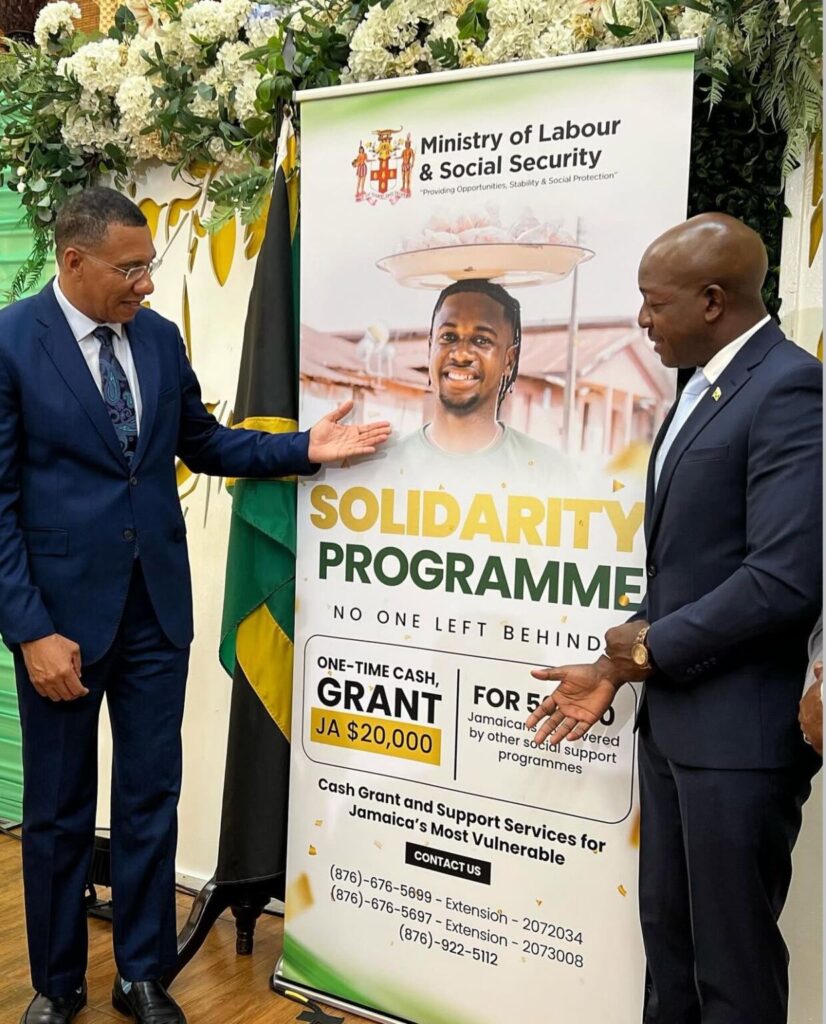
Keynote Address
by
Dr the Honourable Andrew Holness ON, PC, MP
Prime Minister of Jamaica
At the
Launch of the Solidarity Programme
On
June 25, 2025
______________________________________________________________
I’ve often said that poverty has several dimensions to it. The ones that we pay attention to would be the lack of income, so we would say that people are income poor, they just don’t have money to purchase the basics. The other dimension is information, and in today’s world, there’s so much information, but there is really not much knowledge, and you have to go through a process to convert information into knowledge and so the lack of that process, which is usually described as education, but it could be exposure, training, good developmental circles in your family to help you to contextualize, there’s usually an absence of that. People who are poor usually have an information deficit, so they make poor decisions.
And then there is the access to amenities, proper healthcare, water security, and therefore, persons who are poor usually don’t have access to good amenities and social services and government policy is directed at trying to improve those. We have been absolutely very successful in giving people income by virtue of getting more people employed. When you look at the unemployment rate today, at 3.5% we’re virtually at full employment relative to a decade ago, when we were like 13% unemployed. Access to amenities, that continues to be a challenge, but if you look at where we are with access to education, we practically have universal access to education at the secondary level. Quality still remains an issue.
We changed this whole healthcare dynamic. We created a health-seeking behaviour in the Jamaican population. There are still challenges, but more Jamaicans now are able to access healthcare and certainly to be able to get access to it at affordable rates. Previously, healthcare you had to pay and as it now relates to the issue at hand, which is how do we deal with the other dimension of poverty, which is alienation, and in a society like ours, where we see certain segments of the society moving ahead, making headway, getting access, there are others who are looking on and saying, this society, does not care for me so there is a segment of the society that feels that they are left out. That’s another dimension of poverty, and those who feel that they’re left out, they’re usually on the margins of the society. They’re much easier to develop antisocial behaviour, and ultimately they create a counterculture that works towards the degrading of the society.
Ultimately, they take a very negative view on the society and you will likely hear them say, nuttn nah gwaan and we encounter that right across Jamaica. So even though the unemployment figures are clear, businesses are saying we can’t find people, there is still a segment of persons, as you go around the country will say, I can’t find employment. And the question is why? There are issues that they have not been included in all that is happening in the society, whether it is the HEART Programme, which is now free, the subsidiary programmes of HEART, the CARE Programme, the LIFT Programme, and all the other programmes that we have put in, they are just on the margins.
Some of it is attitudinal. Because they are alienated, they are on the fringe of the society. They simply just don’t make themselves available, and so they take up a negative view, I can’t bother to, and if I go, they’re going to turn me away. You hear all of these things: the government is only for the rich, only rich people go and get through, and that is absolutely not the case. And we must challenge that view, and we must be instrumental and deliberate in challenging that view that the government is only for some people or only for the rich. But then there are those who want to be included, but there are structural issues, and you find that alienation can be very high, particularly in rural communities. Infrastructural things like transportation can be an issue. They just simply can’t go to the places where they have to register. Access to the internet, for example, can be an obstacle that excludes Jamaicans from participating in the economy and there are other issues as well.
When we sit down as a government to make policy to treat with this issue of poverty, we’re not just looking at the income that people have and how do we increase their income. We’re not just looking at how do we get more people knowledgeable and to use information wisely, information literacy, or enabling access to amenities. We also have to be instrumental in reaching the minds of those persons who feel that the system is against them.
We have to treat with this business of alienation, which arises out of the historical inequities in our development as a nation, which has led to what the economists call income inequality in the country. And we have to tackle that, and we have to make sure that whatever policy that we put in place does not lead to an exacerbation of income inequality in the country.
Our policy on treating with poverty is carefully crafted to ensure that we reduce income inequality in the country. So you are going to be bombarded with all kinds of policies, all kinds of promises, but you have to examine each and every one of them very carefully because the end result of some of these policies would be to increase income inequality.
Remember, every decision that government makes gives somebody equity. Likewise, every decision that the government makes could take away equity from someone and so some policies sound very good, but if you examine them carefully, it is giving a benefit to someone whilst depriving someone else of a benefit.
I don’t want to go into too many of those. I’ll deal with those policies and dissect them at another time. Those policies say we’ll give you a deposit on something, where only maximum 2000 persons could get it and other people are there looking on, what about me? And we have heard some of those promises and policies being purported, particularly in housing.
When we did the increases in the income tax threshold, we immediately recognized that we would be giving a benefit to those people who are employed, which is what the income tax threshold does relative to other persons who may be employed but are below the threshold; they get no benefit.
So, for the people who will get the benefit, this is the greatest thing but they’re not necessarily looking at the people who are employed who earn below the threshold, they get no benefit. Is that fair? It may not come out in the media discussions. Journalists may not write about it, but I have to pay attention to it because at the end of the day, if one set of people do very well and another set doesn’t do well, it creates the inequality, it creates the alienation, and it creates the social tensions. So, as a government, we have to pay attention to that, and so we did the reverse tax credit where over 300,000 Jamaicans got a tax give back of $20,000 on their account if you earn less than $3 million.
People are wondering, why are we doing this? Why was it necessary? It was necessary to ensure that we do not end up with longstanding exacerbations in our income inequality. And then we also recognized that we should look at those persons who are not currently captured in our social safety net. We have expanded the social safety net significantly with the introduction of the non-contributory social pension for a person 75 years and older, and that was an attempt to ensure that not just because they’re retired but to ensure that there is equity in our society for those persons who have no income at an older age.
We ensure that there is equity as well by expanding training through HEART by making HEART free, getting more of our youngsters into training so that they have a better chance of getting educated so that they can break at least that one dimension of poverty, which is lack of employment, lack of income, and we have expanded the PATH programme with many benefits including greater support for persons getting certification through CSEC and Cape and in addition to supporting nutrition in school through lunches and so forth.
Our social safety net has been expanded widely. The gap in the social safety net as it relates to this issue of alienation would be those persons who are not captured at all in the social safety net so they get nothing from the state and they may very well be looking on and seeing their neighbour getting a social pension, their neighbours’ children getting CSEC support, getting PATH, or they may not be on PATH themselves and they are wondering. They hear the Prime Minister talk about people being employed and there is growth in the economy, but what about me? They may very well form the view, it’s because they don’t care about me. They may very well take anti-social positions relative to the state.
In completing our social safety net and social interventions, we decided that we need to express solidarity with those persons who are not formally captured in either employment or the social safety net. Bear in mind that we have also expanded the social safety net with unemployment insurance, which is in the works and we have expanded even further with the tourism pension plan so we have done all kinds of things to expand the social safety net, but there may very well be a critical number of Jamaicans who are still not covered, still not captured in this, and this is why we have launched the Solidarity Programme.
There might be some who will criticize the programme and say it’s only $20,000, and it’s one-off, that is where they don’t understand the programme. This is what is described as a conditional cash transfer. It is conditional on the person receiving the transfer to become formally registered in the social safety net so that you can continue with formal benefits over time directly, that’s what it is.
We give an incentive for people who may be attitudinally opposed because they just form the view the societies against them so we are going to have to reach out to them now, and that is why the programme is designed as it is where we will be utilizing several avenues of intervention. We will be using the MPs, the churches, Justices of the Peace and other personnel who work in communities to identify those persons and register them and then the ministry itself will have a special team, which will be trained to move around the island and identify these persons.
And of course, we encourage everyone who falls in the categories that have been already outlined: elderly person 60 and over without any form of social support, you’re not on PATH, you’re not getting what is called a social pension or NIS, please reach out to the Ministry of Labour and Social Security. Persons with disabilities who are not already catered to under the various disabilities programmes, let us know.
Just on the weekend, I met a father who was pointing out to me that his son has a developmental disorder. His son is now 19 and he has been dealing with these issues. He has to buy the medicine all by himself and there are programmes there, which I’m sure if he were introduced to them, he could get support. So again, this issue of knowledge and just taking the view that the state doesn’t care and therefore even if I go, I’m not gonna get through. And some of them would’ve gone and they would’ve had a bad experience and then they say I’m not going back again so we have to reach out to those persons.
Youth between 18 and 35, not in employment education or training, and that’s particularly what we used to describe as the unattached youth. Now, we haven’t done a recent survey to see what the number of unattached youth are, but I’m fairly confident that that number would have been significantly reduced given the fact that HEART has constantly now for the last two years pointed to a massive increase in their registration. I recall the last number was 120,000 additional persons registered in HEART Programmes so we are having an impact on the number of unattached youth, but there is still a large number.
As I move around the country, I’m still meeting up on young persons who are saying that they can’t find work and I’m puzzled. I’m absolutely puzzled but when you inquire further, the main issue would be they’re not certified and to get employment these days, the employer needs to manage the risk of employment by having certification shown. You can imagine as an employer, someone come to you and say, I’m a welder, I’ve been welding for 20 years and you take on the person and they might know the basics of welding, but they may not know standard and businesses must be compliant with standards.
They have to ensure that their employees go through a process of training. We do have that challenge of having young persons still who are not certified, though they may have skills. And of course, there are many young persons who have no skills whatsoever and absolutely no certification and a major challenge is transportation and housing because where the jobs are versus where they live, the cost of transportation and housing makes it not economical for them to take up jobs so we have to give them support to deal with this kind of frictional issues which creates this residue level of unemployment in the society which is why there are persons wondering why is it that we are expanding the JUTC bus routes into rural communities.
For this very reason, we need to have a bus system that is reaching all over the island with subsidized transportation so that that residue number of persons who are not employed can get on a bus and get to work and get back home. That is being worked on, which is why we are buying the hundred new buses and we are strategically, slowly but surely expanding into these communities to deal with this frictional issue.
Medically indigent individuals. If you are ill, shut in, can’t work and you are on none of the social safety net programmes; please reach out to this programme, low-income informal workers and you see quite a bit of low-income informal workers all across the country. You drive around and you see somebody with a stall and they have a few mangoes on it and you wonder how do they survive from that. If you are in that category, reach out to the Solidarity Programme.
And persons without a birth certificate, the birth certificate and the NIDS are going to be the foundation documents for identity in Jamaica. If you now don’t have, reach out to us, we’ll put you on this programme and put you in the system for proper identification.
Micro businesses affected by disaster in the past year and this is really set up to do the kind of mopping of exercise post Beryl. If we did not get to those persons who were affected by Beryl, this is the programme under which you should apply.
You could see then that significant thought has been put into this programme. There are those who are thinking this is an election programme. This programme was announced in November but it was thought about at the same time when we did the reverse tax credit and funded so this is not a promise, this is funded. This is in the budget. It took us some time to roll out how it will be done so that we don’t end up with issues of people trying to get, but the programme doesn’t work because the administrative issues weren’t sorted out so we took the time to work out those issues so once the minister declares a programme as live, then everyone should be able to participate in it.
So again, just in summary so that everyone understands how to position this programme, this is a part of the government’s social safety net. It is designed particularly to treat with those persons who are not yet registered in one way, shape, or form, or are beneficiaries of the existing social safety net programmes. And the social safety net programmes are extensive, whether it is PATH, whether it is the social housing, whether it is the tourism pension, whether it is the soon to be rollout employment insurance, whether it is all the programmes that we have under PATH, whether it is what we do through the HEART/ NSTA, the Jamaica National Service Corps; all kinds of programmes are there to give support to the Jamaican citizen at the different stages of their lifecycle. But if you are not a part of any of them then we are very concerned that there could be growing alienation in the society, that there could be this pervading and pervasive view that ‘nuttn nah gwaan’ which leads to a negative outlook on life, which is self-fulfilling. If you believe ‘nuttn nah gwaan’ nothing will go on for you so we are reaching out to you with this window to get you into the formal system and to be clear, this is not to keep you in the social safety net. The purpose of this is that if you are unable, because you may be medically indigent or you are now retired, then we continue to support you. But if you are able, then the objective is to empower you so the social safety net is a runway on which you can take off, not on which you should live and that is the idea that we’re going to enable you.
You come in as a youngster who is not getting any benefit at all, we’ll get you into HEART. You will get a stipend, you will get transportation and lunch. Then we will move you into a job that is suitable and then from there, you earn your income and you start your life and become a contributing member of the society and that’s the objective.
There’s another programme in this strategy and that is the HOPE for Children’s Trust, which was announced again two budgets ago and we are still in the development phase. We are seeding that HOPE for Children’s Trust with $200 million and that will be a deposit starting for all children born at Jamaica’s 60th anniversary of independence. We will create a deposit account for all those children and of course, it’s not for all Jamaica children, it’s means tested. It’s directed at those households whose income is below a certain level or are registered on PATH and so the objective is that those children, when they turn 18, they will have an endowment to start with thereby in the future reducing income inequality in the country.
Let’s face it, Jamaica’s middle class will grow naturally. As employment increases, the middle class will grow and so you’re going to find that more children are going to do extremely well in school, qualify for higher level education but those persons who are left out right, they’re always going to feel that the society is not for them and so what we have to do is to be proactive, deliberate, and instrumental.
Reach out to them, bring them in, let them know that this is one country, the government is for everybody, they too have a place, we don’t look down on anyone or exclude anyone, this is for every Jamaican, and therefore we have named the programme quite aptly solidarity. This government stands in solidarity with every Jamaican. We want every Jamaican to succeed, and we are moving the country from poverty to prosperity which is why we can stand here and say proudly that the absolute poverty rate in Jamaica has been cut from 16% to 8%, and we are committed to eliminating absolute poverty in Jamaica. It can be done, and these programmes set us well on our way to achieve it.