
Special Press Briefing: Tropical Storm Melissa | October 25, 2025
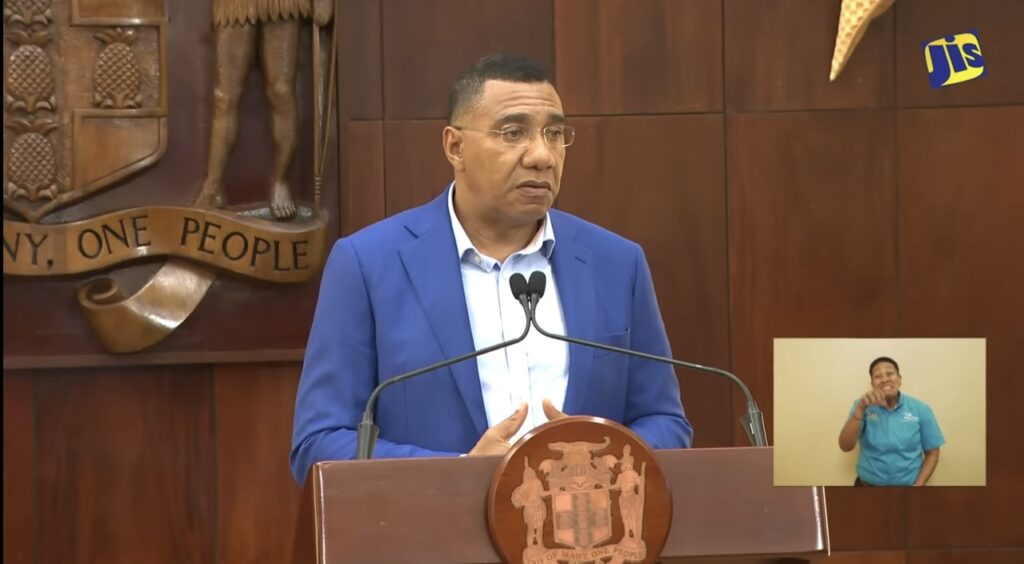
Address
By
Dr the Most Honourable Andrew Holness ON, PC, MP
Prime Minister of Jamaica
At the
Special Press Briefing: Tropical Storm Melissa
On
October 25, 2025
________________________________________________________
Good morning, Jamaicans, here and overseas, who may be watching this press briefing.
Firstly, a few comments on the system itself. The system is quite an unusual one, sitting in the Caribbean Sea for such a long time, making up its mind where it will go. It is obvious that it now has a trajectory where we can, with great certainty, say that Jamaica will be impacted. Let me be clear that the entire Jamaica will be impacted by this storm. The outer bands seemed to be very wide, and it is already affecting the Dominican Republic and Haiti with significant rainfall. We should expect the same.
The first impact that we should be preparing for would be heavy rains. Once it becomes a major hurricane, which is projected to be within a day, then we will have heavy winds. The third impact will be the length of time that it will stay. If it continues to be as slow-moving as it has been, then we could expect anywhere from two to three days or even longer. Those are the three things that should be in your mind, be prepared for.
Now, I know that there are many Jamaicans who are anxious, who are very concerned, and rightfully so. You should be concerned, but the best way to address anxiety and any nervousness and concern is to be prepared. I would urge all my fellow citizens, everyone who is now feeling nervous, anxious, uncertain, that now is the time to be prepared, and the elements of preparedness for a hurricane would be, first of all, you want to protect your shelter; that’s absolutely critical because in a hurricane, you need to be somewhere where you can be sheltered. Roofs, windows, start battening down.
I noticed that many Jamaicans are putting building blocks on their zinc and so forth. That is a solution, but a better option would be to use sandbags, which stay longer and are not likely to be blown off. If you can find plywood or anything of that form to protect your windows, that would be useful. We always say to remove threatening branches from trees. We have seen one incident where someone was injured trying to do that, so we advise that if you’re doing that, be super careful in doing so.
The next layer of preparation would be to look for areas that are vulnerable to flooding. If you find that your yard is below road level or in a water zone, meaning you have built in a river course, you are on a slope, you’re near to the sea, you are in a low-lying area, you are close to or on a gully bank, or historically you are in an area where the river may change course, you want to take protective measures. And again, simple sandbagging can be useful in directing water away from your shelter.
Once you have sorted out your shelter issues, then you have to look for sustenance, food and water. Make sure that you have food that is non-perishable and water that is in proper containers scaled to the number of persons who live in your household. Then you want to ensure that you have at least some form of lighting because it is highly likely that the electricity will go out either preemptively or as a result of the storm itself.
Batteries and flashlights are recommended. The good old home suite home lamp is always there, but we’re always very careful- that’s a last resort. Today’s technology with LED lights, you can have lights going for a little while at night. Solar lamps are always good to have. These are things that you would want to have in your possession.
Of course, in today’s world, telecommunications is important. Make sure you have at least some credit if you use prepaid plans, and keep your devices safe. We can’t give you any guarantee that throughout the storm you will have full coverage. It is likely that you may have some coverage at some point, but you should always in your hurricane plan, be prepared that you may be out of communication but nevertheless, keep your instruments safe. Don’t let them get wet so that at least if the signals were to come back, you’ll be able to connect.
Having done all of that, there is another important thing which we ask you to do. Keep your documents safe. Your identification, your passport, any prescriptions that you may need to be refilled, your land titles and all of those things, keep them safe, keep them in a safe place. Yes, there would be distribution of benefits without the need for identification, but that would be very limited. In fact, in the humanitarian relief and recovery phase, I would say that most, if not all, the distribution of benefits will require some form of identification because of the accountability issues that even though it’s a hurricane, we can’t suspend accountability. So keep your identification safe.
There are some other things that we would want you to do in being prepared. Speak with your children about the hurricane because they are going through their own uncertainty crises, which you may not immediately recognise. They may not take it seriously. Some may think of it as fun, and they may run outside and run in the rain playing football, and accidents can happen. We urge you to have a frank discussion about what to expect in a hurricane and why it is important to stay sheltered during the hurricane. We don’t want to have any deaths during the hurricane, and an important part of that is to keep your household safe inside.
Outside of that, communities are an important response tool to the hurricane. I remember during Gilbert, the community in which I live, everyone came together, and that helped to keep the community safe. It helped to deal with emergencies and just good old sitting down talking, dealing with the challenges that would’ve occurred. In today’s parlance, we say it helps with mental health. Community is important, look on your neighbour, reach out to your neighbour, find out what is happening, ask how you can help or ask for help.
Outside of that, there is the local government response, and Minister McKenzie would have addressed this issue of what the local government is tasked and resourced to do, and then there is the national response. Now, I know that at this time, there are many people who simply have no resources at all. They’re not able to go to the supermarket and buy even one bag of crackers. I am aware, and we have tasked the Ministry of Social Security to start to preposition supplies, but in reality, we wouldn’t be able to get supplies to everyone who is genuinely in need of the supplies. The most immediate first responder is usually either your church or your member of parliament, or your councillor, or the police.
We are going to make provisions for the councillors and the members of parliament to be able to, where they can, because they are humans too, and they wouldn’t be able to be out in the storm, but as much as they can, we will resource them to be able to assist. I will be clear with this, they will not be able to assist every case. It’s just physically not possible, but inasmuch as cases are brought to their attention, their network of workers and community activists and so forth would’ve brought cases to their attention, then we can assist.
We are very grateful and very thankful for the philanthropic organisations that exist in certain communities that are already starting to mobilise and doing work. We intend to reach out to most and cooperate with them and assist them in being able to get supplies and distribute which leads me to another point of preparedness nationally, and that at this time there must be a unified position with all the civic stakeholders and all our political stakeholders.
I have been in communication with the leader of the opposition. We should meet today at, I believe 12:30pm and I will give the opposition a full brief. I’m certain that they will have suggestions, which we will listen to and take on board. And if determined, then we will have a Zoom call with members of parliament. I know many of them are in the field, so it depends on how many we would be able to mobilise, but we have already provisioned them with resources to clean drains and gullies. I know many of them are out in the field supervising these works and from being a member of parliament myself and having gone through this many, many times over, your constituents are of the belief that every drain and every gully is going to be cleaned. That may not be possible.
Certainly, you would need much more equipment mobilised than we have capabilities to do much more supervision and so what the MPs would be doing would be trying to concentrate on the main ones, that is where their efforts would be. So, if you didn’t see the drain running behind your yard being cleaned, don’t believe that no work is happening. Work is happening, but it may not be in your locality. That is being monitored by the NWA and we’ll get a report very soon as to how many drains we were able to clean. That is indeed a very important preemptive action when it comes to treating with flooding.
So, outside of that, from an administrative point of view, all our entities have been tasked and mobilised. I suspect all the officers understand what the mission is. From all indications, it is going to be a direct hit and all of Jamaica will be impacted. I urge everyone to be wise about this, to put aside the nervousness and the anxiety and be practical. Prepare, as I have outlined how we should be prepared, and continue to pray.
We have seen hurricanes at the last moment take a turn for the better, and I still have hope that the impact will not be as bad as it is shaping up to be but we will prepare for the worst and continue to pray for the best. The impact, whatever it is, the preparation can have some mitigating effect on the impact, but the real work starts the hour after the impact. And what we have done in terms of national preparedness is to put everything in place to be able to respond the hour after the impact and that is how quickly we intend to recover from this hurricane.
Ladies and gentlemen, thank you.