
USS Nimitz Reception
Remarks
by
Dr the Honourable Andrew Holness ON, PC, MP
Prime Minister of Jamaica
at the
USS Nimitz Reception
on
June 2, 2026
—————————————————————————————————-
Thank you, master of ceremony.
Let me thank our hosts, Rear Admiral Cassidy Norman and Commanding Officer Joseph Furco, and other members of the command team of the USS Nimitz.
The Leader of the Opposition,
Members of my Cabinet,
Chargé d’Affaires Scott Renner,
Members of the Diplomatic Corps,
Other specially invited guests,
All friends, this is a good evening.
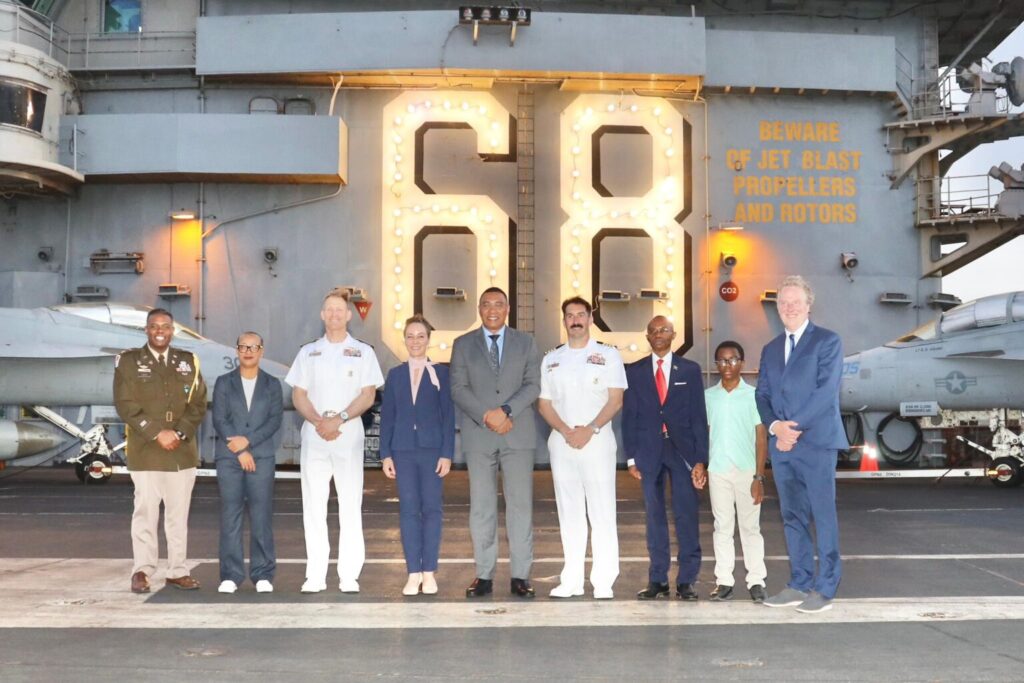
It is a pleasure to be with you this evening aboard the USS Nimitz here in Kingston Harbour. Indeed, I dare say that this may be the first time that a Jamaican prime minister has stood onboard a nuclear-powered aircraft carrier docked in Kingston Harbour, but I could easily say I believe it’s the first time a prime minister of Jamaica has stood on a aircraft carrier anywhere. On behalf of the Government and people of Jamaica, I welcome Rear Admiral Norman, Captain Furco, and the men and women of the USS Nimitz to Jamaica.
Every Jamaican knows that Kingston Harbour is the seventh largest natural harbour in the world. Some of us may have doubted whether or not a US aircraft carrier could be docked here in Kingston Harbour. Well, we are the seventh largest natural harbour in the world so yes, we can host the largest ships. It is deep enough to receive the largest vessels afloat and situated at one of the most strategically consequential points in this hemisphere within reach of the Panama Canal, positioned between North and South America, and at the intersection of the major maritime corridors linking Americas to Europe, Asia, and beyond.
Jamaica is, at its core, a maritime nation, even if most of us don’t always think that way, but yes, we are a maritime nation. Every barrel of fuel that powers our economy, every container moving through our ports, every ton of food that supplements what we grow, all of it depends on safe open sea lanes and our ambition is explicitly tied to this harbour and these waters.
Jamaica’s ambition is to become the logistics hub of the Americas, the premier node connecting global supply chains between the continents, a gateway comparable in function to what Singapore, Dubai, and Rotterdam represent in their respective regions. That is not a distant aspiration. It is an active national strategy with infrastructure, legislation, and investment already in motion.
That ambition, however, can only be realized if the maritime space is secure and the same geographic advantages that make Jamaica attractive to commerce also make these corridors attractive to those who would seek to exploit them for other reasons. Transnational criminal networks use these same sea lanes. They move firearms, and it is those firearms that have fueled gang violence that would have cost us so many Jamaican lives. They move narcotics. They probe every gap in maritime surveillance, every seam between jurisdictions. These are not abstract threats. When a weapon is intercepted at sea, it is a weapon that does not reach a community in Kingston or Montego Bay or Spanish Town.
Jamaica has been deliberate and strategic in building the partnership that address these threats. Through our cooperation with the United States Southern Command, the United States Navy, the United States Coast Guard, and other law enforcement partners, we have developed real operational capacity in intelligence sharing, maritime domain awareness, joint interception, and the training of our own forces. This is not security that happens to us, it is security we have worked to shape as sovereign partners with our own analysis, our own interests, and our own judgment.
I want to say something about the nature of that partnership because it matters. Small island states in the Caribbean are sometimes spoken about as if geopolitics is something done to them rather than something they participate in. That has not been Jamaica’s experience, and it is not our posture. We engage with the United States as equal partners with shared interests, maybe not identical interests, but substantially aligned ones. The basis of that relationship is mutual respect, operational trust, and a clear-eyed understanding of both sides of what we each bring to the partnership. That is the foundation on which it operates and the foundation on which it will continue to operate.
The USS Nimitz is here as part of Operation Southern Seas. The presence of this vessel is a signal that the United States takes this hemisphere seriously and takes its partnerships here seriously and our being on this ship here tonight is a clear signal of the value we each place on this partnership.
Maritime partnership means much more than security operations. When Hurricane Melissa struck last October, the capacity to respond quickly, to move supplies, restore communication, and coordinate relief was also a function of a maritime space through which regional and international partners could provide logistical and operational support. And here, I would like to thank the United States for supporting Jamaica’s recovery and humanitarian efforts, particularly with airlift capacity.
As climate risks intensify in the Caribbean, this dimension of our partnership will only grow in importance. A secure well-governed maritime space is the precondition for everything else we are trying to build. To the sailors and officers of the USS Nimitz, the work you do is largely invisible to the people who benefit; that is the nature of effective deterrence. There is no press conference when a threat is quietly neutralized, no headline when the sea lane stays clear; not these days, however, we see it nonetheless, and we are grateful for it.
I’m also told that among the crew of this vessel are many women and men of Jamaican heritage, Americans who carry Jamaica with them in their names, their families, and their stories. To you especially, welcome home. You represent something important about the ties between us, between our two countries, ties that are not only governmental or commercial, but human and familial, running across generations and across the waters. We are proud of you. I hope that all of you, whatever your background, will have the opportunity while you are in Kingston to experience the warmth, the culture, and hospitality that Jamaicans are known for, because Jamaica, like most things worth knowing, is better understood close up.
To Rear Admiral Norman and Captain Furco, thank you for the spirit in which you bring this vessel into our waters. To Charge d’Affaires Renner and the team at the United States Embassy, thank you for the consistent substantive work of keeping this relationship grounded in practice, not just in principle. The relationship between Jamaica and the United States is broad and longstanding, built on shared history, family ties, trade, and the movement of people between our countries across generations. We value it and we intend to keep building on it.
To my Jamaicans here this evening, look around you. The USS Nimitz is the lead ship of its class, one of the largest vessels ever constructed, and to my knowledge has never before docked in Jamaican waters. I cannot say when or whether such an occasion will come again, so let this moment register. Take in the sheer scale of what surrounds us and let yourself feel what it means to have this vessel here as a symbol of friendship and partnership from our longstanding close and critically important neighbour in the region, United States of America.
God bless you all.