
Prime Minister Holness Envisions New Era of Regional Energy Security Driven by Caribbean Resources
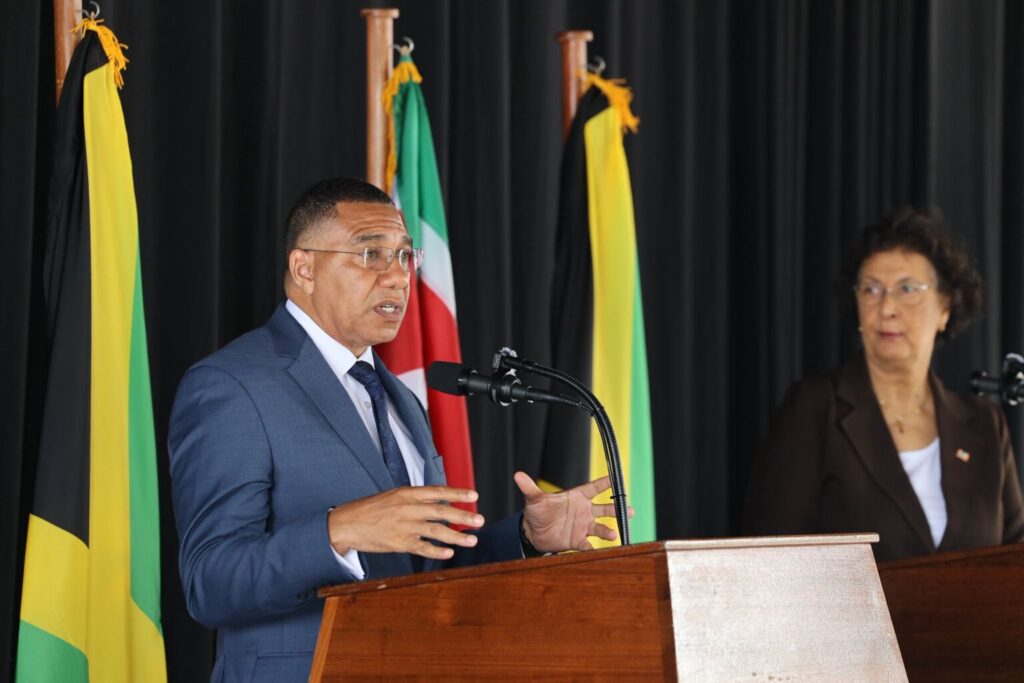
Prime Minister Dr the Most Honourable Andrew Holness has expressed strong optimism about the future of energy security in the Caribbean. He highlighted an unprecedented opportunity for regional cooperation, energy independence, and sustainable economic growth through the development of indigenous energy resources.
Addressing regional leaders, investors, and industry stakeholders at the Suriname Energy, Oil and Gas Summit and Exhibition (SEOGS 2026) yesterday (June 23, 2026) in Paramaribo, Suriname, Prime Minister Holness underscored the importance of a balanced and practical energy strategy. He emphasised the need to combine traditional and renewable energy sources to secure the region’s future.
“Because we are realists about the climate, we must also be realists about energy. The responsible path is oil OR renewables. It is a pragmatic mix. Oil, gas, solar, hydro, and eventually nuclear. That keeps the lights on while we build a cleaner future our children deserve,” Prime Minister Holness stated.
The Prime Minister noted that the Caribbean is now positioned to achieve a level of energy security previously beyond reach, driven by significant discoveries and developments in Guyana, Suriname, Trinidad and Tobago, and potentially other nations across the region.
“Something historic is now possible. Among Guyana, Suriname, Trinidad and Tobago, and perhaps in time others, including Jamaica, this region holds world class resources that open an opportunity we have never had before; energy security supplied within our own family,” the Prime Minister said.
The Prime Minister continued: “Producers supplying reliable oil and gas at fair and predictable prices will give islands the runway to scale the renewable energy solutions that suit them best.”
Prime Minister Holness emphasised that greater regional energy cooperation would help shield Caribbean economies from volatile international energy markets while ensuring more stable and predictable energy costs for households and businesses.
The Prime Minister noted that energy independence would allow Caribbean nations to retain greater value, capital, and decision-making authority within the region while reducing vulnerability to external shocks and fluctuating global energy markets.
The Prime Minister also outlined Jamaica’s ongoing efforts to strengthen its own energy resilience. While noting that Jamaica imported nearly US$2 billion in petroleum products and natural gas in 2024, Prime Minister Holness emphasised the government’s determination to diversify the nation’s energy mix and reduce its exposure to international price volatility.
“Today, Jamaica is taking charge of its own energy future. We are seriously exploring our offshore frontier, and early-stage seabed work completed this year has returned encouraging preliminary signs of a working petroleum system. While these are early days and no promises are being made, we are cautiously and prayerfully optimistic,” Prime Minister Holness noted.
In the meantime, Prime Minister Holness congratulated Suriname on reaching a transformative stage in its development journey. The Prime Minister noted that the Grand Morgu project, supported by recoverable resources estimated at more than 750 million barrels, approximately US$10.5 billion in investment, and planned production capacity of 220,000 barrels per day, represents a landmark achievement not only for Suriname but for the wider Caribbean.