
JSE 21st Regional Investments & Capital Markets Conference
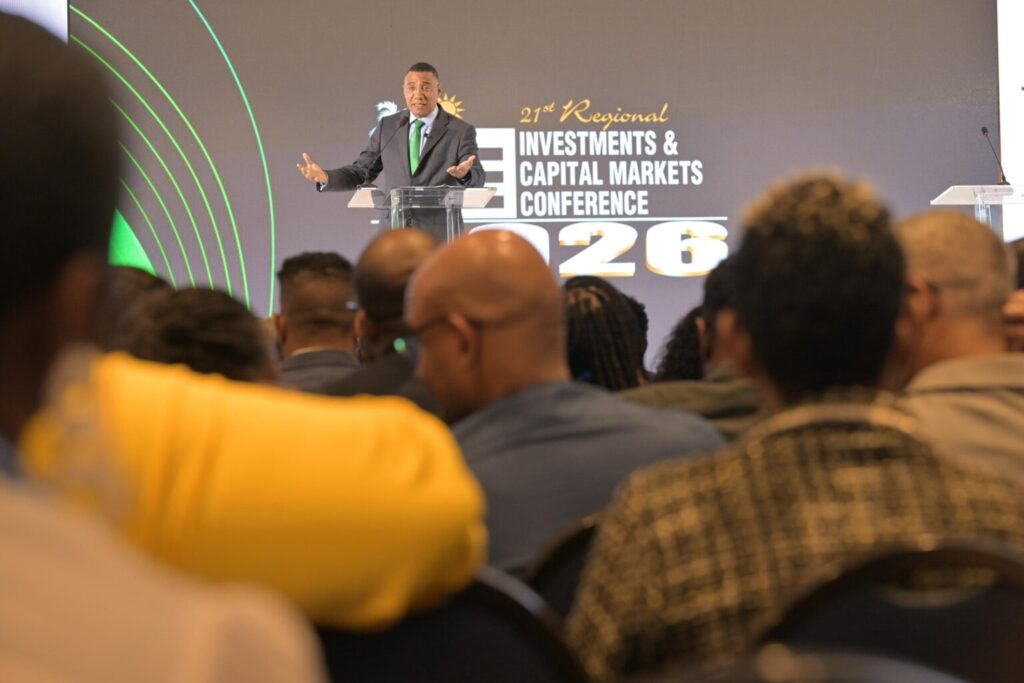
Keynote Address
by
Dr the Most Honourable Andrew Holness, ON, PC, MP,
Prime Minister of Jamaica
at the
JSE 21st Regional Investments & Capital Markets Conference
On
January 20, 2026
—————————————————————
Let me repeat my Happy New Year greeting and best wishes for healthy, happy, productive, wealthy, peaceful, and of course, prosperous 2026.
Let me give commendations to the Dinthill choir. Clearly there is a vast reserve of talent in the country and Dinthill is one of those fields that we will have to tap for our talent in oil. Yes, there are some of you who thought that I would’ve been knocked down in the last boxing match. I got a few punches but I’m still standing strong and I’m here with you today. This would be, maybe about my 11th time presenting at this conference, and it is always a pleasure. It is indeed what I call a calendar event. They don’t ask me, Prime Minister, are you going to attend this, they just put it in the diary because they know that I will be attending. I give God thanks that I have been able to be with you for all these years, and again, my commendations to the Jamaica Stock Exchange for hosting this very important event.
Allow me to acknowledge my ministers:
Minister of Finance, Fayval Williams,
Minister of Industry, Investment and Commerce, Senator Aubyn Hill.
I’m seeing in my script Delano Seawright. Is Delano here?
Members of the Diplomatic Corps,
His Worship the Mayor, Mr Steven Whittingham,
Mr Livingstone Morrison,
And Professor Angus Young, Chief Executive Officer of NCB Capital Market, Professor of International Relations. Thank you for your treaties on Caribbean geopolitics and global hedge money.
Our longstanding friend, Mr Gregory Fisher, Managing Director of Jefferies. As usual, we pay close attention to your perspectives,
And The Doyen, The Darling, the Honourable Marlene Street Forrest. How are you, Marlene? You’re looking resplendent as usual.
Executive representatives of public agencies, private sector entities, and financial and academic institutions,
And my favourite catchall greeting; all nice and decent people gathered here today. It’s good to be with you. It’s a privilege to join you at this important Regional Capital Markets Conference convened under the theme “Capital Markets Fuelling Economic Resurgence and Resilience”.
Just under three months ago, on the fateful day, October 28, 2025, we faced one of the most severe natural disasters in our modern history. And just to clarify, this was the third most powerful hurricane produced in the world, whether Pacific Cyclone or Hurricane in the Atlantic and it was the second most powerful hurricane in the Atlantic. So, without question, we were hit by one of nature’s most powerful blows and yes, we had a plan until we got hit, and that’s the nature of life. The test is not that you were hit, you are going to get hit in life. The test is whether or not you can get back up. And yet here I stand before you today, and yes, Jamaica is standing up before you today as well.
Jamaica has that only weathered the storm, Jamaica is recovering rapidly and Jamaica is moving forward with purpose. The true measure of resilience is not simply how a country responds in the immediate aftermath of a shock, but how quickly emergency response transitions to normal economic life; that’s the true measure.
By that measure, Jamaica’s recovery is well advanced. Today, approximately 93% of households have electricity restored. Water systems are also over 93% restored, but recovery is not only about the utilities, it is about whether the economy is functioning. Today, businesses are reopening, workers are returning to their jobs, transport routes are operating normally, schools, clinics and public services are functioning, and commercial activities and the informal economy have resumed right across Jamaica. This is not to say that there are not persons who have been dislocated, businesses that have not reopened, but generally having been hit by a Category 5 Hurricane, when you compare Jamaica’s relief and recovery to its peers that have been similarly hit, some who would have motherlands as Professor Young pointed out, we don’t. So, when you compare us to our peers, we have exceeded them and when you compare us to other developed countries, if you look at Katrina and other events like that, you will see that Jamaica’s recovery, for similar or worst type disasters, that we have done fairly well.
Just last week, Jamaicans saw this recovery reflected vividly on the ground in communities such as Border, between St Elizabeth and Westmoreland, vendors and small operators, many of whom were directly affected by the storm were back in business. Stalls reopen, trade resume, the daily rhythm of economic life returning; these are concrete indicators that confidence has returned and that confidence matters not only to households and small businesses, but to investors, lenders, and capital markets assessing the strength and trajectory of the Jamaican economy.
Today, Jamaica is not in crisis mode. We’re not in emergency stabilization. We’re moving forward with purpose. Another powerful indicator of Jamaica’s market confidence was a recent action of the rating agencies. In the closing weeks of 2025, all three major international credit rating agencies, Standards and Poor’s, Moody’s, and Fitch reaffirm Jamaica’s Sovereign Credit ratings with a stable outlook. Standard and Poor’s maintain Jamaica’s BB just two notches below investment grade. Can you imagine when we reach investment grade? Moody’s actually upgraded Jamaica to Ba3 and Fitch affirmed Jamaica’s BB-.
In the aftermath of a Category 5 hurricane this is extraordinary. Just imagine how the same rating agencies would’ve viewed Jamaica just over a decade ago. A shock of this magnitude would’ve inevitably resulted in ratings downgrades and pushed Jamaica into macroeconomic and debt crises. The rating agency cited Jamaica’s strong fiscal buffers, the credibility of our institutional framework for fiscal prudence and debt sustainability, the effectiveness of our multi-layered disaster risk financing strategy, and the speed and coordination of the government’s response. All of this tells the world that Jamaica’s economic resilience is well reinforced by design, not by accident, deliberate, intentional, instrumental.
Long before October 28, 2025, we had already put in place a multi-layered disaster risk financing framework, the product of years of strategic planning, discipline, fiscal management, and proactive investment in national resilience. The framework was, as I said, deliberately designed to ensure that when a disaster strikes, the government would be able to respond immediately, credibly, and without destabilizing the economy. That preparation has proved decisive in our post Melissa response. At the domestic level, we had approximately $5.3 billion available in the contingencies fund, that’s from our budget, and $1 billion in the National Natural Disaster Risk Disaster Reserve Fund, which provided some immediate fiscal flexibility, that’s from savings. And we had a little debate in Parliament about what should be the ceiling for the fund and what it demonstrated is that I don’t believe there is full understanding of the disaster risk management strategy of the layered financial strategy that we have put in place, or even a proper understanding of the fiscal strategies that the Ministry of Finance has employed to ensure that we can respond effectively. I think that when you compare what has happened in the past to what has happened now, the management of Jamaica’s fiscal affairs today is far superior than anything that we have experienced before in the past.
Now, at the regional and international insurance level, Jamaica received US$91 million from the Caribbean Catastrophe Risk Insurance Facility, one of the largest payouts ever made in the region and our US$150 million catastrophe bond was triggered automatically based on parametric thresholds delivering liquidity without delay, negotiation or conditionality.
At the contingent credit level, we had US$285 million available through the Inter-American Development Bank’s contingent credit facility, which was swiftly upside to $300 million. We had us $42 million scalable to US$84 million available under the World Bank Catastrophe Deferred Drawdown Option. Taken together, this meant that Jamaica had approximately US $662 million in liquidity available almost immediately following the hurricane. You have to ask yourself, why did we have this? It was not an automatic thing that happens each time or for every country that has a hurricane, all of these were prearranged. It was planned, put in place to finally, once and for all, acknowledge that Jamaica is going to be hit by a shock, an exogenous event over which we have no control, but that is not an excuse. That has been the cycle in which we have been caught up for the last 50 years. Each time that we are hit by a shock, we are not prepared, and then we blame the shock.
The difference with this government is that we don’t blame shocks. We don’t blame external events. We don’t blame external powers. We take responsibility and we put measures in place. That’s the difference. We don’t look at the rain and ask it, why is it raining. We don’t look at the hurricane and say, why did you come. We don’t argue with nature. We prepare for nature, for politics, for economics and we work for peace. This is planning, preparedness, and responsible governance in action. It ensured that Jamaica did not wait helplessly for assistance. We were ready to act to protect our people while maintaining market confidence and economic stability but Melissa was without precedent in terms of its scale, the extent of infrastructure damage, the displacement of thousands of families, the destruction of livelihoods and the long-term economic implications meant that while early liquidity was essential, additional financing was required, not merely to repair damage, but to rebuild Jamaica stronger and more resilient than before.
In the weeks following the hurricane, we engaged intensively with the leadership of the International Monetary Fund, the World Bank, the IDB and CAF, that is a Development Bank of Latin America and the Caribbean Development Bank. The G20 provided the platform on which this intense engagement was executed. I pause here to reflect that this is the second time that Jamaica has been invited to participate in the G20. Jamaica is not a G20 country. We’re not, but we are recognized for how we have managed our affairs. This is a new era of diplomacy. It’s a new era of geopolitics. The old era, which some people are still stuck in, and how they see the world and how they expect the world to respond to them could not survive in today’s world. And we have to establish that clearly.
I hear the commentators, many of them seem to be stuck in an era. Where they believe the world owes them something. You have to be able to find your way in the world. You have to be able to find the opportunities, mitigate the threats. There is a generation that still thinks about political independence. What I’m struggling for is Jamaica’s economic independence. You can talk all you want about your political independence. At some point, you have to be able to back it up with your economic independence.
So, Professor Young, thank you for that. Again, well-written treaties. Every country has to play for their interest and sometimes we don’t do a good job in explaining to our population what are the interest, but one thing you will be assured of is that this government is going to ensure that Jamaica’s best interests are always forefront in our minds, and we are always advocating and pursuing it which means that we must always have access and we must always be at the table. It’s not always going to go our way, but we must always have access. We must always be able at some way; some level to have the proper exercise of state craft to exert influence through various forms of power. Even small countries have power. Some people just don’t understand the new state craft as to how you exert that and how you use that. For us and for this administration, pursuing economic independence ultimately will result in your political independence.
For many years, Jamaica has been diverted into all kinds of ideological fantasies that resulted in us wondering in the wilderness of economic despair. We will not do that again. So, when we are faced with these challenges, we are not afraid to go on the international stage to ensure we have access so that we can speak with credibility because we have demonstrated that we are a responsible country with strong institutions and so the result of that is that we were able to secure $6.7 billion in financing.
Now, I can hear the sitting say, but those are loans. Some of it would be grants, but the real secret is the access to low-cost financing with very little conditionalities. In fact, conditionalities which align to the things that we have to do and should be do and are doing anyway. If this had happened, 30 years ago, the cost of the financing would put us in a debt trap and then we would turn around and say the international community created a debt trap for us. I know it sounds harsh, and I’m expecting the critics to come out of the woodwork tomorrow. I’m ready for them, but that’s the reality.
And why am I saying this? It is important that all of you here who are investors understand that government will not put your investments at risk. You can be assured that we are not going to wander off into political fantasies that put your investments at risk because no matter what, there is an inextricable link between politics and economics. You have to play the politics right to make sure that your economy works well and not all countries in the region have this very good relationship between the government and the private sector. It is one of the assets that Jamaica has, and we should make sure it is preserved. And I say this to our Jamaican private sector, which is not just NCB. Our private sector is also the lady frying that fish in Border. In fact, she’s more of the private sector and I am not going to do anything that will prevent her from having her fish sold to local and foreign tourists so she can send her children to school because that is how you preserve and build the dignity of the people. I want that message, which is unscripted to percolate and filter throughout the audience.
We were able to secure US$3.6 billion in sovereign debt financing and $2.4 billion in private capital mobilization. And of course, we had already accounted for the US$662 million but I want to focus on the $2.4 billion because yes, the available financing which will be directly to the government will have an impact on our debt to GDP ratio without question, but we are not going to able to mount an effective reconstruction without the partnership of the private sector, and there is $2.4 billion in this package for the private sector, for new businesses and new enterprise, new infrastructure, rebuild and reconstruct hotels, and farms and businesses. I use this opportunity today speaking to the private sector of Jamaica and our friends internationally, that the hurricane possibly sending us a message came ashore at new hope. We must not waste the crisis that the hurricane would’ve create which is, if you flip it around, it is an opportunity to reconstruct and rebuild all of those parishes who were before the hurricane in need of major investment. Now we have the opportunity to actually do the investment with the financing.
All the businesspeople from the corridor stretching from Manchester going through St Elizabeth, into Westmoreland, into Hanover, into St James, into Trelawney, into St Ann should be thinking, how can I be a part of this. The projects that I had developed, and I just couldn’t get it financed, now is the time to say let’s go with this project. The financial intermediaries now is the time to be preparing because when we do the reconstruction, we’re not just going to rebuild what was there, we’re going to build things that weren’t there before. We’re going to be building forward, not just better, but we’re going to be building forward.
I see the hurricane as an opportunity for investment induced growth. That’s what it is, and I encourage the private sector to see it in this way. We’re currently focused on recovery from a climate related shock. It is important to realize that we are in the midst of a highly unsettled geopolitical and geo-economic environment, and we are operating in a world marked by rising geopolitical tensions and economic fragmentation where trade relationships are being reshaped, where strategic disputes have intensified, and even longstanding alliances are under strain.
In such an environment, climate events, geopolitical tension, supply chains disruptions, financial volatility and security risks, do not occur sequentially. They overlap and they reinforce each other so for a small open economy like Jamaica, this global environment reinforces a simple but critical truth. We have to remain prepared for our economy to weather external shocks of all sorts, and we must be prepared not only for hurricanes, but for a broad range of external shocks, climatic, economic, geopolitical, and financial that will test our system simultaneously. Resilience is therefore no longer optional. We have to be thinking in resilience.
We’re going to reconstruct the areas that were damaged, but we’re going to do it with a forward thinking. We’re going to seek to include new businesses and new infrastructure, including new towns, new roads, new schools, new hospitals but there’s one important thing that we have to also do, we have to build them with the next hurricane and the next shock in mind. We have to build them with resilience so we’re not going to rebuild the hospital that is right on the sea. And if you think about it, Falmouth Hospital is right on the sea, the Black River Hospital is right on the sea. We’re not going to do that anymore. We’re going to move them inland. Black River is at or below sea level. We’re going to have to figure out how we over time rebuild the town, but in a safer way so resilience is a critical part.
We have decided that we’re going to establish the National Reconstruction and Resilience Authority, an institution mandated to coordinate post-disaster reconstruction and long-term resilience building. This will be a centre of excellence, a single point of coordination, a platform for public/ private partnerships, which we will be reaching out to the private sector in a deliberate way to see how we can partner to get the projects that you had in mind for the area, new projects, financed and executed and it will be a bridge between climate resilience and economic development.
In a few days, I will be making further announcements about where we are with NaRRA. We have just put out an advertisement for an executive officer to lead the entity. We have established it temporarily as a department of the Cabinet office. Tomorrow actually, the Cabinet meets to make the final decisions as to the organizational structure, the governance, the short list of initial projects that it will undertake, and the legislative agenda.
You will recall that last year when I addressed this event, I put out there that we are going to have SPEED, the government’s attempt to deal with Jamaica’s growing and very dense bureaucracy. Well, we’re going to use the hurricane as the test case for how we can introduce SPEED in the Jamaican bureaucracy to get these projects that must be done quickly. And I also said that we’re going to pivot to growth. Well, there is no better pivot than to do the investments that will induce growth because of the hurricane. So, the things that I had announced not knowing that there would be a hurricane, we must now use them to the advantage to recover the loss in economic value and output that resulted from the hurricane, but more than that to put Jamaica on a better position to grow even faster. Just think of it, when has Jamaica ever had at its disposal $6.7 billion to spend on building its economy. Jamaica’s economy in terms of current value may be about $21 billion. Just think, if we do it right, if we get it right and add in a synergistic way, $6.7 billion of value to the economy, that’s a sea change in Jamaica, and that’s what NaRRA will be established to do, to make sure that we secure the benefit from this infusion of new financing into the country. And so, businesspeople I know are already thinking, how can we be a part of this and the government is open, we want the partnership with the private sector to do this because government can’t do it alone. We don’t have the absorptive capacity to do this by ourselves so it must be done with the private sector. So again, I make the appeal to our private sector leaders, get ready.
But there is another element of our recovery and our performance that I want to grab your attention with, and that’s a discussion on public safety. No discussion on economic confidence and investment would be complete without addressing public safety. Here too in Jamaica, we have made extraordinary progress on this. In 2025, Jamaica recorded 42% reduction in homicides compared to 2024. Let me clear, this is not a fluke. In 2023, we had an 8% reduction. In 2024, we had a 19% reduction, and in 2025, we have had a 42% reduction. As of today, we are 50% below last year this time. We track it every day.
Let tell you, I wake up first. I have a routine. I informationalize. I check the headlines, read whatever important articles, look through my emails, but one of the things I do, I call up some of the ministers and or critical sector leaders, and one of the important calls I make almost every morning is, what is the murder rate? It’s one of the calls the commission of police, I’m sure he knows when he gets that call why I’m calling him, because you can only manage what you measure and that’s what we have been doing. We have been very clinical, very strategic, very deliberate, and very committed to reducing the ultimate index of violence in the society, which is the murder rate.
It was one of those intractable problems that many of you here would’ve thought Jamaica would never be in that position. There are still those who are trying to find all kinds of reasons to say it is not real. Well, aside from El Salvador, Jamaica is the only country in the region to have achieved this, and as I’ve said we’re going into our fourth year. The plan, because all of this is by plan, it’s not by accident, we established Plan Secure Jamaica, and we backed it with a $90 billion budget investing in our security forces, and we are now reaping the results. The next phase of the plan is to move the society to peace.
There are two elements to the public safety issue in Jamaica. The first element is organized criminal enterprises that use violence for economic and social control. We euphemistically call them gangs. Now, they’re not some disadvantaged youngsters who are on the fringe of the society. No, no, no. These are people organized for illicit activity, whether it is human trafficking, drugs, other contraband, cyber; all kinds of things, and they take life in the pursuit of their economic activities or they seek to control communities to cover their illicit activities. If unchecked, they become a challenge to the state. In other words, they become another power that could challenge the state.
I want to put it in context. That is what was happening in Jamaica. Criminal enterprises were challenging the state. Whenever that happens, if it is not checked, the end result of it is Haiti. Now, if you look across several countries in South America, most recently Guatemala, before it was El Salvador, Honduras partially had that problem, Peru, Ecuador; all of those countries have that problem. Right in our region, Trinidad, the Turks and Caicos, St Kitts, St Lucia; all of them had that problem. The narrative is very limited and does not acknowledge that we face that threat, but I am not fooled, neither am I deterred by the shallow narratives that are in the public space about what we have to do to reduce this threat, this very real national security threat. We have reduced it and we continue to erode it, so that’s one element.
The second element is social violence, the use of violence in social interactions, intimate partner violence, violence in the disciplining of our children, violence in the family which we call domestic violence, and just general violence in our social interactions. That level of violence has become almost cultural. We cannot, as a people resolve conflict without violence. I am not speaking to you as a social scientist. My presentation is to people who understand business and economics. Violence has an economic cost. Violence places a limit on your economic growth horizon. If we could have had 6 million tourists coming here for every time there is a negative travel advisory, consider that people who have to think about insurance to travel, they change their minds. There are certain markets that you won’t get into when your stats are reviewed.
There are those who would say, violence is a social issue, it’s because of economic deprivation and persons who are marginalized, without thinking that those persons actually create the marginalization by placing a limit on our economic success by the decisions they make to become criminals. I know what I said is harsh for many, but just think, not every youth in the ghetto takes a up gun and becomes a criminal. Why should the good ones who don’t do it, who are the majority, 95% of them suffer for the 5% that do? Until our society stands up in unison and say no more of this, we will be just, we will provide you with the opportunities, we will seek to ensure that you are properly integrated into society, but there will be firm consequences for you if you decide to pursue a life of crime and deprive everybody else of their safety.
Until we get rid of this ambivalence in the society, we’ll always be at risk. Businesses will have to pay more for security. Homeowners will have to pay more for security, reduces your productivity, reduces your enjoyment and pursuit of happiness. It is a cost to our country. Most of all, it destroys the brand that keeps people coming here. The brand of Jamaica, the peaceful country, Jamaica, no problem, man, Jamaica, the country of equity and fairness and social justice; those people who do that must face consequences.
Let this be the decade where we remove that from our society in the same way that we have achieved fiscal discipline. Let us use this decade to eliminate violence from our society. Let this be the decade when Jamaica truly attains peace, and this will reinforce our economy and the very people who claim that they’re involved in crime because they have been marginalized. They too will have the opportunity to share in this economy, to become stockholders and shareholders and start their small business. We want you to become business owners. We want you to become entrepreneurs because much of the effort that they put into crime, if they were to put it into business, they would be successful.
Another critical element since I have stirred you up with that presentation is the cost of energy. Growth also requires addressing structural cost drivers. Energy costs remain one of the most important constraints on productivity in small island economies, and this is a major area of focus for the government as part of the pivot to growth. That is why the government issued the notice to JPSco in July 2025 regarding the license, which expires in 2027. We have appointed consultants and commenced the process of negotiation with JPS to see whether there can be mutual agreement on new license terms that will result in a path to lower electricity cost, expansion in renewable energy capacity, improved customer service and accountability, as well as improved grid resilience to natural disasters.
Not only are we going to renegotiate the license, we did not allow the hurricane to change us from that path. Maybe some other government would’ve caved in and say, well the disaster, let’s not try to renegotiate. No, we are firm on the path that we must renegotiate the license for a better license that will bring down the cost in the long term and at the same time, we facilitated the JPS with a loan that will get the grid back up so that the economy can be restarted and that is actually now what is happening very quickly after the hurricane.
The last issue I want to deal with is the financial sector and capital market reforms. Professor Angus Young also addressed that in the last part of his presentation. Jamaica’s current financial regulatory framework was shaped largely in the post FINSAC era at a time when our macroeconomic reality was fundamentally different from the one we inhabit today. It was constructed in a period mark by vulnerability and low confidence with an overriding necessity to restore confidence and stability to the financial system.
Let me say unequivocally, that framework has served Jamaica well. It has delivered financial stability, strong and credible prudential oversight, sound well-capitalized institutions, and systemic resilience across the financial sector as a whole but regulatory frameworks are not meant to be frozen in time. Jamaica’s regulatory architecture was forged in an era where the central imperative was risk containment to stabilize and economy merging from crisis and to protect the system from failure. It has been a phenomenal success in achieving that mission. We now have a responsibility to build on that success. The architecture that once focused primarily on risk containment must now be recalibrated to enable opportunity. The same framework that shielded Jamaica in a period of vulnerability must now be adapted to support expansion, innovation, and scale in a period of strength. This is not a repudiation of what has worked. It is the next logical step in Jamaica’s economic evolution.
Today, Jamaica operates in a vastly different macroeconomic environment with significantly lower public debt, robust external reserves, credible and durable fiscal anchors, and deeper more sophisticated domestic capital markets. The risks we face today are different. The instruments available to us are more complex and the opportunities before us are far greater. It is therefore time deliberately, responsibly, and transparently to revisit and modernize elements of the financial regulatory framework, not to weaken stability, but to ensure that regulation is aligned with evolving risk profiles, increased market sophistication, innovation in financial products and instruments, and the imperative for capital markets to play a more dynamic role in fuelling economic resurgence and resilience.
This is not deregulation, but smarter regulation for a stronger economy. Stability remains non-negotiable. Financial soundness will be protected, but stability must now serve as a platform for growth, not a ceiling for growth. The regulatory regime must evolve. It must continue to preserve confidence, but also focus on unlocking capital, deepening markets, and positioning Jamaica’s financial system to support the next phase of national development. I will not be making specific policy announcements today; however, I wanted to give you an indication of the policy direction. Those who know what I have said in these coded words, understand exactly where we will be moving, which is why I’m saying the private sector is a critical partner, get ready. We must create opportunities.
As we approach the upcoming budget presentation, the government will be bringing forward initiatives that are consistent with this approach, initiatives that strengthen our capital markets, modernize elements of the regulatory framework and ensure that Jamaica’s financial system is fully equipped to support economic resurgence and long-term resilience.
Ladies and gentlemen, Jamaica’s story after Hurricane Melissa is not a story of fragility. Finally, we’re not a fragile economy. Well, there is still areas of fragility, but considerate we have been hit by a global pandemic once in a hundred-year event, several tropical storms, then we were hit by Beryl, immediately have to Beryl, unseasonal rain which destroyed our road network. People forget about that. Three weeks of rain every day across the country, and then the following year, hurricane Melissa, then drought. Almost for every year drought and we’re still standing, still viewed with optimism.
Yes, narramet with some fisher folk on Friday because there were some ladies who were pointing to their boats that were destroyed. And the funny thing is, there’s one gentleman who was saying, look at the boats, all of the boats were destroyed, and the government must act quickly. So, we asked him his name, and the minister took his name, went on his phone, and sent a message to his technical officer and said, what’s the situation with this gentleman? And then the person sent back a message to the minister to say, yes, he got his grant of almost a million dollars to repair his boat which is just a part of the Jamaican experience. He was there advocating that government needs to act, but he’s not saying a word that he got his grant already.
I say this to say that sometimes we’re hard on ourselves. We must never forget the poor and those who are dispossessed but we must not act as if that is the totality of the Jamaican story. We must always remember we are a blessed people and as bad as it was, it could have been worse. We were spared the worst and we must not frown on that blessing. We must be grateful to God, and we must use that reprieve as the basis on which we move forward in confidence with vision in unity that we will rise from this challenge better than we were before.
God bless you and thank you.