
Official Opening Wisynco Brewery and New Manufacturing Facility
Remarks
by
Dr the Most Honourable Andrew Holness, ON, PC, MP,
Prime Minister of Jamaica
At the
Official Opening Wisynco Brewery and New Manufacturing Facility
on
January 13, 2026
——————————————————————-
The year is still new, so allow me to wish for everyone a happy, healthy, peaceful, fulfilling, wealthy, productive, and prosperous 2026.
Allow me to thank the Masters of Ceremony,
And allow me also to acknowledge Ministers Hill and Charles and our ministers of state who are present with us.
I’m searching to see whether or not Mayor Leon Thomas is here, and of course, Member of Parliament, Alando Terrelonge, Minister of State. You showed me a picture. It was 10 years ago. I had a full head of black hair then, William, and so did you, and Andrew, thanks for the invitation. Indeed, it is my pleasure to be with you today.
Today’s ceremony is far more than the official opening of a new facility. It is a statement about the direction of Jamaica’s economy, the maturity of our institutions, and the confidence that serious investors now place in our country’s future.
We are gathered here at Lakes Pen, St Catherine to mark a significant expansion of Jamaica’s manufacturing capacity, but also to recognize something deeper, the ability of Jamaican enterprise to think long-term, invest boldly, and compete at international standards. This new bureau and manufacturing facility reflects not only private sector ambition, but the cumulative results of years of disciplined national reform.
For six decades, Wisynco Group Limited has grown alongside Jamaica itself, evolving from modest beginnings in one of the most sophisticated, fast moving consumer goods manufacturing and distribution undertaking in the region. The journey mirrors Jamaica’s own economic transformation from vulnerability and volatility to stability, credibility, and opportunity. This facility stands as the latest chapter in that shared story of success. Manufacturing matters not only because it creates jobs, but because it anchors productivity across the economy. It deepens value chains, drives skills development, supports exports, and creates resilient employment that is less vulnerable to external shocks.
In today’s world, shaped by disrupted supply chains, geopolitical fragmentations, heightened strategic competition, and growing climate related risks, countries that can produce competitively at scale and to international quality standards are better positioned to sustain growth and recent developments in our region and hemisphere have only reinforced this reality.
William, in his presentation, gave us some statistics. He pointed out that in 2016, the best estimate for Jamaica’s GDP was about US$16 billion. You may have confused it when he went on to say that Wisynco’s total revenues were $60 billion, he meant JMD$60 billion but the country’s GDP at that time was US$16 billion. Can anybody tell me what the GDP is today? The best estimates would be between 20 to 21 billion US dollars, and it sounds like we have done a lot. It sounds like we have grown rapidly. The truth is that if you were to strip away inflation from that, our real GDP at constant 2016 dollars would be somewhere around about 17 to $17.5 billion.
I’m just trying to read the faces in the audience to see if that sunk in had made any impact on you. The point here is that for us to grow, our productivity needs to exceed inflation, and for that to happen, we need to invest in plants, in infrastructure, that is going to increase rapidly our productivity. Unfortunately, our economic thought at present does not make the connectivity between productivity and inflation. We see the two things as separate, but our government policy has been very effective at managing inflation.
In fact, what we have done in the last decade with the Bank of Jamaica and our monetary policy is to focus exclusively on controlling inflation, targeted control of inflation and that has been fairly successful. We need the flip side of that policy, which is to target productivity to increase the output of the country. There are many dimensions to this productivity problem. Today, I won’t get into all of them, but just to list issues to do with labour productivity.
For example, issues to deal with infrastructure and how infrastructure supports productivity. I mean, let’s put it in practical terms. If you have to move from this warehouse and your production facility, and every step of the way you are encountered with potholes and traffic congestion, it adds cents to your cost which for every unit of product accumulates to the bottom line.
Infrastructure that is strategically planned, infrastructure that removes congestion, infrastructure that locates your production facility closer to your ports or give you easier access to your ports, reduces the cost and improves your bottom line, improves your output, improves productivity, but there is one thing that firms can do internally to improve their productivity. Aside from efficient management, which is clear that Wisynco has good managers and a good and strategic board that is looking at investments, but that is to invest in your plant and invest in cutting edge technology.
In fact, the greatest multiplier of productivity is the introduction of new technology, and so I’m happy to be here today to witness this new investment, which has certainly introduced new technology into the production space in Jamaica, and I want to make the point a little deeper now. When we talk of the GDP of the country, the classic definition of GDP would be consumption, everything that you consume plus investment what you do, plus government spending, meaning what the government do: the roads, the bridges, public transportation; these kinds of things, and then the net between export and import. If you are a net exporter, you’re contributing to your GDP expansion. If you’re a net importer, your GDP is going to be lower. If government spending increases without necessarily crowding out private investment, then your GDP will increase.
Government, have for the last decade increased significantly the capital budget of the government. Meaning we have spurred growth by placing significant emphasis on infrastructure development. However, we need firms to contribute to the expansion of the GDP even more by increasing their investments and we have seen this happen right before our very eyes.
In the 60s and 70s and 80s, Marcus Garvey Drive was almost the kind of exclusive domain of Jamaica’s manufacturing and production corridor, but what has happened since then, since the last 10 years. You look at Lakes Pen, all of this area as you drive in, you see several factories and warehousing and manufacturing facilities evolving. Just look along the Mandela Highway and right across Kingston and then look at the near port operations as well so there is an expansion going on but think about it. If in real terms, in the last 10 years, we’ve just added approximately a billion, maybe $1.5 billion to our GDP, as a nation that’s not something that we should be proud of. We could do more and therefore I use this platform as I have the attention of some of our larger investors here. How are you, Adam?
I use this platform to challenge the investors. Now is the time to increase that I in the equation of C for consumption, I for investment, G for government, X minus M, export and import. Let’s expand the investment, but not just any kind of investment. You want cutting edge investment because the cutting edge that incorporates technology increases your productivity and the time is right, the time is now, because, the government has put in place a policy which allows for accelerated capital allowance and we introduced this in this year’s budget, coming to the end of the budget year.
Let me read it carefully so that I don’t introduce a new policy by accident. So, the confidence has been reinforced by deliberate policy choices. In the 2025/ 2026 budget, we introduced an accelerated capital allowance regime designed to incentivize companies to invest, expand, and modernize their productive capacity by allowing businesses to write off major capital investments more quickly and we are allowing the effective cost of expansion, improving cash flow in the early years of the investment, and strengthening the returns on long-term projects. This is exactly the type of forward-looking, pro-growth policy environment that supports decisions like Wisynco’s new brewery facility.
I don’t have to ask, I know you’re taking advantage of the accelerated capital allowance, and I use this opportunity to encourage other firms, other investors who are thinking about it to let’s just do it now because the government policy and environment support these long-term capital investment decisions. But I also wanted to point out that it is not just that the government is supporting the environment for business, but our international rating agencies.
In the closing week of last year, all three major international credit rating agencies, Standard and Poor’s, Moody’s, and Fitch reaffirmed Jamaica’s sovereign credit standard with a stable outlook. Standard and Poor’s maintained Jamaica’s BB just two notches below investment grade and I think everybody here understands what investment grade is and we’re just two notches below. If we get to investment grade, we don’t have hands to receive investments, so we’re getting there slowly but surely. And Moody’s upgraded Jamaica’s rating to Ba3. This is right after a Category 5 hurricane. And Fitch affirmed Jamaica’s BB- rating. Clearly people who study the global market and study Jamaica’s position in that market have confidence in the policy menu of the government, has confidence in the regional economy, and has confidence generally for the outlook of Jamaica.
So, if there is this confidence externally and the government is doing the right thing, then our businesspeople who are critical to the growth of the GDP, I encourage you. I thank you for what you have done, but I encourage you to do more. So, William Andrew, great, not enough. Do more. I see Adam there praying that I don’t call up on him. I know you have plans, Adam, but still do more. Now is the time for us to invest in in Jamaica and the truth is that this year we are going to be impacted in terms of the growth outturn.
Five of our parishes have been badly hit, agriculture, tourism, and other enterprises will be affected. We are moving very quickly to stand up businesses in these parishes and to have the roofs of those who have been affected repaired or replaced but the only way for us to come out of this is to grow our way out of it. There is no international aid that can recover us. The days of us looking for some country or some benefactor to come and assist, those days are over. We must stand on our own two feet and recover by ourselves. That is a definition of an independent country.
There are a lot of people who talk about independence, talk big, beat their chest, but you can only do that in this global environment, in this very complex and rapidly changing environment when you have a strong economy, when your country is growing, when you deal with crime, when the international rating agencies look upon your policies and say yes, Jamaica is doing well. The days of the revolutionaries who see more of politics than really looking about the interest of their people, we must not go back to those days.
Jamaica can be assured that you have a government that look about the interest of the Jamaican people, that when we stand on the world stage, we are respected because we are a strong democracy, we have a strong rule of law, we can stand up and say murders were high and we cut murders by more than half, we are returning our country to peace and our economy is growing. Let us focus on these things. We can stand proudly and say that before the hurricane, we had a 4.3% unemployment rate, the lowest ever in our history and I’m certain, we’re going to get back to that in a few more months. These are the things that we must remain laser focused on and not get distracted.
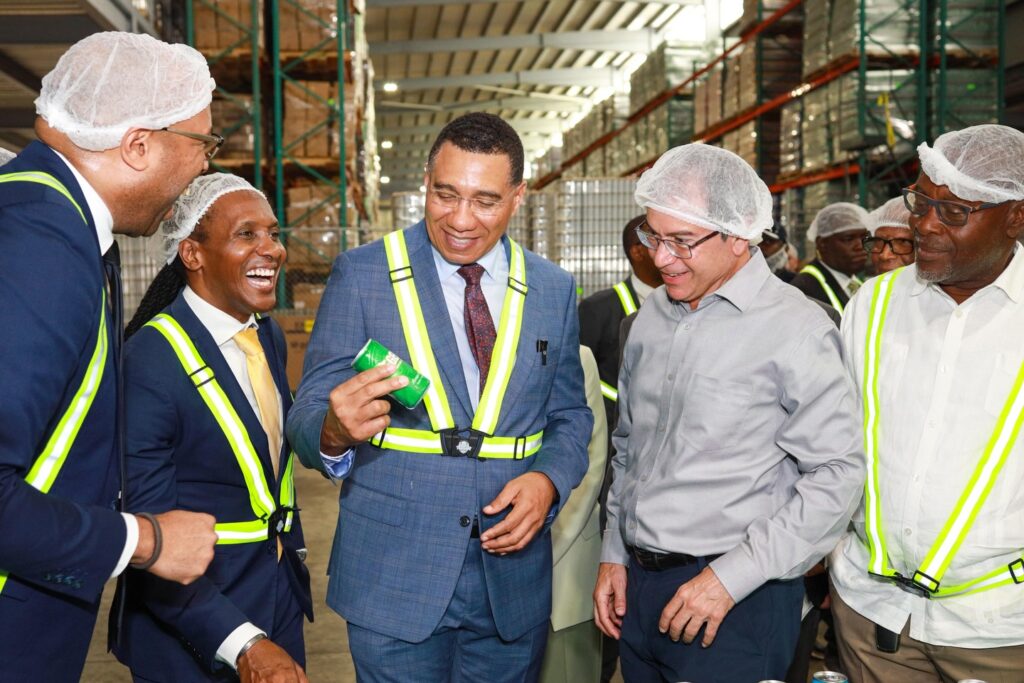
I want to hear about more investments coming into Jamaica. You know what gives me so much pride as I’m walking through this massive facility? William tells me that if you walk this facility twice, you will get your daily 10,000 steps. I’m going to check my watch because I walked it once. I walked it back. It’s a huge facility and as I’m walking the corridors, the number of young people that are employed here go home with an income. Some of them might be in school, some of them would’ve bought their house, some of them would’ve gotten a car as a result and looking forward to expanding their household and their livelihood; that’s what we need to focus on.
For many years, we were distracted, wandered off into all kinds of issues which never served our interest or our purposes. Well, in me as your Prime Minister, you would know that the fight that I am involved in is the fight right here, and we are winning the fight right here in Jamaica. Every day we are winning. We have brought down our debt to GDP. Let’s not look at what has happened now as a result of the super phenomenal event of the hurricane. Were it not for the hurricane, we would’ve been about 60% debt to GDP. We’re going 10 budgets no new taxes. We have stabilized inflation rates. We have stabilized the currency. Gone are the days when people live in fear of what is going to happen to our currency. We have reduced the murder rate significantly. We have maintained positive ratings with the rating agencies right throughout. We’re winning the fight here.
Granted, there are still many battles to be won. We have to win the battle of the cleanliness and public sanitation of our environment and the beautification of our environment. We have to win the battle about rebuilding our aged infrastructure. Every single road in Jamaica, there’s a pothole or it looks like a quilt. We have to win that battle, and we have programmes designed to improve the infrastructure. There are many other issues, but one thing we can be clear is that we are putting runs on the board. We’re improving Jamaica year by year, and in the last decade the Jamaica of 10 years ago is not the Jamaica of today. The Jamaica of today is superior, far better than the Jamaica of 10 years ago.
I close my presentation again by reissuing the challenge to our investors. The people who contribute through the private sector to the expansion of the GDP, now is the time for you to be thinking creatively. Now is the time for you to be entrepreneurial as you are the entrepreneurial class. Now is the time to be thinking on big projects, not small, timid projects, but large-scale projects that will move the needle.
So, William and Andrew, the next time I’m here you will be showing me a picture or a video of this speech and saying see, instead of a $70 million total investment, I want to hear about a US$1 billion investment that Wisynco is making to supply Trinidad and Guyana and the United States with products. That these brands that you’re about to launch with this brewery, that you’re going to use the value in brand Jamaica to promote these brands to make them global brands, that’s what we want our investor and business class to be thinking. That is how we get real growth, and you can be assured that you will have a government that will keep policy stable and predictable, that will ensure that you have access to markets that matter, and that there is peace in the Jamaican society.
God bless you and thank you.