
Launch of the Shelter Recovery Programme
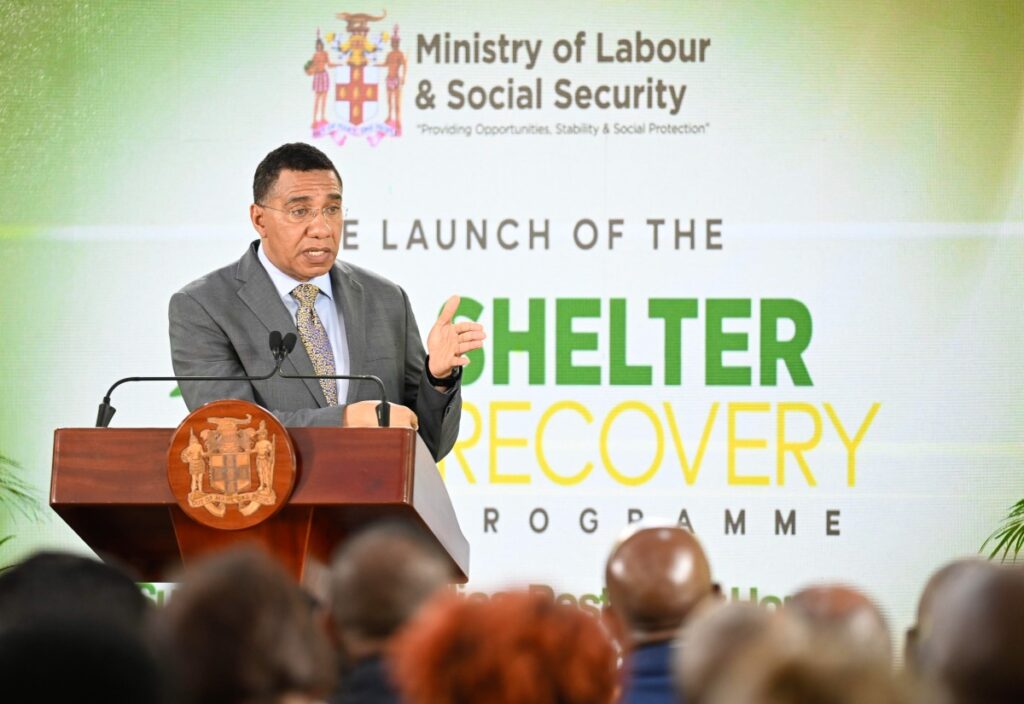
Keynote Address
by
Dr the Most Honourable Andrew Holness, ON, PC, MP,
Prime Minister of Jamaica
at the
Launch of the Shelter Recovery Programme
on
January 15, 2026
————————————————————-
Allow me to wish for you all a happy, peaceful, healthy, loving and prosperous 2026.
All distinguished ladies and gentlemen,
Jamaicans listening,
Members of the Cabinet who are here,
But I want to especially acknowledge Kate Forbes, President of the International Federation of the Red Cross and Red Crescent Societies. I do this because the Red Cross is a huge institution, probably the largest and oldest humanitarian entity in the world supported through various conventions including the Vienna Convention and I was reminded yesterday that the Red Cross is an auxiliary to the government. They’re in countries all over the world and they work closely with government. Mainly, they provide good advice to the government as to how to manage disasters. They act as a force multiplier in terms of rapidly increasing the capabilities of governments to provide volunteers, and they ensure also that the relief and humanitarian efforts meet certain standards to preserve the dignity of the beneficiaries so they’re very critical and it is not always that Jamaica would have the president of such an august institution visiting, and so I must make much of it and we are grateful to have you and thank you for your support. Of course, one of the things that the Red Cross does very well is to raise funds and I am told that you will be raising some funds for Jamaica and certain programmes will be well sponsored and supported.
Now, in today’s world, we can’t take it for granted that the public will understand everything that the government does. In fact, the more we study this issue of government communication, the more we realized that the more we say, the less people understand and that is because there is an entire industry now created around attention. In the traditional and conventional way of communication, maybe 10, 15, 20 years ago, government communication had a kind of central position. You would consider that to be the go-to source for authoritative information, but in the democratization of media and the evolution of the citizen journalist and social media, you find within that quite a bit of antisocial media. Meaning, that there are persons whose purpose is just to provide a counter narrative that may not be true.
This is not to say that the democratization of the media landscape through social media and the citizen journalists is not a good thing. I think it’s a great thing. I think it has expanded information and given more access, but it also means that government has to change the way in which it communicates to also address this emerging antisocial phenomenon, which if not addressed in the attention economy, can have people’s attention being captured for the wrong reason, and it can lead to destructive and antisocial outcomes, deviant outcomes even.
This administration has taken a very instrumental direct approach that we are going to stand in the information market. We’re going to increase our efforts to communicate with the people, to meet them at their level of understanding, but also to elevate the level of understanding. What we put out must be the truth and what we put out must edify, it must uplift people and it must give hope.
So, in a programme like this where I have seen an artificially generated image of the Minister of Labour and Social Security and of other influential persons including myself doing things that I cannot do, which is dance, we have to be absolutely careful that there is no hijacking of a programme like this that could have persons being caught paying for receiving the grant, for example, because there are such scams out there where an unsuspecting person may be caught up in a scheme to say, let me help you to get the $500,000 grant. There is no intermediary. I want to make that point clear. The Ministry of Labour and Social Security is not hiring anyone, any agent, any intermediary to help you to get the grant so if anyone comes to you, or you may see something on any up the social media suggesting this, please dismiss it.
We are having the launch today to focus the nation’s attention on the programme and to give the necessary information so that you as the citizen can be empowered with the information and act accordingly in your interest; that’s the purpose of a launch.
Now, we have spent the last 45 days in structuring the programme, but we have spent the last 75 days doing assessments. Just to be clear, when the hurricane struck, the government already had in place a plan, a system, a structured programme as to how we will respond and having gone through Beryl, we were able to identify the weaknesses, and we were able in some instances to take corrective actions. In some instances, we had to be taking action while at the same time trying to deliver service. One of the things that we were able to stand up quite quickly, but not as effectively as we would want would be assessments.
Immediately after a disaster, we must conduct damage assessment and we were able to do damage assessment, first of all, using satellite imagery and using artificial intelligence to recognize damage patterns and that gave us the initial formation of what the picture would look like for damage across the nation. We were able to use, again, volunteers from the Red Cross, the staff at the Ministry of Labour and Social Security, in addition to other persons who came on as volunteers over those 75 days, and I’m pleased to report based upon the information I’ve received from the Ministry of Labour and Social Security is that we are over 70,000 assessments to date.
It doesn’t mean that we have assessed everyone just to be clear. We may very well have missed someone. The assessors may have come, stopped at your neighbour’s home, but maybe you weren’t there and so they didn’t see you. It doesn’t mean that we have skipped you and left you out. What it means is that you should use your initiative and get in touch with the local office or find the number and call. As the minister has pointed out, they have a calling number now, and there is an online platform for which you can self-register. That means you can give some preliminary data, which would be then reviewed, and an assessor will come and verify so I want that to be clear to all persons who could be potential beneficiaries.
The structure of our disaster response is, first of all, preparedness, that happens right throughout the year. Just before the disaster, we engage in a process which we like to call informationalization; we give you as much information as possible about what could happen in the disaster. And then after that, we engage in the relief exercise, and then after relief, we enter what is called the recovery or the restoration phase, and then after the restoration phase, we enter the reconstruction phase. If you try to position yourself now 75 days or so after disaster, you would say we are firmly in the recovery phase, but it’s not sequential. It doesn’t mean that you have to do relief and then you end relief and then you go into recovery, and then you end recovery and then you go into restoration. No, all of these things are happening simultaneously, but they will be at different levels of intensity, so you can say 75 days or so after the storm, that we are in a lower intensity as it relates to relief efforts, and it’s not just that the government is winding down relief efforts, the people are tired of it, some of them. They will tell you, look, I don’t want any more food packages now, bring the zinc. I want my roof to be restored. Meaning mentally, psychologically, the mindset has shifted where now we want to see recovery and that does guide government’s policy. Let me just depart quickly and say this.
For example, there are persons who would say, listen, the government should keep duty free regime for relief into the country for a long period of time. Well, we try to keep it as long as we can because the truth is that what you really want now, is not necessarily the relief supplies. What you really need is the building materials because of the different phase in which we are naturally emerging. And so yes, at some point we try to accommodate, at some point we have to draw the line because we also need the revenue in order to pay for the recovery. These are things that we have to balance. But if you listen to the discussion in social media, sometimes it goes the other way. In other words, there is no consideration of where the revenue is going to come from to pay for the recovery and the reconstruction, so we take this opportunity to explain this to the public in a ceremony like this.
All of these things are happening simultaneously, relief, recovery, reconstruction. We are effectively now in the high intensity of recovery. The recovery has several elements to it, but I will just use two. The first element of recovery is the restoration of infrastructure and utilities. Essentially, we have restored almost 95% access by virtue of roads and bridges and so forth. There are some breakaways that still exist. They’re there because it’s going to take a huge effort in terms of engineering and cost to restore some of these breakaways, and then we have to consider, can we deal with this in recovery, or should we deal with this in reconstruction? We have to be thinking, should we rebuild this road, or should we find a different alignment for the road? These are some of the considerations.
So when citizens are saying my road isn’t fixed, we understand the dislocation and discomfort but we have to think of it very carefully because we could very well go and fix it back and then a next shower of rain comes because the soil is just not stable to receive a road and the road shouldn’t have been built there in the first place had we known then what we now know. These are some of the considerations that citizens should bear in mind when they are confronted with some of these issues as a result of the hurricane.
In terms of infrastructure, as I’ve said, road is about 95%. You would’ve heard a few days ago that electricity is at 92%. I’m not going to pick on Dayton and his presentations in Parliament regarding the JPS loans and so forth but suffice to say that the loan to JPS was necessary to accelerate the recovery of the public utility of electricity which drives the recovery of water and telecommunications as well so it’s critical to get back electricity. And again, that has to be done strategically. We won’t be able to give back electricity to everyone on day one or right away, so we do critical corridors, critical installations, and then we move to the off paths; the last mile as we call it. We are expecting that by end of February we should be in the high nineties in terms of restoration of electricity. When I did the research, we are above our peers. I mean countries of our size, economy, and capabilities in terms of how fast we have returned infrastructure and just slightly below first world standards.
The other element of recovery would now be to get persons back in shelter. Now, notice I’m not saying we’re going to get you back in your home, which suggests our kind of final solution. What we want to be able to do in the recovery phase is to relieve the discomfort of not having a roof over your head, a shelter. That’s a critical thing right now, and there are many, many, many Jamaicans who are without shelter, a roof over their head. Two image that is seared in my mind driving through, I believe it would’ve been Bluefields, was seeing in the winter of forest, meaning the denuded forest someone found it necessary to heist the Jamaican flag. Some of you would’ve seen that, and that was just so inspiring but just driving past that, there was a house that was totally destroyed, a grandmother lying on the couch and her family around her trying to comfort her. There’s no house, just a couch and furniture strewn all over the lawn and the grandmother obviously ill and the family just trying to comfort her, and today, there are still families in that circumstance as I’m reminded constantly by Dayton and others. Floyd Green, Member of Parliament for Southwest St Elizabeth, he constantly reminds me as well of the families that are without shelter.
We would’ve wanted to do this in December or earlier. The challenge was that it would be difficult to undertake payments not knowing what the full extent of the damage was, and the only way you could get that full extent is to actually go and do assessments. As statisticians will know that when you start to examine a data set over and over and over and over again, you start to see patterns emerging so we wouldn’t know with 10,000 assessments whether or not 50% of them would need $500,000 and 20% would need $200,000 and 30% so you could very well end up committing yourself with a budget that has no real basis on how it should be categorized and so we had to wait until we had sufficient saturation and pattern emerging of what would be the nature of the damage and therefore the type of allocation that should be made and so we felt that we reached that point about two weeks ago, and therefore we were able to now mobilize and launch the programme so you would now hear the categories; 75,000 minor damage, that would get you a couple sheet of zinc, put back on your roof. Of course, this is not meant to totally rehabilitate. This is to support. You have to make a contribution to that process so that’s for minor damage.
For major damage, we are assessing that you may have lost a section of your roof that would amount to maybe a room, but the structure is still intact. It’s still functional, it’s accessible, you still have some shelter, but there’s great inconvenience. And the severe damage would mean that you would’ve lost probably roof accounting for more than two rooms or a total loss. The structure is inaccessible or totally damaged, and for that you get $500,000.
Now, we know that the restoration of shelter is not only the restoration of the roof and therefore the assessors, the instrument that they go to the public with would ask what are your critical needs. Some people would say my critical need right now is to get furniture because water intrusion was really my issue, it damaged all my furniture. I don’t have any bed; I don’t have anything. Some people may say I need to get back things for my children to go back to school or some other need and that is what you would categorize as rehabilitation. But if it says my major need now is housing and shelter, then clearly you are under the ROOFS Programme, which would be the restoration of owner or occupant family shelter. This is not anything to do about commercial buildings.
If you are an owner of several houses, you can only get one benefit. This is not for the greedy, this is for the needy. I have to be clear on that, which is why we do an assessment, we take your TRN, we make sure you’re uniquely identified so that you can’t get a benefit here and then come over and get another benefit there. What that does is deprive someone who really needs the benefit where you would’ve gotten twice. We’re very careful in putting in place a system of accountability, which is built from the assessment that is done to ensure that we get the maximum benefit to the maximum number of persons.
The strategy of the government for roof restoration and shelter restoration is to, first of all, address those persons who are not able to restore their roofs themselves, vulnerable in the population and they may have lost everything. We have what is called the government directed or government led roof restoration program. You may recall that very early in the day I had indicated that the JDF will lead that and the JDF is in the field coordinating with other engineering corps who have come to Jamaica to volunteer. I want to here acknowledge the engineering corps from the Government of Guyana, the engineering corps from the Government of Ghana, the engineering corps from Rwanda. They are on ground and we still have a commitment from Ethiopia, and I want to thank our brothers in the Caribbean and in Africa who have come on board to support.
They have been deployed right across Jamaica. The JDF is in Accompong. They’re exclusively there working along with the citizens. You would’ve seen me visit and it’s going quite well. Ghana is also in St Elizabeth in another area and Guyana is in Westmoreland. I gather they’re going to give a honorary brigadier title to the Member of Parliament, Dayton Campbell, and with that he will migrate to Guyana. This is the only time i get to roast him. The Rwandan team is on ground. They’re being briefed and they will be deployed to areas in St James. That programme is underway and they are repairing roofs.
I want to at this point especially recognize two donors who have come on board to support the programme. I want to recognize Kemtek Development. They contributed $70 million worth of material. And I want to acknowledge New Era Homes. They are contributing $160 million in materials. I don’t know if Mrs. Taddeo is here representing. Thank you so much. They’re contributing $160 million in supplies and tools which will be spread across the various engineering corps to support the roof restoration. I encourage other companies.
By the way, I’ve only counted two companies that have contributed directly to this government directed roof restoration programme, but there are many private sector companies who on their own would’ve gone out to support the restoration of roofs. I’ve seen some of them in terms of being captured on social media and so forth, and I want to commend them and encourage them. We would love to work with you. And at this point, I should also recognize TransJamaican Highway. They have a programme that is coming on board where the government will supply them with the beneficiaries based upon the assessments and then they will do the restoration; that’s the kind of directed government led roof restoration.
Then we have the NHT. The National Housing Trust as our nation’s premier housing agency has rolled out a suite of additional support for its contributors and the wider public, which commenced November 4, 2025, last year. Thirty days or so after they were out there supporting the public. They have a hurricane relief loan of up to $3.5 million for NHT mortgagers and contributors for their immediate relatives to assist in effecting repairs and home improvements to improve disaster resilience. For example, converting from zinc roofs to reinforced concrete slabs or in installing hurricane shutters and that programme is ongoing. Persons are applying and loans are being dispersed. They have a six-month moratorium from November 2025 to April 2026, and this is an automatic temporary suspension of all the required monthly mortgage payments for mortgages in the seven worst affected parishes, namely St James, Trelawny, St Elizabeth, Westmoreland, Hanover, St James and St Ann.
Approximately 30,000 loan accounts have benefited from this automatic moratorium for mortgagers, and for mortgagers in other parishes, requests for the moratorium are being considered on a case-by-case basis. So again, this is information that may not be known widely in the public but should be known when the response to disaster is being assessed. The NHT has given a six-month moratorium, 30,000 mortgage accounts that they don’t have to pay for the six months.
There is a disaster relief grant of up to $500,000 to contributors of the NHT who sustained damage to their homes or those of their immediate relatives. The programme essentially mirrors the ROOFS Programme in the sense that the maximum benefit is 500,000 and the benefit is given upon an assessment, and it’s very important to understand that, again, if you’re getting a benefit through the NHT you cannot come and get a benefit under the ROOFS Programme, and that is why the programmes mirror each other so there’s no higher benefit to get from the NHT or a higher benefit to get from the ROOFS Programme.
Of course, there is the Insurance Programme that the NHT always has the peril insurance coverage, and I want to take the opportunity to remind persons, as long as you are an NHT mortgagor you continue to be, and if you have sustained damage, you can apply for your insurance coverage.
The NHT is financing the prebuilt modular housing solution for rapid deployment programme, and this is being implemented through the New Social Housing Programme. The NHT is spearheading a rapid deployment housing solution and is procuring 2,500 prebuilt semi-permanent modular units. The first tranche of 500 housing solutions is expected to arrive in the island in mid-February. These are units of approximately 300 to 400 square feet with a kitchen, bathroom, and living area. These units will be deployed by the Ministry of Economic Growth and Infrastructure Development through its social housing programme, along with the Ministry of Local Government and Community Development. They will be responsible for identifying the individuals to benefit the deployment and allocation of these units, which were procured by the NHT.
How this will work? Again, these units are going to go to the most vulnerable, persons who won’t be able to find the first cent to pay a contractor or a carpenter so you would be looking at possibly an elderly someone who is shut in, a mother with six or seven children and nobody to help; these kinds of vulnerable cases. Of course, I am not the arbiter of vulnerability. We leave that up to the assessors who are guided by, for example, the guidance of the Red Cross and so forth in looking at the human needs and how they should be treated with. My job is just to make sure that the money is there.
The restoration of owner or occupant family shelter programme, the ROOFS Programme, and I want to credit Minister Montague for coming up with this acronym, ROOFS. This is the third component of the Shelter Recovery Programme. We have allocated JMD$10 billion in the first instance, $10 billion is a lot of money, and immediately after the all-clear from Hurricane Melissa, we mobilized teams to conduct assessments. As I’ve said, we are at 70,000 assessments and we now know how to categorize these assessments and to make allocations accordingly.
Now, I want to clarify how these allocations are made. As I had said earlier, we understand that not everyone will be using their resources to restore their roof. There will always be some need for maybe furniture, maybe school uniforms, maybe something that we wouldn’t even know and understand that would be necessary for the restoration of the household to normalcy. We understand that so what we have said is that that activity is called rehabilitation and for rehabilitation expenditure, the ceiling is $75,000. If you are assessed as having minor damage, you will get a grant of $75,000. You could use that grant, if you had a little stall and you want to get it back up, that’s your business. If you wanted to buy back the kids school uniform and books, that’s your business. If you wanted to get back a mattress and a stove or so, that’s your business. You can use the grant for that. There’s no restriction on $75,000 but you could use the whole thing to get 10 sheets of zinc and put back on your roof for minor damage.
If you got major damage, you will get $75,000 out of the $200,000 that you can use for rehabilitation purposes. There will be no restriction on that. The other $125,000 you can put that towards your roof, that is restricted and you can only use it at selected authorized hardware or material supplies roof directed. If you are assessed as having 500,000 in damage, again, $75,000 is unrestricted. You can use that for rehabilitation purposes and the other $425,000 focus exclusively on your roof and we had to do this. The experience we have had is that there are persons who are going to say I’m going to wait for the money from abroad and what I am going to do with this, it might be a noble thing such as school fee, or it may go to support the local bar.
Now, from my desk as the Prime Minister and from the desk of the Minister of Finance, it’s all economic activity but from a moral standpoint, from a national recovery standpoint, we need to see the roofs go back on because we know what is going to happen. The same people who got it are going to turn around and say the government never gave us anything or what the government gave us is too little, so what do you expect. We can’t have that so I’m going to take this opportunity to appeal to you. I know 90% of the people who get the grant, they’re going to put on their roofs, they’re going to use a funds responsibly, but it is the 10% that is going to create the problem and so I’m appealing to those persons who already have it in their head, please use the grant for the purpose for which it was given. It’s a lot of money. It’s taxpayers’ money. It’s money for which we’re going to have to pay for in debt and interest. I mean, there is this notion that we get a lot of grants, and everybody gave us a whole lot of money. What we have received in grants and donation is not anywhere compared to what we have spent so far from taxpayers’ resources and what we have borrowed so the government can’t be frivolous with how it uses these resources. We have to be thoughtful, and we have to always have accountability in the back of our mind.
Lastly, I’ve studied a number of disaster response strategies from around the world and there are some countries which they use this as an opportunity as we are saying to rebuild forward and so what some countries do in this phase is to delay the housing recovery because they understand that there are houses in locations that shouldn’t be there in the first place. Not because you don’t want the persons to have shelter, but we know what is going to happen again, and the problem is going to reoccur and what we would be actually doing is an injustice to the people who live in vulnerable areas. And so, some persons move the restoration of roofing out of the recovery phase and into the reconstruction phase where they can find alternative locations, subdivide land, build housing schemes, and then relocate. That means that the inconvenience in living in or living without shelter is extended. We took the decision that we want to get the economy back up and running very quickly; that’s priority number one, so we can pay for the reconstruction, and we do acknowledge the human suffering so we’re doing the shelter restoration in the recovery phase and not wait.
It doesn’t mean, however, that there will not be a relocation effort because what is clear is that houses are located in areas where they shouldn’t be and a major storm is going to happen again, and we don’t want to have the same thing happening over and over and over again. I want to just read something since I have your attention. In the 65 years since 1960, the Atlantic has produced 799 recorded storms. Remarkably 201 of them occurred in just the last decade, meaning from 2015 to 2025, my administration. Of the 34 Category 5 hurricanes recorded since 1960, 14 have occurred since 2015. What that is telling you is that definitely we’re seeing more intense, overlapping, and more frequent weather events that have super phenomenal impact on lives and balance sheets.
I know the social tensions that immediately arise when we talk about relocation and issues to do with land but you can be wedded to the past and that’s where you’ll stay or you can come to grips with the world that is changing around you and be prepared to change and strategize how to overcome the obstacles and that’s what your administration is prepared to do but we can’t do it in contention. We can’t do it when there are people deliberately trying to mislead and misdirect the conversation and therefore, we are upfront, we are front facing with the information. If you want to know something, ask. Don’t assume. The government is open and we will give you the right information and direct you. We are saying, hey, pay attention here and for this programme where $10 billion is about to be spent, it is important that all the recipients or potential recipients understand the programme so that they can get the maximum benefit. In terms of relocation, we’re going to try to do that mostly in the reconstruction phase, which you’ll hear more of from me about what is the next move as to what we’re going to do with reconstruction.
Last thing is- and I see the chairman of the UDC here which I tasked to assist with the recovery of Black River debris management. A part of the recovery process is treating with debris, that has been very challenging. I heard the head of the NSWMA saying that they have gone over 27,000 loads of debris from across the island. Our original estimate is that they would need to move about 450 to 500,000 truckloads of debris, it’s significant. It’s a lot but they’re chipping away at it. We have given them 10 additional trucks. They really need probably like a hundred trucks to make progress, and it is affecting municipal waste collection generally because resources have to be moved into debris management, but I will be addressing that in another presentation. But just to say to the public that is listening, yes, we see the challenge with waste collection and we’re going to address that very shortly.
Ladies and gentlemen, I hope that what I have presented would’ve clarified and given the citizens of the country enough information for them to make wise decisions and to be active and participatory citizens.
Thank you very much. God bless you and all the best for 2026.