
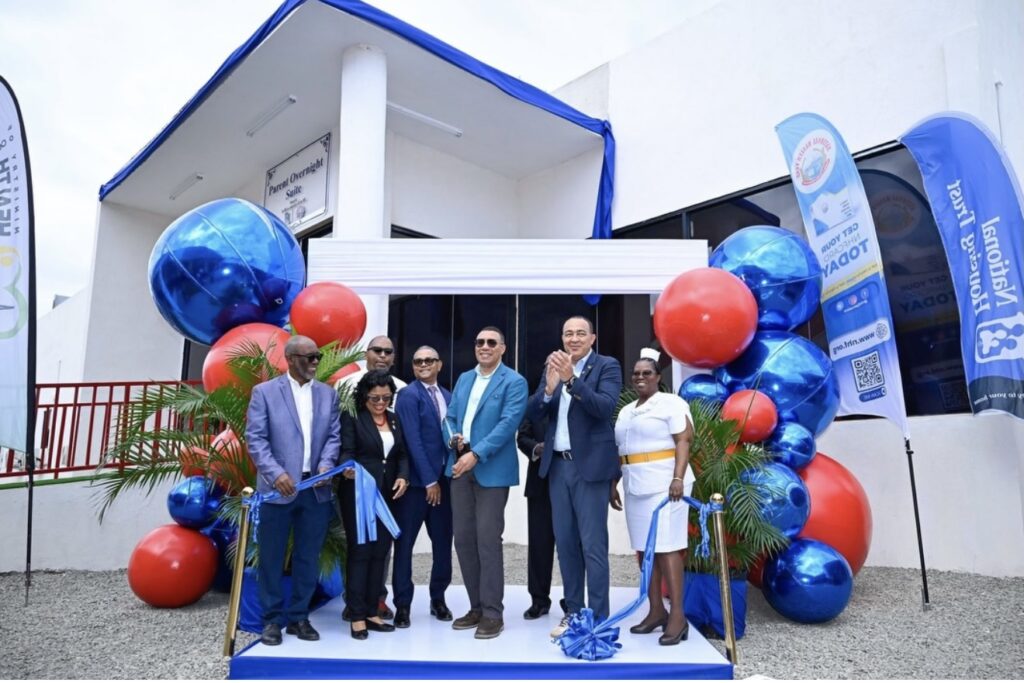
Official Opening Ceremony of the Bustamante Overnight Suite
Keynote Address
by
Dr the Most Honourable Andrew Holness, ON, PC, MP,
Prime Minister of Jamaica
at the
Official Opening Ceremony of the Bustamante Overnight Suite
on
January 30, 2026
————————————————————————-
The Right Reverend Leon Golding. I know you prayed for me in my absence. I heard the prayers. Thank you very much for your offering of intercession.
Honourable Christopher Tufton, our Minister of Health and Wellness. Very important, sometimes we forget that Minister Tufton he’s not a medical doctor, but he knows so much about health by now that I believe he should just formalize that and go and do a medical degree,
Our Member of Parliament, Julian Robinson for Southeast St Andrew,
Mr Linval Freeman, Chairman of the National Housing Trust,
And the Deputy Chairman of the National Health Fund, Mr Michael Stern,
Mr Mark Martin, Parish Manager for Kingston and St Andrew Health Services,
And of course, how could I forget Mr Wentworth Charles, the Chairman of the Southeast Regional Health Authority,
Mr Anthony Wood, Chief Executive Officer of the Bustamante Children’s Hospital,
Mrs Michelle Finnikin Campbell, Acting Director of Nursing Services at the Bustamante Children’s Hospital,
Reverend Beverly Donald, Chaplain, Bustamante Hospital for children,
Members and Stakeholders of the various teams from the NHT, the NHF and from SERHA,
Heads of department and members of staff of the Bustamante Children’s Hospital,
Other specially invited guests,
All nice and decent people,
I entered the room quite aware that it was past midday. It was afternoon, but I still greeted you, good morning. That’s my way of apologizing for arriving here just a tad bit late, but I had good reason. When I finished my engagement, these days I can’t just go and speak and leave. The Members of Parliament here will understand that the people want to see their prime minister. Yes, Julian, they want to see their Prime Minister, so I was detained a little bit and then I had a wonderful experience. I didn’t realize it was on my schedule, so we were heading down Stony Hill, and I saw the police come out into the road and they were directing me to turn up into a lane. I said but this is not on my agenda and I’m late.
Anyway, we ended up going up a little driveway and stopped. They said Prime Minister you cannot come to Stony Hill and not visit a centenarian. She was 103 years old and so I stopped and had a little conversation with her; sharp as attack, mentally fit, which helped her physical longevity. I was told that she does her crossword puzzles every day. So, I said, listen, you better rub some of that longevity off on me and we had a good little chat. But then the icing on the cake is that, while we were there, a lady came out and somebody said to me, Prime Minister, you don’t know this lady? I said I can’t quite say I know her and then the who person was doing the introduction, said, well, she taught at St Catherine High School. St Catherine High School is my alma mater. And then she said, so Prime Minister, you don’t remember me and I felt a little bit strange there because obviously it’s somebody I should know and she said, I used to teach you. You were in my class, and I just melted to see someone from so long ago. She was my seventh-grade teacher, and we had a little chat, caught up a little bit so I’m certain you have forgiven me now for my delay.
Today is a good day, a day of gratitude, of growth and of grace. It is a day when we open a door that leads to relief, recuperation, and renewed hope. And it is a day when Jamaica demonstrates once again that we build not only structures, but strength, not only facilities but futures, and not only rooms but resolve.
We gather on the grounds of the Bustamante Hospital for Children, an institution with a proud and profound heritage. For 60 years, this hospital has been a beacon, steady shining, unswerving caring for our youngest across Jamaica, and as minister pointed out, across the wider Caribbean. It stands alone in our region as the only specialist paediatric hospital in the English-speaking Caribbean treating children from birth to age 12 with an extraordinary array of services from general medicine to cardiology, neurology, nephrology, oncology, surgery, intensive care, and more. And we will augment this in a few months when we open the Western Child and Adolescent Hospital which again, we will be the only English-speaking country in the Caribbean to have such a facility, probably just generally within the region. Jamaica is becoming a centre of excellence in health for children and adolescents, that’s good. That’s an entire industry and an entire economy that can be created around that.
With 279 beds, including 6 beds for ICU and 10 beds for cardiac ICU units and an accident and emergency department that sees approximately 70,000 patients every year, the hospital is nothing less than a national cornerstone, a lifeline for families in their most vulnerable moment. Yet even the strongest institutions must evolve, even the brightest light must be renewed, even the most committed caregivers need a space where compassion is complimented by comfort, that brings us to today.
For decades, the need for parents to remain close to their hospitalized children has been recognized as an essential part of paediatric care. Parents are not visitors in their child’s recovery; they are partners in it. They are the familiar voice in an unfamiliar place. The reassuring touch in moments of fear, the steady presence that helps a child feel safe. Sometimes they are the medicine that no doctor can prescribe, but for too long our parent overnight suite did not reflect this reality. It could not accommodate the numbers. The previous facility limited, aging and deteriorating offered some shelter but it was not a sanctuary. It allowed rest, but it did not really facilitate restoration and as the hospital expanded in scale, complexity, and medical capability, the gap between the care of our children and the support that the parents needed, that gap became increasingly evident and so as part of a broader partnership between the National Housing Trust, the National Health Fund, and the South East Regional Health Authority, we committed to constructing a modern to parent overnight suite, one grounded in dignity, comfort, and care.
This project was approved in 2018, I remember it well, and it was announced in my budget presentation of that year, and we broke ground in 2021. As we celebrate today’s achievement, it is also important to acknowledge an uncomfortable truth, this project should not have taken so long. From 2019 onwards, the journey was marked by repeated delays, no doubt COVID. And COVID, construction and hospital; all three don’t work well together, so we understand that, but we also had contractor underperformance, termination of contracts, repeated notices of underperformance, redesign challenges. You start and then you realize you left something off, or you didn’t reinforce something and you have to redesign, theft of materials.
And as much as the three agencies worked well together and I’ve been bigging them up, the NHT, the NHF and SERHA, we have to pay attention to this one. Overlapping responsibilities between agencies and then extended procurement timelines, all of which created a cumulative slowdown that stretched the completion date far beyond what was originally intended. Added to that, the disruptions of Hurricane Beryl and Hurricane Melissa, which halted activities at the site and forced further extensions. But the truth is, while bad weather and pandemics will unavoidably delay construction, bureaucracy should not, and this is something that we struggle with as a developing country.
Developed countries struggle with the same thing too. The experience of this project highlights a deeper systemic challenge. Too often well-intentioned safeguards become obstacles. Too often procedures designed to protect the public’s interest end up postponing the public benefit, that’s the reality of Jamaica. A system that protects integrity, but prevents delivery is not protection, it is paralysis and that is the challenge we face as a country. I want to point out here that the old narrative of Jamaica, the old paradigm of Jamaica, was that we could not build this because we didn’t have the money. That’s what the commentators used to say, we’re a poor country, we don’t have the money. We can build this. We’re not saying we’re flush with cash, but the reason why we took the decision in 2018 but we’re only delivering it now is not because of lack of funds, there’s nothing here about a budgetary constraint. What prevented it was some force majeure, but largely it is our inefficiency as a public bureaucracy to convert the capital budget quickly.
Our capital budgets have increased in the last decade significantly; we have doubled our capital budget. The issue is how to convert the capital budget quickly. Now, a part of that conversion is, as you would’ve seen, first of all, what we now have, a very robust system called the Public Investment Appraisal System, where all the projects go through a very rigorous scrutiny and oftentimes the projects are not assessed upon the basis of whether or not they’re needed. They’re assessed on all other kinds of parameters. They look at environmental, they look at financial feasibility, they look at structural and civil engineering; all kinds of other parameters are used to judge a project. Oftentimes the public’s urgent need is not ranked as a priority. We have the classic case of a bridge on the border of Trelawny and Manchester, a bridge that was destroyed by a flooding as a result of a tropical storm and that project had to go through this public investment appraisal process, which caused extensive delays and a lot of money spent to answer all kinds of questions. None of them answered the question how quickly could the people get back their bridge.
But we can’t blame that process because it is important that all projects that are competing, that want the public funds, that they meet a standard, so it is there to protect the public’s interest to ensure that public expenditure is efficiently utilized. Once you have passed this investment appraisal and the decision is yes, it’s a good investment, then the next step is the design of the project; that’s where your architects and your engineers, and your environmental planners and all the technical experts come and they design the project. And then when that is done, you go to another process, which is called procurement.
I think there is agreement generally in the parliament that much more needs to be done to make procurement more efficient. Procurement can take anywhere from six months to two or three years sometimes. All kinds of things can go wrong in procurement and the way in which procurement is set up, procurement does not consider the parent who is coming in from Hanover to be with her child that is ill. That’s not a consideration in procurement.
And then after you’ve finished procurement, you have to go to contracting. You have to now define the terms on which the construction is going to take place, obligations are going to be met, warranties are going to be issued, and indemnities, and insurance, and bonds, and all kinds of things, and that can take some months as well.
And then when that is finished, there is construction. Oftentimes the construction is the shortest part of the process but if you do not have good contractors, that can be elongated as well and as Jamaica grows, and we have more capital projects to do, we are seeing the need to have a contractor class that is equal to the task.
We have this concept of the contractor as a man with who may not even have an office anywhere, he just comes with a few workmen and that can’t carry us to where we need to go. We need contractors who are invested in the process, they have the technical expertise not just in construction, but they have the technical expertise in project management, in financial management, in accounting and record keeping, that they understand the social, political, and cultural issues in the areas that they work, that they are very much committed to delivering on time, not cutting costs, but saving costs. We definitely need a contractor class like that, and we are going to be taking some policy decision soon to help to support our contractors to help them develop so that they can take on projects at scale.
One of the challenges we face in housing, Minister Tufton, is that we don’t have contractors that can build at scale that we need. We don’t have many so we are stuck in the limit of building a thousand houses or maybe 1,500 and we need a contractor who can take on 10,000 houses at a time and we need to develop that skill indigenously. The contractors are critical partners in the government converting the capital project into growth. They are important to the government achieving its growth mandate.
Without them and without the contractor class thinking a particular way, we will not be able to achieve the kind of growth that we need and I just use the opportunity here to say that the government has a train line of projects. You used to hear the term pipeline of projects. We don’t use pipeline because you can’t see what is coming. Sometimes you turn the pipe on and it’s just air coming through it. No, we have a train line of projects and sometimes the projects are being delivered all over Jamaica and the public really doesn’t get a sense as to what comes off that train line almost on a daily basis.
Today in Stony Hill, I’ve handed over one of our New Social Housing Programme units. It is a multi-family unit that accommodates three families, 12 persons living in it, lovely facility. It’s part of our big yard/ tenement yard replacement and that was done lovely. And then today we are opening this facility here.
Yesterday, Matthew Samuda was touring our water project in St Catherine, where the content project that we’ve talked about for almost a decade, that project is coming onstream very soon, which will bring water into the corporate area, almost every day some major project. In other words, the conversion of the capital budget into infrastructure that is changing the lives of people is happening, but it is happening too slowly. We need to ramp up the scale at which we are doing it and the contractors, because they’re the ones who will literally take the cash and convert it into concrete.
I hope I have elucidated some issues and made our position on national development as it relates to the capital budget clear. This project is therefore both a celebration and a lesson, a celebration of what we have achieved despite obstacles and a lesson about what we must change so that future projects do not face the same faith. Bureaucracy should be a gate that filters risks, not a wall that blocks progress. However, the fact that we have this overnight suite here today speaks to the commitment and persistence of our civil servants to see important national projects through to fruition. It is a testament to perseverance, a project that endured storms, literal and figurative hurricanes, pandemic, delays in supply chains, contractor termination, redesign, but thankfully we have reached completion.
Better late than never, but we say it another way, mi late, but mi reach, and it is a testament to compassion because the heart of this building, it’s not just concrete. The heart of this building is care. A hospital treats the body, but a home strengthens the spirit. By creating a space that feels like home, we strengthen both. When parents are arrested, they are better able to care for their child. When parents are nearby, the child feels safer, and when families are supported, healing is accelerated.
To the team at the Bustamante Hospital for Children, your work is demanding, difficult, sometimes heartbreaking. Day after day you turn uncertainty into stability, fear into reassurance, crisis into care. The parent Overnight Suite amplifies your work, and I hope it will make it a little bit easier for all. It deepens the circle of care. It recognizes that your fight is not only for the child, but also for the family beside the child. May every parent who enters this suite find rest and renewal. May every child whose parent is close by, feel comforted, reassured, and strengthened. And may this hospital strengthened by this new addition continue its legacy of healing with heart, with honour and with humanity.
Thank you, and may God bless the Bustamante Hospital for Children and the families it serves.