
Subsea Cable Project Letter of Intent Signing Ceremony
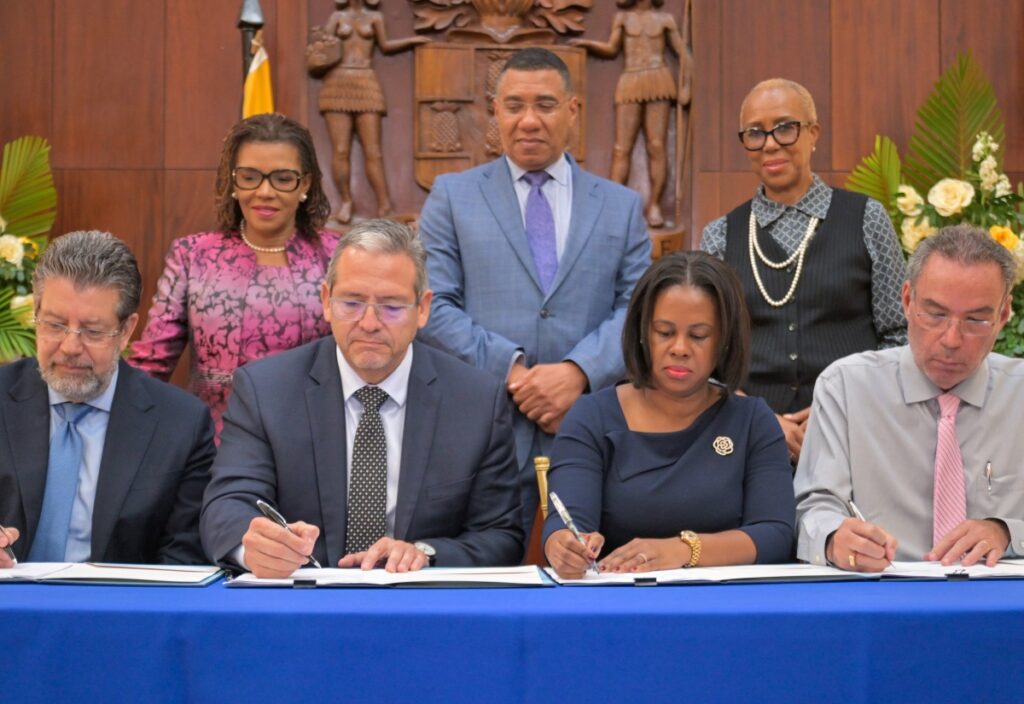
Keynote Address
by
Dr the Most Honourable Andrew Holness, ON, PC, MP,
Prime Minister of Jamaica
at the
Subsea Cable Project Letter of Intent Signing Ceremony
On
February 3, 2026
————————————————————————-
Ministers Vaz
Our Minister of Finance, Fayval Williams
And Minister Audrey Marks
And I must tell you that all three of them convinced me that this was a good thing to do. Not that I was not aware of the benefits, but we are doing this against the backdrop of just coming out of the third most powerful hurricane that the world has ever produced or recorded to have produced that did significant damage to Jamaica and so everything that government does will be seen through that prism. Every dollar expended will be judged as to whether or not it goes towards our recovery and our eventual reconstruction, so we are politically sensitive to these issues, but the hurricane exposed us. It uncovered vulnerabilities, which have always been there, but maybe covered up in the fact that they were never tested and we lost telecommunications to a large part of the island.
Of course, nothing to do with Subsea Cable, but as would be the case with a Category 5 hurricane, but you could very well extrapolate what could happen if you were to be impacted in such a way. It doesn’t have to be by a hurricane, it could be by any number of things that could impact your telecommunications, and it is at that moment that every Jamaican who was without service, as we call it in Jamaica, telecommunications service for an extended period would be absolutely frustrated. Some would’ve been even more frustrated about the absence of telecommunications and the absence of electricity especially those who rely on telecommunications for their livelihood, which is by the way, a growing number of Jamaicans.
Today, it is a pleasure to join you for what is without question an important and optimistic moment in Jamaica’s journey towards becoming a digital society. Today, as we sign this letter of intent with Trans Americas Fiber System, we have taken a significant and deliberate step in transforming the digital architecture of our nation. This is not simply another infrastructure project; it is a strategic intervention in preparing our people to succeed in a modern technologically driven world.
Today, we are making an investment not only in cables beneath the sea, but in opportunities above ground. We are laying the foundations for higher economic growth, stronger competitiveness, broader access to education and employment, and greater national resilience. This is what progress looks like when a country thinks not just about today, but about the possibilities of tomorrow. Recent events have reinforced why this approach matters.
In the aftermath of Hurricane Melissa Jamaica faced real disruption, damage to infrastructure, dislocation of communities, and pressure on public service but we have made a deliberate choice as a government, not merely to restore what was lost, but to build infrastructure to carry us into the future. We’re using this moment as an opportunity to make strategic investments that will ignite economic growth and strengthen our national foundations whether in road networks, water, electricity, schools, hospitals, critical public services, and our digital infrastructure.
Disruption, when met with foresight and discipline can become a catalyst for transformation and Jamaica is choosing to build forward turning recovery into renewal and resilience into long-term opportunity. At the heart of Vision 2030, that is Jamaica; a place of choice to work, raise families, and do business, and retire in paradise. That is really a simple but powerful commitment to Jamaica’s development and achieving that Vision 2030 requires more than just traditional infrastructure or traditional thought. We have to think big and we have to think strategically and in thinking big, we have to think about resilience. The question is, who pays for resilience? Who benefits from resilience?
Resilience is one of those services or commodities that everyone benefits from, but nobody wants to pay for. It’s a public good. It’s indivisible, so who has to pay for it? I mean, everybody agrees it’s beneficial, but nobody wants to see a dollar added onto their bill for resilience. Can you imagine if we were sending out electricity bills or telecommunication bills or whatever bills, and there’s a thing that says resilience? Nobody would pay for it but clearly everybody wants the network to be able to stand up to storms and recover quickly after storms, so governments have to think strategically.
When you are faced with a disaster, it gives you an opportunity because the challenge with resilience is that you have legacy infrastructure that was not built for the threats and challenges that you currently experience, that’s essentially the problematic of resilience. Your road infrastructure can’t stand up to the intensity of rains so if there is a disaster or there is a disruption, then it gives you an opportunity to take a second look at your legacy infrastructure and say, wait a minute, maybe we could rebuild this infrastructure even better. Better to deal with the challenges that we experience now but having looked back on the past when we didn’t have those challenges, we then begin to think what other challenges could come, and so you build an infrastructure that is future proof, and so that’s what we’re doing with making this investment.
The other challenge, of course, with building resilience and the question of who pays for it is one issue, the other issue is who invests in it? It’s a moral issue to build something that is going to last, but the market doesn’t always answer that question. The market is going to answer the question what delivers the service efficiently but more important, what delivers the service profitably. Investors are not always going to want to invest in resilience unless of course it serves the issue of profitability and efficiency. And so therefore, for all intents and purposes, I know there are some who will be saying, why is government getting involved in this traditionally a private sector endeavour but let me be clear.
My administration, the Government that I lead is a market friendly government and we do not believe in competing with the private sector. Nevertheless, the government has a responsibility to make markets where it is difficult, or it doesn’t exist and to shape markets when there are potentially what is considered failures in markets. We play that role and we see the need, it’s a public good, strategic good for the country to have resilience in our telecommunications network, and we see it also as a strategic investment in shaping a market that will deliver telecommunications at lower prices. I think those would be the two strategic values being pursued by the government.
Right now, 54% of our traffic essentially goes through one subsea cable so if there ever was a potential weakness or a threat to our resilience, then that would be it, so you need to be able to have not just redundancy, but a diversified provision of the service. That played a key role in our decision building resilience but having essentially so much of your data captive on one subsea cable also means that competition and price structure may be such that you are paying higher than regionally, and that then leads to lower access.
Jamaica doesn’t necessarily have a coverage problem, meaning that you can get signal and fiber going to a large part of the island, but whether or not people can get on and stay on, that’s the big issue because of the cost. As we say in Jamaica, ‘you buy credit and it just eat off like that quick’, it’s gone so we have to address that problem and that’s a market force problem. This intervention, what it does is it places government in a position to strategically shape the market such that the prices and accessibility for the average citizen can go down.
This, by every measure, is a good decision to use public funds to support this kind of investment. It is not intention of the government to operate this, and I think that must be said upfront. We want to invite the private sector to come in but what we have done is to de-risk the investment and to ensure that we have put in enough redundancies in the system and diversification of cables such that there is competition. That’s the shape of the market now, a market that is diversified and competitive which will result in lower prices for you the consumers.
Now, just a little bit of politics because you can’t escape. Politics is imminent and ubiquitous. One of the functions of government, first of all, you want to keep people safe, so a big function of government is safety and security. Then you want to protect people’s freedoms and liberties, and our government is doing that on safety and security.
Last month, that’s just a few days ago, January, we saw a reduction in murders relative to January 2025, we had 33 murders. It was 54% reduction in homicides over January last year so there is no doubt that on the issue of keeping Jamaica safe and secure, government policy is working. This is beyond debate. The statistics are there and we are now moving to the next phase of our strategy.
Peace is sustained safety and security and that’s where we want to be so you will be seeing more policies being rolled out to move the nation to peace and that’s another debate, but telecommunications will play an important role in the dissemination of information that will ensure a robust peace. By and large, part of the security issues would be how we use telecommunications and cyber. Is it being used as the name suggests as social media, or is it being used as anti-social media creating values and trends that work against the society, and against markets, and against people’s safety, security, and privacy and so these are issues that we will have to look at.
But another important role of government is to ensure that persons can live in a society, in an economy where they can afford life. Meaning they can afford the essentials and the necessities of the basic standard of living accepted in the society, affordability. It is not always the case that governments in developing countries get it right. Some governments in developing countries in trying to deal with this issue of affordability end up in a trap, a trap called subsidy.
Recently as I attended the Latin American Caribbean Development Bank forum in Panama, as leaders presented, you could see many countries coming to terms and coming to grips with how do we get our fiscal situation under control and yet deal with this issue of cost of living and affordability, and many of them are faced with this issue of what do we do with subsidies because on the one hand, it does help the cost of living, but on the other hand, it drives up debt and inefficiency in their economy.
Thankfully, Jamaica has gone through that phase, and we are now out of that phase for the last decade because we have very strong fiscal rules. It doesn’t mean that government has abandoned instrumental, intentional, and direct ways in trying to reduce cost of living. Indeed, we have selectively intervened where necessary to reduce cost of living. We have done so in electricity, we have done so in public transportation, particularly to counter inflation that is outside of our target but the best way to do it is to build infrastructure that is efficient.
The greatest subsidy that you can give to the people of your country is efficiency and so when we say we are tackling inefficiency in bureaucracy, and this is somewhere where we have to go, this is about making the products and services that you get more efficient so it costs you less. Inefficiency is as big a problem as corruption, so our government is focused on both things, treating with corruption and treating with inefficiencies. In fact, there are two sides of the same coin often, but we are also focused on building infrastructure that can deliver services at a much greater rate, much greater pace, and that also will increase efficiency.
Recently, I toured one of Jamaica’s important food processing entities in St Catherine, and they were right beside a bridge that had deteriorated over many years. Now, this entity provides meat staple protein to the country and because the bridge is down, they have to reroute their trucks. It costs more energy, and because the bridge is down, their workers have to take a longer route and pay more in transportation.
Now, nobody will say that, but it does impact on the price, so when your critical infrastructure is not able to deliver efficiently, there is a little tack on to the price eventually, but the consumer doesn’t see it like that. They say it’s inflation, but a part of it is also poor planning for the infrastructure and so what we as a government is focused on, is on building the world class infrastructure that reduces the cost to business and the cost to you. That’s how we approach affordability. Other government say, well, it’s going to take 20 years to do this, we don’t have the funds to do it, I will give you a subsidy, and that adds up. By the way, you end up paying for the subsidy in more taxes and more fees.
We have a different economic model here and we’re very conscious of not to be hiding costs under political labels. We don’t do that; we go straight to what the issue is. If the issue is inefficiency, we’re going to deal with that. We’re not going to add on another cost and call it something else and make it a political label, and people feel that they’re getting a gift. No, that doesn’t make sense for us. For us, we treat with the real problems.
The problem with telecommunications, a part of it is the infrastructure is old, by the way. It’s aged, it’s almost at end of life, it doesn’t carry the capacity, and it’s not diverse and it doesn’t have enough redundancy; that’s the challenge so government makes the investment, makes the market, and shapes the market to bring down the prices, and that’s what this is about.
We are also not into this business of building roads to nowhere, so we don’t invest in infrastructure that cannot support new industries and new businesses emerging. We’re looking into the future and saying this isn’t here yet, but we’re going to build it and it will come eventually, but we’re not going to build a road that will never be driven on. That’s not what we are doing, and this is not what we have done here. Once this infrastructure is in, this becomes another tick in Jamaica’s attractiveness for investors. So, when countries are looking at places, where should I put our business process outsourcing, where should we put call centres, where should we put our digital business; Jamaica has several subsea cables connected with great redundancies at great prices. This is a place where we should come and relocate. In a nutshell, that’s what we’re doing here and the people of Jamaica I hope will understand the investment and support the investment and be encouraged that the government is taking decisions for your safety and security, for your economy in terms of affordability, and for the resilience of our country and society.
Thank you.