
Consulate General of Jamaica New York Reception
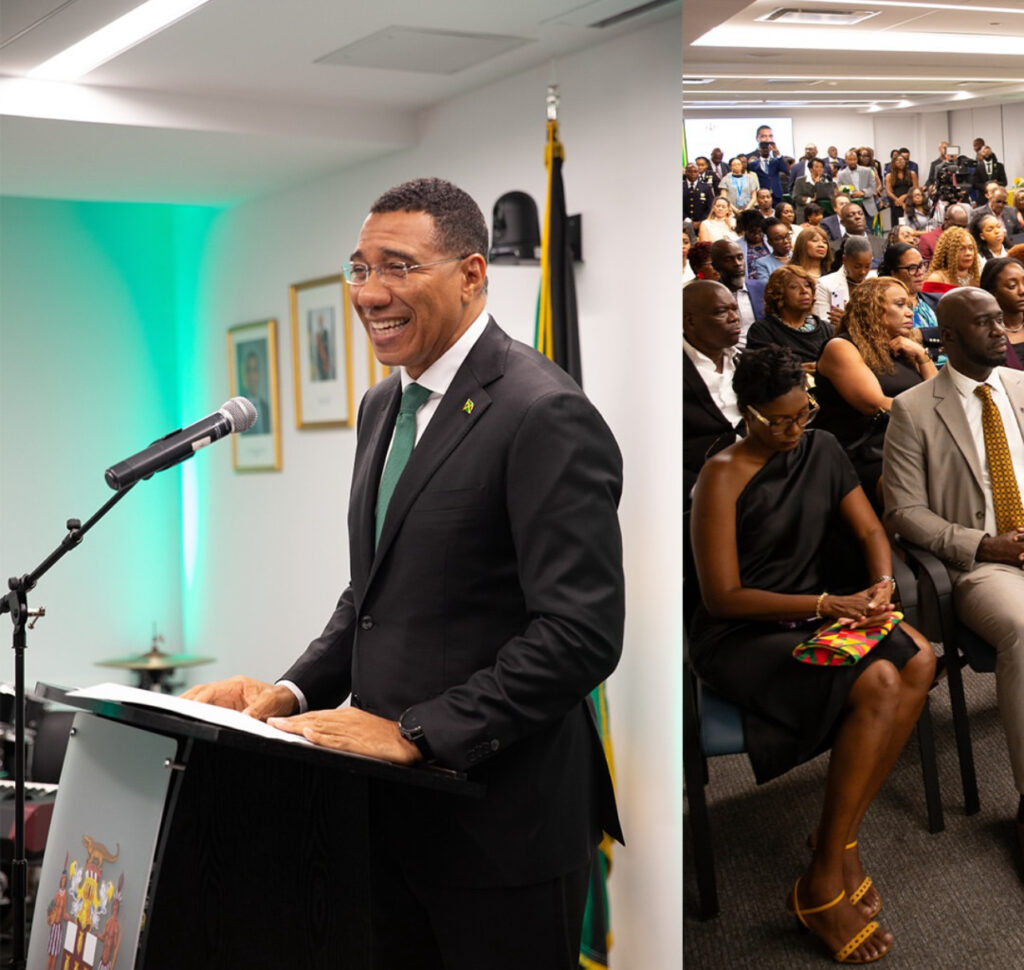
Address
By
Dr the Most Honourable Andrew Holness ON, PC, MP
Prime Minister of Jamaica
At the
Consulate General of Jamaica New York Reception
On
September 26, 2025
————————————————————————————————————
Thank you very much, minister. And everyone should know that is not why you have been reappointed as minister.
Allow me to again, acknowledge our hardworking Minister of Foreign Affairs, our newly appointed Ambassador to the United States, a man with so many titles; major general, former commissioner of police, former chief of defence staff, a fantastic Jamaican who has contributed so much to development of Jamaica. I just call him Tony.
Ambassador Brian Wallace, our permanent representative to the UN, someone who I’ve known for many years, and who is making his own mark in the UN as a well-respected voice.
I am going to acknowledge in her absence Alsion, our Consular General and of course, the incredible staff of the consulate who made all of these arrangements and for the great hospitality.
Let me acknowledge members of the global Jamaica Diaspora Council and Youth Council who are here.
Members of clergy, civil society, academia and private sector who are here.
My Jamaican family and friends, one love.
It is always a pleasure to be in New York, home of the largest and most vibrant Jamaican community in the United States, and I dare say the world, outside of Jamaica.
I’m grateful to Consul General Alsion Wilson for making these arrangements but I would like to also acknowledge her in other ways. For example, it was her hard work that secured us this building. And it was her hard work again, that stood up the consulate in terms of training, standards, quality of service and I know it has not always been an easy road. I know there were challenges along the way, but I believe everyone would’ve by now bought into the vision that she has had for this consulate.
The last time I was here, she pointed out to me the number of Jamaicans that this consulate serves. The consulate receives over 5,000 calls per day, and she also pointed out to me that there was a significant increase in the number of Jamaicans seeking to secure their passports and citizenship. I don’t know why but we welcome all Jamaicans who want to formalize their relationship with Jamaica or who wants to return home. I’ve always maintained Jamaica is our homeland and even if you don’t live there, you must always feel you have somewhere to come back if anything were to… It is a good thing with Jamaicans; we can speak with our hands. Always know that you are welcome to your homeland, and what we’re trying to do is to build a place where you can feel at home when you come.
So, obviously I’m here to participate in the Milestone 80th Anniversary of the UN and to deliver Jamaica’s policy statement both at the General Assembly and other meetings that are happening in the periphery of the General Assembly, and we have also had several bilateral engagements, which all have been very fruitful. The Jamaican people have grown, in my opinion, to appreciate the importance of foreign policy engagement. They know that we are not just here profiling and that there are real benefits delivered by our engagements overseas.
Foreign policy is an important and meaningful part of governance in Jamaica whether it is we are impacted by travel advisories, by changing laws in different jurisdictions, or trade issues; whatever issues there are that affect Jamaicans, they know that their government has the ability, the capabilities to have access in important areas, can speak with world leaders and can bring our position in such a way that we are not seen as extreme, we’re not seen as dogmatic and ideological, but people who are businesslike, serious, people who are seen as reasonable, and people who will engage in dialogue and meaningful discussions, people who are seen as understanding how the world works and that is what we need.
We must be seen as Jamaica understanding how the world works, securing our seat at the table and always being there to ensure that our principles are upheld, but equally that our interests are advanced, and that is how we have executed our foreign policy; a very pragmatic foreign policy that supports our economic development and protects our interests which includes the interests of our diaspora. That’s how you should consider foreign policy and our engagement. It is the creation of an umbrella of protection under which we all benefit whether you are in the diaspora or you’re living in Jamaica, you know that you have the coverage of your Ministry of Foreign Affairs and your government.
During the pandemic, during other crises, people who travel appreciate the value of having your embassy, your consulate, your high commission because they do give you coverage and protection. This is my first overseas engagement since I was re-elected to this position of Prime Minister and just to say a few things on that. We know that there is no honeymoon in this election, so we are going right back to work. We took no breaks. The government never took a break.
Government operated seamlessly throughout the elections. Those of you who observed it, you would realize that the administration that we lead is one that operates seamlessly whether it is a pandemic, whether it is a hurricane, or whatever major issues that may occur; we believe that there must be no break or disruption in government and I think we have demonstrated stable government right throughout. And even in the election, government continues, and days after the election, we are back at our desks, we are doing things and a few days after the elections, I’m here right at the UN executing our foreign policy.
We recognize that the Jamaican public would not be prepared to say you just won an election, it will take time for you to get things done. The view would be and rightly so, we returned you because you had momentum, carry through that momentum for even further delivery and that’s what we have been doing. We’re going to run through that tape, move with the momentum and deliver more for the Jamaican people.
Jamaicans, especially those who supported the government, would acknowledge the historic nature of a third term for the administration. We view it as an endorsement of performance over promise. This is a big shift in the dynamics of Jamaica because let’s face it, politics in Jamaica I guess like elsewhere is very personal, very ideologically driven sometimes, which means that sometimes reason is secondary to passion and how people feel, but what we have seen in this election is that the majority of constituencies and the majority of voters seem to have cast their ballots based upon merit.
In other words, I think the electorate is moving from traditional kinds of perspectives on how we should select our government to more examining the manifestos and commitments and policies and that’s good. I’m not saying that this is widespread. There are still people who just believe time come but there are certainly now more persons who are looking deeply and examining the statements made, the policy positions proffered, the propositions; they’re looking at them very seriously and making their decisions based upon the performance and the credibility of the government and I think that augurs well for Jamaica. It means that Jamaica will become more economistic in its views and once we develop that economistic culture, then we are well on our way to being pro-growth, pro efficiency, pro production and that’s where we want to be as a people.
Whilst there is a great deal of celebration around a third term, for me, what I’m happiest about is that most Jamaicans would’ve participated in the politics of their country and made a decision based upon reason and rationality. But that is a self-reinforcing good because for the government to be elected, it then can’t rely wholly and solely on its base, meaning the people who will support it regardless of its performance. The government to be elected has to appeal to the reasonable middle, has to perform and has to deliver a better proposition.
So, now we have performance-based government, that’s effectively what this election has thrown up. I’ve said this to my ministers that we have now set this new paradigm, and we are going to be judged by it. I think they all understand that and so we are already looking to put together for the Jamaican people an incredible and irresistible proposition for a fourth term.
I want to thank you, the members of the Diaspora for your support for Jamaica, your commitment to Jamaica. I want to point this out to you. Some of you may know this, but approximately 17% of Jamaica’s GDP would amount from remittances. What you send back home, it’s not just stopping a gap, it’s absolutely important. And I remember during the pandemic when incomes just disappeared, it was the remittances that kept grandma, uncle, cousin, that kept the people who were on the periphery of our society, the most vulnerable, that kept them alive, kept them surviving during the pandemic and you continue to do this. Your remittances, send children to school, ensure households have food and amenities. It’s invaluable but we are moving now into a different dispensation where remittances and philanthropic endeavours will continue to be important, but there are other avenues now where the diaspora can make significant contributions.
The perspective when I speak to members of the diaspora is I want to help, I want to be able to give back, but it’s very difficult. When you come into the Jamaican environment it’s very difficult to find your way around and then there is always a perspective, what are you going to do to make it easier for members of the diaspora to be able to participate in the country? I have a simple answer. It not about making it easier for any category of Jamaicans, it is about just making Jamaica easy for everyone; that’s the solution.
In the last 30 years, Jamaica has become a very complicated bureaucracy where it is almost impossible, very difficult to do business in Jamaica. I won’t go into too much of it, but we have been going through several reforms, and each wave of reform comes with its own set of rules, and now we need to do a reform of the reform. Literally, that’s what needs to happen now.
We did a reform, let’s say, in procurement, and that added a whole layer of rules. We did a reform in public sector investment and expenditure, which we call the PIAB (Public Investment Appraisal Branch) process so government can’t spend without a special capital expenditure without a certain set of policies and procedures following. That adds another layer, another set of rules, then we have the AML and other financial requirements that adds another set of rules and regulations, then we have anti-corruption regulations.
There’s nothing wrong with a complex system and the definition of strong and resilient system is that they’re complex, but when they become complicated, that’s when you have a problem. And I think our systems have become very complicated, very difficult to manoeuvre and sometimes you could say that they are self-serving.
In other words, they only exist to perfect the rule rather than to deliver the service and that is a big problem and that is why my administration, long before the election, we have said that we are going to review all of this, and we have put in place a programme which we call SPEED. That is being led by our former ambassador to the United States Ambassador, the Honourable Audrey Marks, who is now a minister with our portfolio in the Office of the Prime Minister and so she will be addressing all of this. She will be dealing with our business process re-engineering. She will be looking at the integration of technology and digitization, the use of AI and working with business to ensure that the steps to productivity are as few as possible and easy to scale as possible. That is something that the diaspora should pay attention to because the objective is to make efficiency and investment attraction for Jamaica.
So yes, we want Jamaica to be the fastest and easiest place to do business in the world while being compliant with global standards, that’s the objective. We are not saying we’re going to become non-compliant, absolutely not. We will maintain quality, we will maintain standards, we will maintain compliance, but we will certainly re-engineer our processes to make them more efficient and make them more relevant to the needs of the people.
Another element of our mission is to make Jamaica more productive. Let me quickly give some background to that because whenever we talk about productivity immediately in the minds of the listening public, I’m saying let’s work more efficiently and people may be interpreting that as saying, you expect me to work harder for less pay. We can’t escape our history. When you talk to someone who is working very hard and getting minimum wage, this idea of productivity is not going to click. What clicks is pay me more first, and I can appreciate and understand that because from your perspective, you are already working hard and not being paid enough.
I’m very cautious how I broach this conversation about productivity. But if you allow me a few minutes to put it in context and to our friends listening on TikTok and Instagram and Facebook and YouTube, and people who are listening, I want you to listen to what I’m saying divorced of cultural and historical context.
Now, Jamaica, let’s say 15 years ago was on the brink of financial ruin, almost at the brink of bankruptcy, and it forced the leaders of the country, business, political unions, and otherwise to recognize that the high interest rate policy was leading the country to ruin and they agreed that they would have to do something about it. And with partnership of the IMF, we embarked on a journey of fiscal discipline. Fiscal meaning the management of the tax revenues and public expenditure of the country, and that is now viewed as the textbook classic case of how a country can reform itself.
Jamaica was once considered the basket case. Now, it is the case study. It is true, and that took, of course, social partnership. It took our businesspeople to understand; real sacrifices were made. Some of you may remember that there were several debt exchanges, NDX1, JDX and so forth, where businesspeople literally took haircuts off their debt. The unions made sacrifices as well. There were several wages freezes that capped the increases of wages to the public sector for several years. The public made huge sacrifices. In three budgets the government hauled in, my recollection is, between 30 to $60 billion in new taxes in order to fund the budget. Government had to limit expenditure on a whole host of social services, but at the end of it, Jamaica developed fiscal discipline.
We ran a 7% primary surplus for like five or six years, very high in order to pay down debt. The result of that story is that our debt was as high as 144%. I recall if you put certain other entities in it, it would be as high as 151%. Now, today, our debt is 62% relative to our GDP. So before, about 144% of GDP, today it’s 62% of GDP and our debt servicing requirements have gone down significantly. That’s a good story but where we are today will not carry us without peril if we don’t grow. In other words, we have managed to bring down the debt with very moderate growth, but by wringing out the greatest discipline in managing public expectations that drive expenditure, controlling wages, and the debt exchanges that we have done in the past, and just making the sacrifice to pay down the debt.
You can’t do that forever because people are going to put political pressure to have our streets clean. Political pressure to have better education, better healthcare, water, and roads. Water and roads were the greatest demand for people in the elections as I moved around and we have programmes there showing that yes, we’re attending to roads and we’re attending to water, but imagine that you lived in Hanover, for example, or some areas of Westmoreland, and for 30 years your road has not been repaired and every day you get up and you walk outside, you can’t even wear high heel shoes out there because that will be the end of your shoes. I was driving on a road, and a youngster rode pass me on his bicycle, and he said, Prime Minister, you can’t fix the road for me so I can ride my bicycle easier. So, you see, the political pressure will build on governments to take on expenditure that their revenues can’t support.
The fiscal discipline that we have, that is government saying, I can only do so much within the envelope of what the revenues of the country afford me. That’s what we’ve been doing, and we have managed to do 10 budgets without asking for any new taxes. In fact, we have court taxes but in the next 10 years, that can’t or will not hold forever. And I want to be clear, because everything I’m saying here, I don’t want anybody to say that I’m proposing taxes in the coming years. That’s not what I’m saying, let’s be clear. What I’m saying is that fiscal discipline can carry you so far. The next step now, which we have already announced our pivot to growth and our ASPIRE programme, is to grow the economy. We must grow the economy because the expectations of our people will drive a particular political economy that could imperil the fiscal discipline.
As a politician, I recognize that the Jamaican people have had pain points that they have had to suffer with, and they have been deprived of things that they have expected for a long time, and that can result in its own political dynamic. People are going to say, I want my road now, I want a housing now, I want these things now, to hell with fiscal discipline and so forth. Just go bar and spend again. Do you see how it could just unravel everything? Of course, politicians like myself, we have a role. I have to stand at a microphone like this and explain it, which is why I said earlier, divorce your viewing of this from your cultural and historical context, and just look at it dispassionately to understand exactly what I’m saying because there is a view with a lot of our citizenry that you don’t have an impact on government.
In other words, there’s a view that no matter what you do, it will not impact government but that’s absolutely not true. Every one of us has an impact on government, and it can either be positive or negative, and a lot of people are acting believing that their actions are positive but when taken together, it can have a negative impact on government. And we have seen this before in our history where politicians have seen the pressure being brought by the people and say ‘mek we run wid it’. That’s what that was about, ‘mek we run wid it’. The actions of the person saying, I want my road repaired and government not doing anything, fix my road; when all of that is taken together and it gets wrapped up in polls and politicians see it and they say, Lord, we are going to lose if we don’t do that, what do you think going to happen? They’re going to make policies that totally unravel and even though we have built institutions to protect against unreasonable policies, it can still happen.
When you hear of a promise that you’re going to increase the tax threshold to $3.5 million and it’s going to cost $75 billion to do that, of course, people are moved by that. And if you got a government that decided to do that, it would totally unravel fiscal discipline, which is why I go back to my point. Thank God that people were listening rationally. I’m not saying everybody because I’m certain that there are those who took that bait but thankfully there are others that said maybe that don’t make sense.
Now, whenever we talk about growth, it is like saying the size of the economy is just going to increase, it’s going to get bigger, but the process to get it bigger is a mystery. We’ve been trying to grow the economy forever, and the last time we saw any significant growth above 4 or 5% was in the 60s when we grew by like 12% one year. To get to that level of growth, it is either that you’re going to discover some very valuable natural resource like oil or something, whatever it is. It’s either you discover that, and you get increased resources from minerals but that has its own challenges because if you don’t manage that well, you can end up in problems. Or you can produce some technology, innovation. The American economy, a lot of its growth is on innovation, production of technology. Or you could grow your economy by services; the provision of services which use the human resource to deliver the service.
You could also grow your economy by being very strategic with your location to position yourself as indispensable to trade in the world; logistics. There are many ways do it, but the government has to be very strategic in what it is doing and how it aligns itself. But what are the obstacles to this?
Bureaucracy is number one and especially for Jamaica where are 70% of our economy is dependent on services. If bureaucracy is an obstacle to the delivery of service, then it is unlikely that you can grow rapidly. So, you see why it is so necessary that the government has an efficient bureaucracy. When I saying you don’t want bureaucracy, bureaucracy is very important. Bureaucracy is necessary. Bureaucracy is the hallmark of modern institutions and governance but when the bureaucracy becomes complicated, dense, and self-serving, it’s an obstacle and so we have to reform the Jamaican bureaucracy so that the services can grow. That’s focus number one for us.
But the other way to grow is to increase your productivity. Again, inefficient bureaucracy is an obstacle for productivity, but there is growth to be had by ensuring that our human resources can produce more with what they currently have, and that’s where our effort is going to be in the next few years in this term, to get our human resources to produce more.
And what does that entail?
We have to upskill, re-skill, and skill the Jamaican labour force. It’s all about education and the education system, but it’s more so about that kind of on-the-job training aligning the education system with industry, getting our people to embrace, adapt, and become native with technology and getting our people to use their creative energies in more profitable economistic ways. That’s what we’re going to be focused on: efficiency in the banking sector, efficiency in tourism, efficiency in logistics. Increasing the productivity in these areas will give you a bump up in your GDP growth each year. That’s a part of the effort, but there is another obstacle to growth in the economy, and I think that this obstacle cuts across everything and that is security,
Aside from the fiscal improvements, in security we have made significant progress in the last 10 years without question. Now I’m not telling you that Jamaica is the safest place, but we are certainly safer today than we were a decade ago. We have made major investments in our national security. We’re far more sophisticated in our national security and we are now in a position where we can look to move from the plane of security to the plane of peace. Let me just give a little context.
The average Jamaican, they’ll see a murder happen and they will just say the state has failed, the security forces don’t know what they’re doing, it’s a gunman that shot another one or whatever, but that’s not the case. What has happened in Jamaica is that there has been a level of organized violence that has a profit motive that is not readily understood by the community experiencing the violence. The community experiencing the violence believes it’s just ‘two boy a fight’ or one road down there don’t like another road, but they’re not understanding that there is someone who has a connection probably in New York or in Miami, who goes and does what they call straw purchases, gets guns, has a contact with a shipper here and consolidators and bring the guns back into Jamaica. That is a high level of organization.
And then there is someone who has to know who this person is who has the gun, go and makes the contact and then while they’re making the contact, say ok now you have guns, you have guns now, tell you what, I want you to control this area because there’s a shipment of drugs or whatever it is that is going to come through and you hold off this place, safe haven for criminals. Or maybe it’s to say, you have guns now, extort. What you see is this one shooting that one because you have an argument over a girlfriend or so but if you delve deeper behind it, it is these kinds of connections. Our interpretation of gangs would be some youngsters who have been marginalized, and they are poor, and the society treat them bad. In other words, we have a kind of romantic view that they are robbing from the rich and giving to the poor; absolutely not.
When we’ve done our surveys of gangs, a couple years ago, we had about 350 of them operating in Jamaica controlling communities, infiltrating institutions, police, customs, all kinds of things. I’m trying to give you a different understanding of the problem. 70% of murders were attributed to gangs. They could be arrested, they’re in prison, they pick up the phone, they call. Families have arguments in Jamaica. They call their brother here and he sends remittance and tell them, go and buy the shot from this one and send the guns down in the barrel in the rice and creates this problem for us so we said no more of that.
We did two things. One, we used states of public emergency, and we established a new law called the Zones of Special Operations to deal with communities at war and we went about in a systematic way to undermine, degrade, and eliminate the gangs. From 350 gangs, we are now below a hundred gangs operating in Jamaica. The opposition was saying you don’t have a plan. We didn’t tell them because some things you just have to do, you can’t telegraph it. Two years ago, I made the call. First of all, I said that we need a parallel war on guns because the focus has always been on drugs, which is just one side of the trail. And then I upgraded that call to say we need to have a war on gangs that is prosecuted in the way in which the war on terror was prosecuted.
I’m seeing some movements now in that regard. I don’t know if somebody was listening, but it seems to be that there are some serious policy measures now being taken on dealing with gangs. In Jamaica we have been very serious about dealing with the gangs. So, now when people see a massive fall off in murders this year, we are now 42% less murders this year than we were last year, but in 2023, we cut murders by 7%, and in 2024 we cut murders by 23% or something like that so we’ve really had a massive impact on crimes generally and homicides in particular.
There’s a second phase of this. We will continue to erode and eradicate the gangs but as we do that, we begin to see another form of violence emerging, and that is the social violence, the intimate partner violence, the violence in the disciplining of children, the domestic violence; just the kind of aggression in the society that leads to a crime in some form, which means that you are violating the physical person and inflicting pain and damage to the physical person so we’re going to have to deal with that.
That is not necessarily a police problem exclusively. That now requires a lot of social workers, it requires our schools. Jamaica has this view that the only way to discipline a child is to use some form of violence, whether it is to talk strongly or slap or to physically encroach on the person. I don’t want to get into the debate. As I said, when I’m speaking on these matters, if we could just divorce the cultural and historic things and just look at it from a practical, rational point of view as we are moving to a newer better Jamaica.
These are things that we have to address, and we have included now in our new cabinet the Ministry of National Security and Peace because we are now going to be deliberate in moving now from crime to peace. It’s not just the absence of violence, but it is the deliberate pursuit and guardianship of the safety and security of the people. It is the peace of mind, that is what we’re going to be pursuing. We actually did do a very intense study on the issue of violence in the society. We empanelled a commission, and they have given us our report, and that report will be made public and we’ll go through an entire process of bringing in the entire society into this discussion as to how do we secure peace.
Now, just think of this. There was a community, some of you may know this community, it’s East Kingston and Port Royal, and then there’s another one, Central Kingston, and those were our historic residential and business communities on the waterfront. I mean, the waterfront anywhere in the world is the highest value real estate, but those communities’ crime and violence took them over but since our efforts in reducing crime, particularly the internecine gang wars, we are noticing that investors are taking some risk. We are seeing a major housing development taking place in East Kingston and Port Royal and in Central Kingston there are at least three developments going on, three huge high-rise buildings being built. That’s the peace dividend. When you bring peace to communities, people will invest and that’s how you get growth.
We are going to continue to press on the gangs, but we are also seeking to build peace. I’ll stop at these three things but if you put all of these things together, Jamaica has never been in this position before, maybe at the beginning of our independence journey, but we have never had these alignments before where we are dealing with some of the intractable problems but having the kind of foresight in planning for the next stage and level of development.
If you think of it, what was the thing that concerned most Jamaicans, crime cut in half. Our murder rate has now moved from about 50 per hundred thousand, we’re about 25 per hundred thousand, and we’re going to continue to push to what the regional average is, which is about 15, and we want to go below the regional average. The US is about 3.6 per hundred thousand, we are heading towards that.
Now, can you imagine we are getting 4 million tourists per year with that level, can you imagine if we’re at three? I mean, we wouldn’t have hand, as we say in Jamaica, and that’s what we want. The debt was as high as 144%, now, it’s at 60% but we will certainly better the target. The target to be 60% debt-to-GDP, I’m certain we’ll do better than that. We’re now two grades below investment grade.
When you’re at investment grade, you don’t really have to borrow, but when you’re at investment grade you get the lowest interest rates. People consider you a safe haven for them to park capital, and that’s where we want to be. To move from there to investment grade, we have to satisfy some of the demands of the people so that the political pressure does not create a political economy that destroys the fiscal discipline and that’s why we are doing some programmes to meet, to release the pressure and the pain points of the people. We have the SPARK Programme. We’re doing 660 roads across Jamaica. We have a massive water programme, a massive highway programme, a massive housing programme. We have to do a review of the social safety net programme PATH because it seems not to be properly aligned with what we offer versus what people need. PATH would be the equivalent of your social security programme. We have to rethink that to make sure that it is effective. We’re doing massive things in rethinking our electricity arrangements, reduce energy in the country. We’re taking all the right steps to improve the quality of lives of Jamaicans.
So, my closing point is that Jamaica is at an inflection point. An inflection point, for those of you who know mathematics, is when the rate of change of a curve increases more rapidly. For us, our inflection point is that the rate of effort is going to yield far more results and therefore we are in, I think, a good place and I’m privileged I consider it, and humbled to be at the helm at this time. And again, I thank you for your attention.